

What are the key considerations for applying powder coating to galvanised steel surfaces?
Applying powder coating to galvanised steel requires careful control of surface preparation, zinc-surface condition, outgassing, coating selection and curing. The steel must be clean and suitably keyed, with part design, drainage and cure-temperature compatibility assessed to achieve a consistent, durable finish.
Applying powder coating to galvanised steel is a specification and process-control exercise, not simply a matter of adding a coloured finish. The main considerations are the required corrosion protection, the condition and variability of the galvanised layer, part geometry, masking and handling requirements, appearance expectations, and the inspection criteria agreed before production.
Define the service conditions first. The finished component should be assessed according to where it will be used and what it will encounter. Outdoor exposure, moisture, road contaminants, industrial atmospheres, chemicals, abrasion and repeated handling can all affect the coating specification. The required finish should therefore be selected as part of a wider corrosion-protection system, with the zinc layer providing the underlying protection and the powder coating adding a further barrier and aesthetic finish. Internal and external faces may have different exposure levels, but both should be considered where condensation or trapped moisture is possible.
Confirm the galvanised coating is suitable for overcoating. Galvanised steel is not always uniform from one component to another. Differences in zinc thickness, surface texture, ash deposits, runs, bare areas and previous storage conditions can influence the finished appearance and adhesion. The galvaniser’s finish should be reviewed before coating, particularly where the parts have been stored, transported or exposed to contamination. Any areas requiring correction should be identified before the powder-coating stage rather than treated as an unexpected defect during final inspection.
Allow for dimensional and functional requirements. Powder coating adds a measurable layer to the component. This matters where parts fit together, slide, locate against another surface, pass through a defined opening or rely on close tolerances. Threads, bores, bearing seats, mating faces and electrical contact points may need to be protected from coating. The drawing or job specification should identify these areas clearly, including whether a small amount of overspray is acceptable and which surfaces must remain uncoated.
Plan masking and hanging points. Masking must withstand the coating process without contaminating the finish or leaving an unacceptable boundary. It should also be practical for removal after curing. Hanging points and contact locations need to support the component securely while limiting visible marks and ensuring that all required faces are accessible. If a contact point is positioned on a functional or highly visible area, it may create a small uncoated mark that requires an agreed allowance or repair method.
Consider component geometry and trapped areas. Deep recesses, overlapping sections, folded returns, box sections and narrow internal spaces can affect powder access and the uniformity of the finish. Enclosed or partially enclosed sections may also retain moisture or process residues if they lack suitable openings. Fabrication drawings should account for coating access, drainage and safe handling before manufacture. Welds, sharp transitions and complex joints deserve particular attention because they can produce local differences in appearance and coating coverage.
Manage the visual specification realistically. A powder-coated galvanised component can have a different texture or visual character from an untreated galvanised surface. Variations in the zinc layer may remain visible through the finished coating, especially on large flat panels or parts viewed at close range. The specification should state the permitted colour, gloss level, texture, coverage and acceptable visual variation. It should also define the viewing distance and lighting conditions for inspection, since minor features can appear differently under direct light than under normal service conditions.
Account for fabrication defects and repairs. Weld spatter, sharp burrs, grinding marks, deep scratches and poorly blended repairs can remain visible after coating. These are manufacturing issues as well as coating issues, so responsibility for correction should be agreed before work begins. Damage caused after coating, such as impact marks or exposed steel at a cut edge, should be dealt with using a compatible repair procedure rather than an unspecified touch-up product.
Check cure compatibility with the complete component. The heat cycle used for powder coating must be compatible with the steel assembly and any attached materials. Components containing seals, inserts, bearings, adhesives or temperature-sensitive fittings may need to be supplied separately or assessed before processing. The relevant requirement is the metal temperature reached by the component, not simply the air temperature inside the oven. This distinction is important for heavy sections, assemblies with different wall thicknesses and parts with significant thermal mass.
Agree inspection and testing requirements. A suitable quality plan may include checks for colour, gloss, coverage, adhesion, coating thickness, visible defects and cure. The exact tests should reflect the end use and be agreed with the customer before production. Inspection should take place at defined stages, including after coating and after handling, so that defects can be traced to their source. Records of the job specification, approved sample, inspection results and any deviations provide useful control for repeat batches.
Control batch consistency. When components are supplied in multiple batches, the same specification, approved reference and process settings should be used wherever practical. Galvanised steel from different sources can vary in appearance and surface characteristics, so a repeat order may not look identical unless the substrate and acceptance criteria are controlled. This is particularly relevant for components installed beside one another or supplied as a matched assembly.
Protect the finish after coating. Packaging, stacking and transport can damage a correctly applied finish through rubbing, impact or trapped moisture. Components should be separated where contact could mark the surface, with lifting and storage methods suited to their size and shape. Packaging materials must also be compatible with the finish and the expected storage conditions. The application specification should therefore cover not only how the powder is applied, but also how the coated galvanised steel will be handled until installation.
For a reliable result, the coating requirement should be reviewed alongside the fabrication drawing, galvanising details, operating environment, dimensional tolerances, masking plan and inspection criteria. Resolving these points before processing reduces ambiguity and helps ensure that the duplex corrosion-protection system performs as intended without compromising fit, function or appearance.
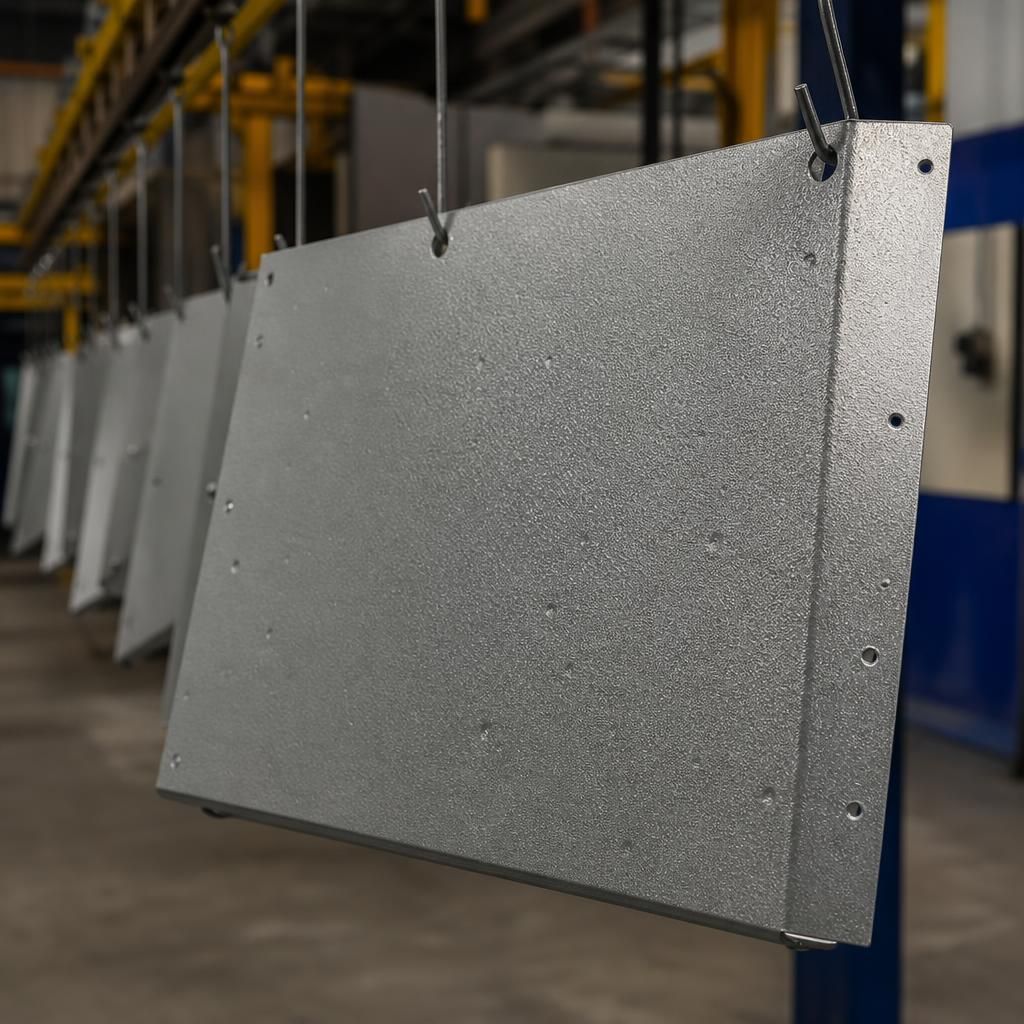
Outgassing is a key consideration when powder coating galvanised steel. During the oven cycle, air, moisture or process residues held within the zinc surface or porous areas of the component can expand and escape through the uncured powder. This may produce pinholes, bubbles or small craters in the finish, even when the substrate appeared sound before coating.
The risk should be assessed during sample processing, particularly for rough galvanised surfaces, cast or folded sections, and components with recessed areas. A controlled trial can show whether the specified powder, film build and cure cycle are suitable before a full batch is processed. Where necessary, the coater may use a validated preheating or staged curing approach to allow gases to escape before the coating fully hardens. Any change to the cure process must still achieve the powder manufacturer’s required metal temperature and cure conditions.
Outgassing cannot always be eliminated through powder application alone. The most reliable approach is to identify the risk during specification, agree the acceptable appearance, and assess a representative sample that reflects the galvanised finish and component geometry. This separates defects caused by the substrate from application faults and helps establish a repeatable process for production batches.