

How does zinc epoxy primer compare to other anti-corrosion coatings for metal surfaces?
Zinc epoxy primer combines a zinc-based sacrificial action with an epoxy barrier, giving steel stronger corrosion protection than a conventional epoxy primer alone. Compared with galvanising, zinc-rich paint or polyurethane topcoats, it is generally selected where a prepared metal surface needs a paint-applied, compatible base layer within a broader protective coating system.
Zinc epoxy primer is a compromise between sacrificial zinc protection and the barrier performance of an epoxy coating. It is usually chosen for prepared steel where corrosion resistance, adhesion and compatibility with a specified topcoat are all important. Other systems may provide better performance in a particular environment, but no anti-corrosion coating is automatically the best choice for every metal surface or service condition.
Conventional epoxy primer
A conventional epoxy primer protects mainly by forming a dense, well-adhered barrier that limits the movement of water, oxygen and contaminants towards the metal. It can offer strong adhesion and good resistance to many industrial chemicals, but damage that exposes the steel can become a starting point for localised corrosion. Zinc epoxy primer adds a galvanic element: when the zinc particles are suitably connected within the coating, they can corrode preferentially to the underlying steel. This makes it more useful where scratches, handling damage or difficult exposure conditions are realistic concerns.
The trade-off is that zinc epoxy formulations depend more heavily on correct application. The steel must be suitably prepared, the primer must achieve the specified film build, and the zinc particles must remain sufficiently connected. A conventional epoxy may be simpler to use where the main requirement is adhesion and barrier protection rather than sacrificial action.
Zinc-rich organic and inorganic coatings
Zinc-rich coatings also use zinc to provide sacrificial protection, so the distinction is not simply zinc versus no zinc. Zinc epoxy primer uses an epoxy binder, which generally gives a strong combination of adhesion, toughness and compatibility with subsequent coats. Zinc-rich inorganic coatings use a silicate binder and can perform well in severe atmospheric conditions, particularly where high heat resistance and strong zinc-to-steel protection are required. They can, however, be less tolerant of application errors, contamination, unsuitable humidity or incorrect overcoating.
Zinc-rich organic coatings use a resin binder other than an inorganic silicate and may be selected when easier handling, flexibility or compatibility with an established paint system is more important. The product data sheet should be checked rather than assuming that all zinc-rich products have the same conductivity, curing behaviour or overcoating requirements.
Hot-dip galvanising
Hot-dip galvanising protects steel by immersing a fabricated item in molten zinc, creating a metallurgically bonded zinc coating. It can provide robust, long-term protection across accessible external areas and is not dependent on applying a wet film to every surface. It may be preferable for suitable fabricated components that can be transported and processed in a galvanising plant.
Compared with zinc epoxy primer, galvanising has practical limitations. The component must fit the process and be designed with suitable vent and drain points. Distortion, dimensional changes, drainage marks and the treatment of threaded or close-tolerance areas may need consideration. Large, complex or already assembled items may be more difficult to galvanise, whereas a primer can be applied as part of a planned coating sequence. Galvanised steel can also receive a compatible paint finish where additional colour, appearance or barrier protection is needed.
Electroplated zinc
Electroplated zinc deposits a relatively thin zinc layer onto a component through an electrical process. It is commonly suited to smaller manufactured parts where dimensional control, a uniform appearance and indoor or moderately demanding service are important. It is not generally a direct substitute for a zinc epoxy system on large steelwork or exposed fabricated structures, where coating thickness, edge coverage and environmental severity may demand a different approach.
Polyurethane and other topcoats
Polyurethane is normally used as a topcoat rather than as the sole anti-corrosion primer. It can provide colour and resistance to weathering, ultraviolet exposure, abrasion and handling when applied over a compatible primer. On its own, it does not usually provide the same steel adhesion and sacrificial zinc action as a zinc epoxy primer. A common protective arrangement is therefore a prepared substrate, a corrosion-inhibiting primer, an intermediate coat where specified, and a durable topcoat.
Alkyd coatings may be suitable for less demanding conditions and straightforward maintenance work, but they generally offer less chemical and solvent resistance than a properly selected epoxy system. Flexible elastomeric or specialist protective coatings may be useful where movement, impact or particular chemicals govern the specification, although their performance depends on substrate preparation and compatibility with the metal.
Thermal-sprayed zinc and aluminium
Thermal spraying applies zinc or aluminium to a blast-cleaned surface by projecting molten or semi-molten metal particles onto it. The resulting metallic coating can provide durable sacrificial or barrier protection without relying on a conventional paint binder. It is often considered for major steel structures and severe service conditions, but it requires specialist equipment, careful surface preparation and suitable control of the sprayed layer and sealing treatment.
Compared with zinc epoxy primer, thermal spraying may involve greater process complexity and may be unsuitable for small, intricate or heat-sensitive components. Zinc epoxy is often more practical where a paint-applied coating system is required, provided the specification accepts its expected service life and maintenance requirements.
How to select between them
- Exposure: assess outdoor weathering, moisture, salt contamination, immersion, chemicals, abrasion and operating temperature. A coating suitable for sheltered factory equipment may not be suitable for exposed steelwork or immersion.
- Substrate: consider carbon steel, galvanised steel, aluminium and other metals separately. Zinc epoxy primer is primarily associated with correctly prepared ferrous substrates; adhesion to non-ferrous metals requires a system specifically designed and tested for that surface.
- Component design: size, geometry, internal cavities, sharp edges, welds, threads and access for preparation can make galvanising or thermal spraying more or less practical.
- Coating system: check primer, intermediate coat and topcoat compatibility. The recoat interval, curing conditions and preparation between coats are part of the system specification, not optional details.
- Damage and maintenance: sacrificial zinc protection can be valuable where minor coating damage is likely, while a hard barrier or flexible finish may be more important where abrasion, movement or chemical contact is the dominant risk.
- Appearance and tolerances: colour, gloss, surface texture and dimensional limits may favour a painted, powder-coated, plated or metallic coating route.
For industrial components, the correct comparison is therefore between complete coating systems rather than isolated products. Surface preparation, edge treatment, film thickness, curing and inspection can have as much influence on corrosion performance as the name of the primer. A zinc epoxy primer is a strong option when steel needs both a zinc-based corrosion mechanism and an epoxy foundation for a compatible protective finish; galvanising, thermal spraying, conventional epoxy or a specialist topcoat may be more appropriate when the component, environment or production process points elsewhere.
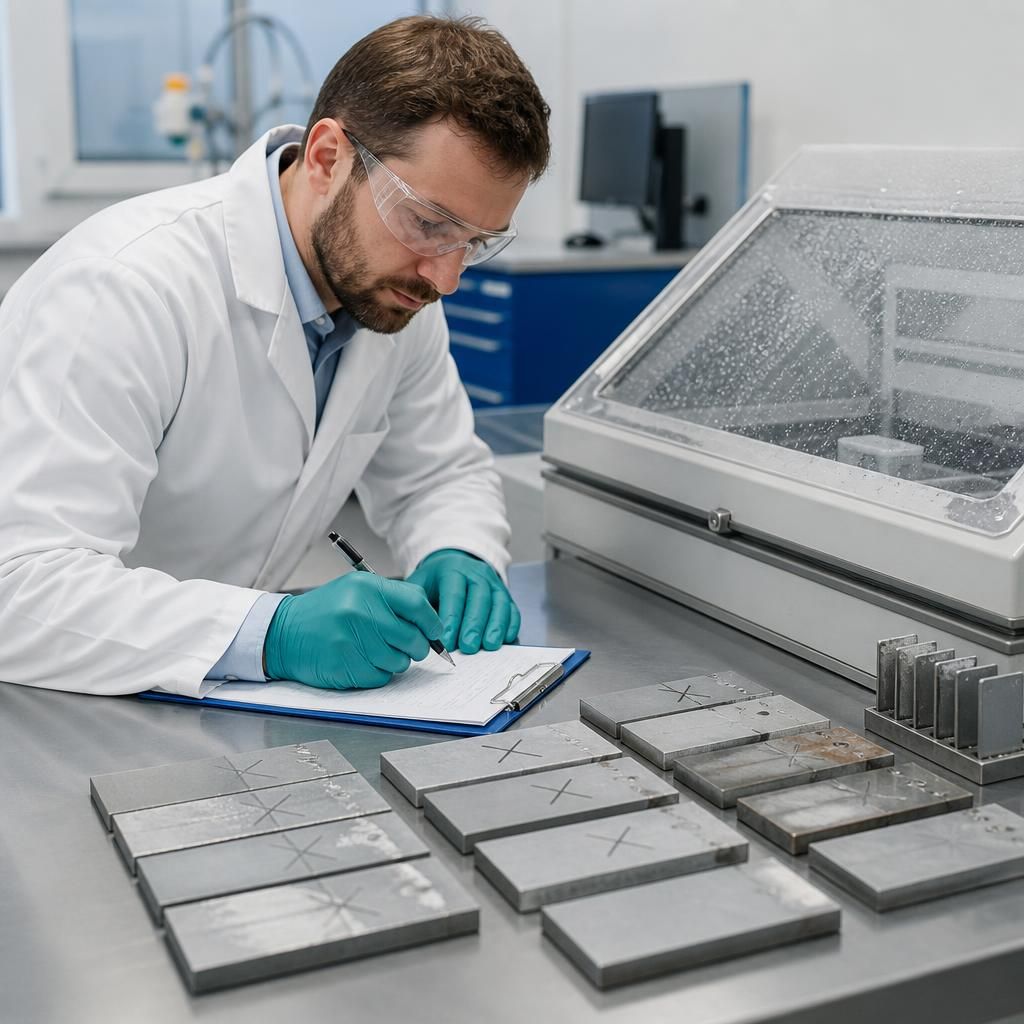
Laboratory corrosion-test results should not be treated as a direct prediction of service life. Salt-spray performance, for example, depends on the test method, coating thickness, scribe damage and failure criteria, so results from different products may not be directly comparable.
When assessing zinc epoxy primer against another anti-corrosion coating, compare the complete specification: substrate preparation, applied film thickness, curing conditions, intended exposure and acceptable maintenance standard. This provides a more reliable basis for selection than choosing a product solely because it is described as zinc-rich, epoxy or corrosion-resistant.