

How does powder coating protect steel against environmental factors?
Powder coating protects steel by forming a continuous, cured barrier that limits contact with moisture, oxygen and other corrosive agents, helping prevent rust and surface degradation. The selected coating formulation can also provide resistance to sunlight, chemicals, abrasion and temperature changes, provided it is matched to the conditions of the application.
Powder coating protects steel by controlling the ways environmental exposure can initiate and spread corrosion. Its performance depends not only on the cured powder film, but also on the steel preparation, coating specification, coverage at vulnerable areas and the conditions the finished component will face.
Moisture and oxygen: Rust develops when water and oxygen reach the steel surface and enable an electrochemical reaction. A properly applied coating separates the substrate from that environment. The most vulnerable points are usually scratches, cut edges, welds, joints, fasteners and areas where water can collect. Good component design, thorough preparation and complete coverage reduce the likelihood of corrosion beginning at these locations.
Salt and chloride exposure: Coastal air, road de-icing residues and some industrial atmospheres contain chlorides that can accelerate corrosion and travel beneath a damaged coating. For these conditions, the pretreatment and powder system must be selected for the relevant corrosion environment. Edge coverage, adhesion and resistance to underfilm corrosion are particularly important, because a small defect can become a wider area of coating loss if contaminated moisture reaches the steel.
Sunlight and weathering: Ultraviolet radiation can gradually alter the appearance and surface properties of some organic coatings. A powder intended for external use should therefore be chosen for its weathering characteristics, including colour retention, gloss retention and resistance to chalking. This is separate from basic rust protection: a coating may continue to shield steel while its appearance changes, but the correct exterior-grade formulation helps address both requirements.
Chemical contact: Oils, cleaning agents, solvents, acids, alkalis and process chemicals affect coatings differently. Resistance depends on the substance, its concentration, contact time, temperature and whether exposure is occasional, repeated or continuous. A suitable specification should be based on the actual chemical environment rather than on a general claim that powder coating is chemical-resistant.
Impact, abrasion and handling: Industrial components may be struck, scraped or exposed to moving materials. Damage that penetrates the film creates a route to the steel, while repeated abrasion can gradually reduce protection. The coating system should be assessed for hardness, flexibility, impact resistance and the expected handling conditions. Areas likely to suffer mechanical damage may also require design changes or a more robust protective system.
Temperature changes: Repeated heating and cooling cause the steel and coating to expand and contract. If the selected system is unsuitable for the operating range, thermal cycling can contribute to cracking, loss of adhesion or premature deterioration. The specification should consider normal operating temperatures, short-term peaks and any rapid changes rather than relying only on the surrounding air temperature.
Preparation is fundamental: Oil, rust, mill scale, dust, moisture and soluble salts can prevent proper adhesion or remain beneath the coating. Cleaning and preparation remove contamination and create a suitable surface for the specified pretreatment. Powder must then be applied at an appropriate, consistent film thickness and cured according to its technical requirements. Insufficient cure can leave the film with reduced performance, while excessive or uneven application can affect appearance and behaviour.
For severe environments, powder coating may form part of a wider protective system rather than being treated as a universal solution. Prolonged immersion, buried steel, heavy chemical exposure or extreme abrasion may require a specially designed multi-layer system, different pretreatment or an alternative coating technology. The correct choice follows from the exposure category, component design, service temperature, expected damage and required service life.
In practice, protecting steel against environmental factors involves matching four elements: the steel surface condition, the pretreatment, the powder formulation and the application process. Inspection should pay particular attention to welds, recesses, edges, drainage points and any areas damaged during transport or installation. Where the environment or duty changes, the coating should be reviewed rather than assumed to provide the same level of protection indefinitely.
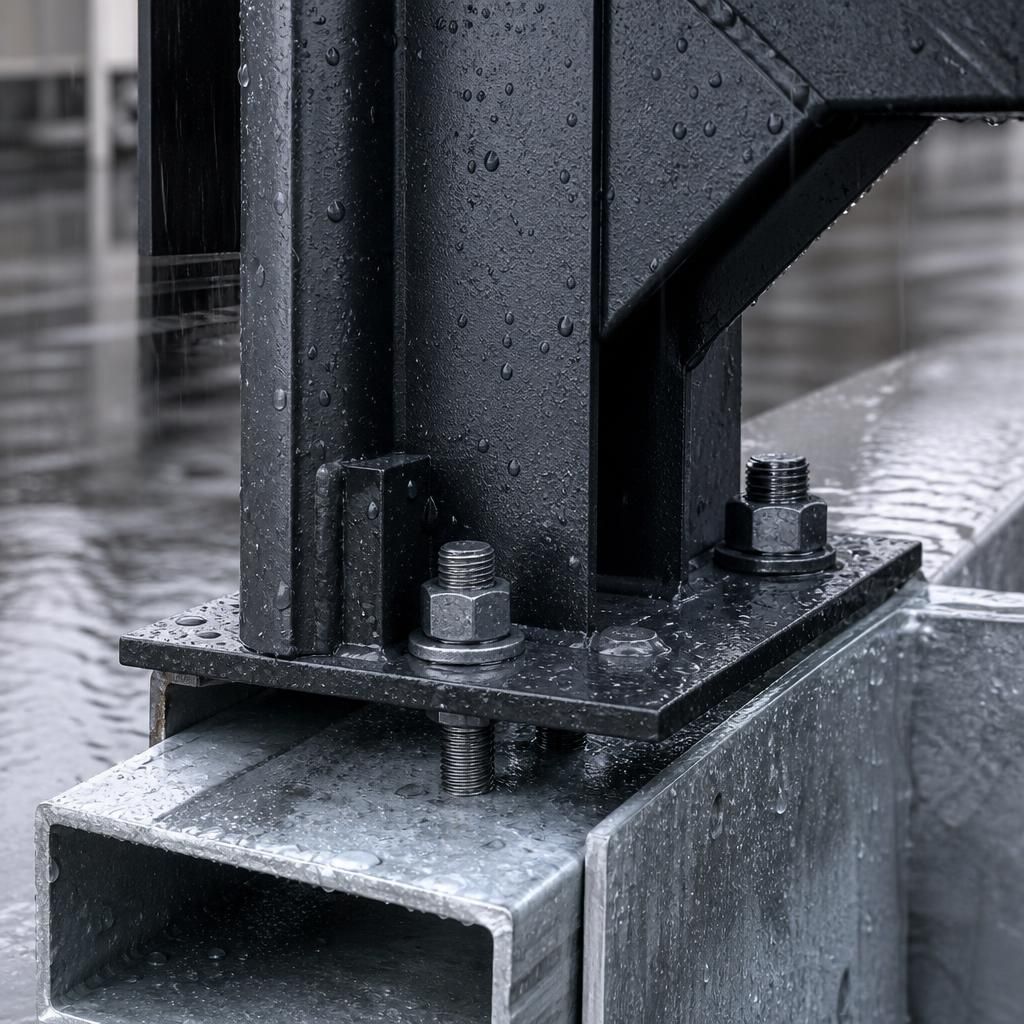
Powder coating can also help limit galvanic corrosion, which occurs when dissimilar metals are electrically connected in the presence of a conductive liquid such as rainwater, condensation or saline residue. The less noble metal can corrode more rapidly at the contact area, even when the surrounding steel appears well protected.
An intact cured powder film acts as an insulating layer between the steel and the surrounding environment, reducing the likelihood of direct electrical contact. This protection depends on continuity around joints, fixing points and interfaces with other metals. Component design should therefore consider compatible fasteners, separation between dissimilar materials and drainage that prevents conductive residues from remaining trapped. Where contact or damage is unavoidable, the coating specification and joint treatment should be assessed as part of the complete corrosion-control system.