

How does RAL 8029 aluminium powder coating contribute to corrosion resistance?
RAL 8029 aluminium powder coating contributes to corrosion resistance by forming a continuous, cured barrier that limits the metal’s exposure to moisture, oxygen and other corrosive contaminants. The colour itself does not provide the protection; long-term performance depends on suitable aluminium pretreatment, correct application and complete curing of the powder film.
RAL 8029 aluminium powder coating contributes to corrosion resistance by separating the aluminium from the electrochemical conditions that cause corrosion and by helping maintain a stable, intact surface during service. Its effectiveness depends less on the shade itself than on the coating system as a whole, including the aluminium alloy, surface condition, powder film quality, component design and operating environment.
Aluminium naturally forms a thin oxide layer, which provides some protection. However, that protection can be undermined by contaminants, aggressive chemicals, trapped moisture, abrasion or contact with dissimilar metals. A correctly applied powder coating adds a more substantial protective layer. When the film remains intact, it reduces the opportunity for an electrolyte to reach the substrate and restricts the local electrochemical reactions associated with corrosion.
Several aspects of the coating system influence how well it performs:
- Film continuity: A consistent coating over faces, recesses, edges and complex profiles reduces weak points where corrosion can begin.
- Adhesion: Strong attachment to the aluminium helps prevent moisture from travelling beneath the film after minor damage or at vulnerable edges.
- Mechanical resilience: A durable cured film can withstand ordinary handling, contact and environmental exposure more effectively than an inadequately formed coating.
- Resistance to the service environment: The powder formulation must be appropriate for the expected exposure, including outdoor weathering, industrial contaminants, cleaning agents or elevated humidity.
One important failure mechanism is filiform or underfilm corrosion. This can develop when moisture enters through a scratch, cut edge or small defect and spreads beneath the coating. The visible damage may initially be limited, but corrosion can gradually reduce adhesion around the affected area. Minimising this risk requires careful control of the complete coating process, not simply selecting a copper-toned RAL colour.
Component design also affects the result. Sharp edges can receive less powder than broad, accessible faces, while deep recesses, joints and overlapping parts may retain water or contaminants. Drainage, suitable radii, accessible surfaces and the avoidance of unnecessary moisture traps all help the finished coating provide more consistent protection. Fasteners, brackets and inserts should also be considered, because exposed dissimilar metals can create galvanic corrosion where an electrolyte is present.
RAL 8029 can therefore be used as part of a corrosion-control specification, but it should not be treated as a corrosion inhibitor in its own right. The colour identifies the appearance; corrosion performance comes from the selected powder chemistry, the condition and preparation of the aluminium, application control, curing and the environment in which the component will operate.
For industrial parts, the coating specification should consider:
- the aluminium grade and whether the component has previously been coated or exposed;
- the expected contact with rain, condensation, salts, chemicals, pollutants or cleaning products;
- the likelihood of impact, rubbing, cutting or other damage during installation and use;
- the required appearance and how readily defects will be identified during inspection; and
- how edges, apertures, welds, joints and attachment points will be protected.
Inspection remains relevant after coating. Areas around fasteners, edges, corners and handling points deserve particular attention because they are more likely to experience damage or incomplete coverage. Cleaning should remove harmful deposits without attacking the finish, and any exposed substrate should be assessed rather than simply covered over. Local repairs may not reproduce the original appearance or protective performance, so the repair method should be compatible with the existing coating system.
For manufacturers and fabricators, the practical conclusion is that RAL 8029 powder coating can provide effective corrosion protection for aluminium components when it is specified as part of a suitable, controlled system. The strongest results come from matching the coating requirements to the exposure and component design, then maintaining the film’s integrity throughout handling, installation and service.
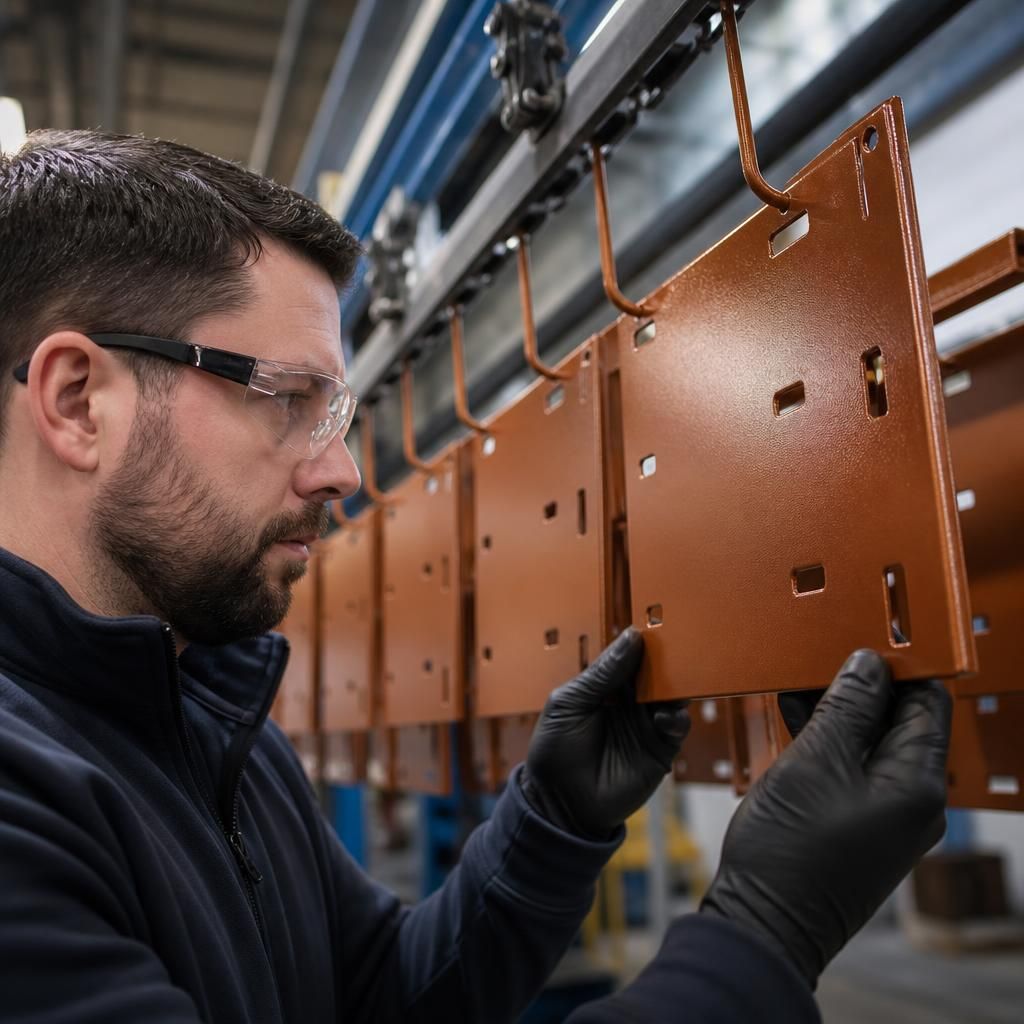
RAL 8029 is an appearance designation, not a corrosion-protection grade. The shade identifies the copper-toned finish, while resistance is determined by the powder formulation and the complete coating specification. Two powders in the same RAL colour can therefore have different suitability for exterior, industrial or chemically exposed applications.
When selecting the system, review the manufacturer’s technical data for the intended exposure, pretreatment requirements, curing conditions and validated corrosion-performance testing. Test results should be treated as evidence for comparing coating systems rather than as a direct prediction of service life, because actual performance also depends on the aluminium, component geometry, installation and surrounding environment.
This distinction helps prevent a common specification error: choosing RAL 8029 for its appearance and assuming that the colour alone provides a particular level of protection. The colour can be retained while the protective requirements are defined separately through the powder system, preparation and application controls.