

How does zinc primer powder coating contribute to long-term metal durability in industrial settings?
Zinc primer powder coating contributes to long-term metal durability by combining a protective barrier with zinc’s sacrificial corrosion protection. When correctly prepared and applied, it helps shield steel components from moisture and corrosive conditions, supporting a longer service life in demanding industrial environments.
Zinc primer powder coating contributes to long-term metal durability by limiting the progression of corrosion beneath the visible finish and helping the complete coating system remain effective after minor damage. Its value is greatest when it is specified as part of a compatible, correctly cured system rather than treated as a standalone finish.
It reduces underfilm corrosion. Bare steel can continue to deteriorate beneath an apparently intact coating if moisture reaches a defect, cut edge or weakly bonded area. A zinc-rich primer helps reduce the rate at which corrosion spreads laterally under the surrounding finish. This can delay blistering, flaking and loss of adhesion, preserving more of the original metal section for longer.
It provides additional protection at vulnerable areas. Industrial components commonly contain corners, welds, apertures, edges and fixing points where coating coverage and film thickness are more difficult to control. These locations often become the starting points for corrosion. A primer layer designed for use beneath a compatible powder topcoat gives the system greater depth of protection at such features, provided the component design and application process allow adequate coverage.
It supports the durability of the complete coating system. Long-term performance depends on the interaction between the metal substrate, primer and any subsequent topcoat. The primer must bond securely to the prepared steel, cure correctly and remain chemically compatible with the layer above it. The topcoat then supplies the required external resistance to factors such as abrasion, impact, moisture and industrial contamination. If either layer is poorly selected or incorrectly cured, the additional primer may not deliver its intended benefit.
Several factors determine whether zinc primer powder coating will extend service life in practice:
- Substrate condition: Rust, mill scale, oil, grease and embedded contaminants can prevent reliable adhesion. The steel must be prepared to a condition suitable for the specified coating system.
- Coating compatibility: The primer and topcoat should be selected as a matched system. Cure schedules, recoat requirements and the chemistry of each layer need to be considered together.
- Film continuity: Pinholes, thin areas, missed edges and damage around holes or welds can create routes for moisture. Consistent application and appropriate inspection help identify these weaknesses.
- Component design: Water traps, narrow crevices and inaccessible internal surfaces can expose metal to prolonged dampness. Coating can reduce the risk, but it cannot compensate fully for a design that retains water or prevents adequate access during preparation and application.
- Service conditions: Humidity, salt exposure, chemicals, temperature changes, abrasion and impact all influence the coating specification. A system suitable for an indoor fabrication may be unsuitable for exposed plant, transport equipment or aggressive industrial surroundings.
Mechanical damage should also be considered. A scratch or impact that reaches the steel does not necessarily result in immediate component failure, but it creates a local defect that should be assessed and repaired using a method compatible with the original system. Prompt attention is particularly important where the component is exposed to persistent moisture, de-icing salts, process chemicals or abrasive materials.
Long-term durability is therefore not measured only by the condition of the surface immediately after coating. It also concerns how slowly defects develop, whether corrosion remains localised, how well the finish retains adhesion and how easily the system can be inspected and maintained. Inspection should focus on edges, welds, joints, fastener areas, drainage points and places subject to repeated impact or abrasion. Where the component is critical to structural or operational performance, the inspection and repair regime should follow the asset owner’s engineering requirements.
Zinc primer powder coating is most appropriate where the cost or disruption associated with corrosion makes a layered protection system worthwhile. It can help preserve the usable condition of steel components and reduce the likelihood that corrosion will undermine the outer finish prematurely. It is not, however, a substitute for suitable steel preparation, correct curing, sound component design or maintenance. These factors work together to determine whether the coating system provides durable protection throughout the component’s intended service life.
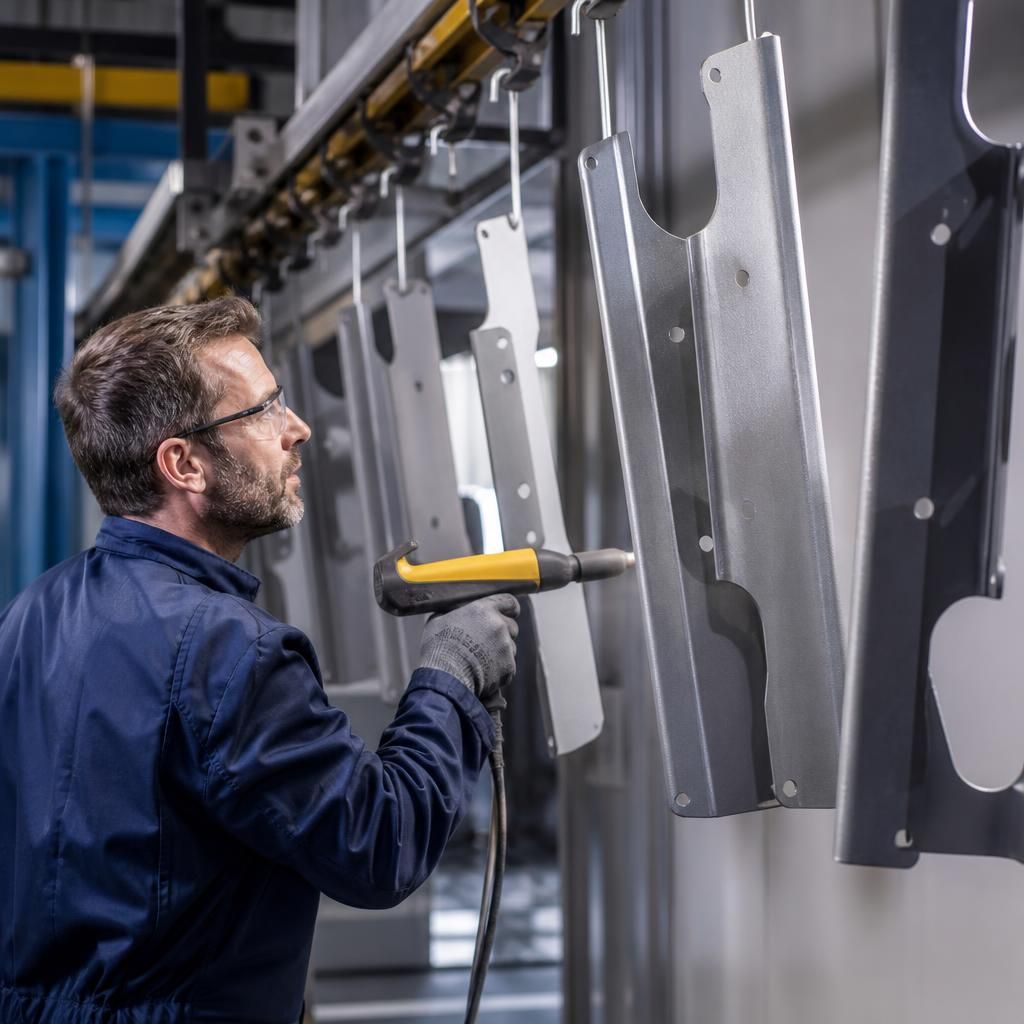
Zinc primer powder coating adds electrochemical protection as well as a physical barrier. Where a defect exposes steel and moisture is present, electrically connected zinc is preferentially consumed, helping to reduce the rate at which the exposed steel oxidises. This sacrificial action is local rather than unlimited: the zinc is gradually depleted, and it depends on suitable contact between the zinc-rich primer and the steel substrate.
The outer powder topcoat remains important because it limits moisture reaching the primer and reduces the conditions that activate zinc consumption. A compatible layered system therefore combines barrier protection from the topcoat with sacrificial protection from the primer, helping the coating system retain its protective function when minor surface damage occurs.