

How does electrostatic epoxy powder coating compare to traditional painting methods in terms of durability and application?
Electrostatic epoxy powder coating generally provides a harder, more abrasion- and chemically resistant finish than traditional liquid paint when the metal is properly prepared and the coating is correctly cured. Its application uses electrically charged dry powder followed by oven curing, whereas traditional painting applies liquid paint by spraying or brushing and relies on drying or solvent evaporation.
Electrostatic epoxy powder coating is usually the more durable option for prepared metal components that can be oven-cured, while traditional liquid painting remains more adaptable for on-site work, heat-sensitive parts, intricate repairs and applications requiring very specific wet-film control. The better method depends on the component’s environment, size, geometry, production volume and required finish.
Durability in service
Once fully cured, epoxy powder forms a continuous film that resists impact, abrasion, oils and many industrial chemicals. It is well suited to metal parts handled during assembly, transport or routine use. Because the powder is applied as a dry film and fused during curing, there is no liquid carrier to evaporate from the finished layer. This can help produce a consistent coating when film thickness and oven conditions are properly controlled.
Traditional liquid paint can also provide effective protection, but its performance depends more heavily on the paint system selected, the number of coats, drying conditions and the control of solvent evaporation. Inadequate drying, contamination between coats or an inconsistent film can create weak areas, pinholes or adhesion problems. A correctly specified liquid system may nevertheless be preferable where a primer, build coat and topcoat are needed for a particular service environment.
Epoxy has an important limitation outdoors: prolonged exposure to ultraviolet light can cause chalking, fading or loss of appearance. For components exposed to direct sunlight, epoxy is often used as a primer or base layer beneath a more UV-resistant topcoat, rather than as the only decorative finish. Traditional liquid systems can offer greater flexibility where the specification calls for a multi-layer exterior coating or where an established wet-paint system has been selected for weathering performance.
How application differs
Powder coating involves several controlled stages:
- Removing oil, dirt, rust, mill scale and previous coatings from the metal.
- Conditioning the surface through an appropriate chemical or mechanical preparation process.
- Ensuring the component is clean, dry and electrically conductive.
- Grounding the component and applying charged powder with an electrostatic spray gun.
- Heating the coated part so that the powder melts, flows and cures into a continuous film.
- Checking the finished coating for coverage, adhesion, appearance and curing consistency.
The electrical charge encourages powder particles to be attracted to the grounded workpiece, including areas that may be difficult to reach with a conventional spray pattern. It does not eliminate the need for correct gun technique, masking or part positioning. Recesses, internal corners, Faraday cage areas and tightly assembled features can still receive less powder and may need adjusted spray settings or additional attention.
Traditional painting is generally applied by spray, brush or roller. It can be carried out in separate coats, allowing a primer, corrosion-inhibiting layer, intermediate coat and finish coat to be selected independently. Each layer normally requires suitable flash-off or drying before the next one is applied. This makes liquid paint useful where a coating specification needs several distinct functions, but it also introduces more opportunities for dust inclusion, runs, solvent entrapment and variation in film thickness.
Production and component suitability
For repeatable batches of removable metal parts, powder coating can simplify production because the material is supplied ready for application and the cured finish is produced in one main heating cycle. Overspray that has not been contaminated may sometimes be managed through suitable recovery systems, although recovery and colour-change arrangements must be assessed for the particular equipment and coating material. Powder application also requires an oven large enough for the parts and a process temperature compatible with the substrate and any components attached to it.
Liquid painting does not require the same oven capacity. This can make it more practical for large fixed structures, assembled items or components containing heat-sensitive materials. It is also more suitable for work that must be completed at the installation site, where transporting the part to a coating oven would be impractical. However, site conditions introduce additional control issues, including airborne dust, humidity, temperature and protection of nearby surfaces.
Powder is not automatically suitable for every metal component. The part must tolerate the curing cycle, provide a suitable electrical path and be designed or prepared so that trapped moisture, air or pretreatment chemicals do not compromise the finish. Threaded holes, drain points, mating faces and other areas that must remain uncoated need accurate masking. Liquid coating can offer greater freedom for localised application, although masking and access remain important for either method.
Appearance, repairs and rework
Powder coating can provide smooth, textured, matt, satin or gloss finishes, subject to the powder specification and application controls. It produces a robust factory finish, but local repairs may be more visible because a repaired area must be blended into a coating that was originally heat-cured. If a component is damaged after coating, the repair method should be selected for compatibility with the existing film and the operating environment.
Liquid paint is generally easier to touch up on site and can be blended over a smaller area. That advantage can be significant for installed equipment or components likely to suffer occasional local damage. The repaired area may still differ in colour, texture or sheen, particularly where the original coating has weathered, but wet paint provides more flexibility for maintenance work.
What determines the better choice?
Specify electrostatic epoxy powder coating when the parts are suitable for oven curing and the priority is a tough, uniform finish for handling, abrasion or chemical exposure. Specify traditional liquid paint where the work involves heat-sensitive materials, very large or fixed structures, complex multi-coat requirements, on-site application or frequent localised repair.
Neither process compensates for poor preparation. Adhesion and corrosion protection depend on removing contaminants, treating corrosion correctly, selecting a compatible coating system and ensuring that edges, joints, cavities and concealed faces are addressed. For powder, the cure schedule must also be matched to the metal temperature rather than relying only on the oven air temperature. A coating specification should therefore define the substrate, preparation standard, coating type, colour and sheen, target film characteristics, curing requirements and inspection criteria before production begins.
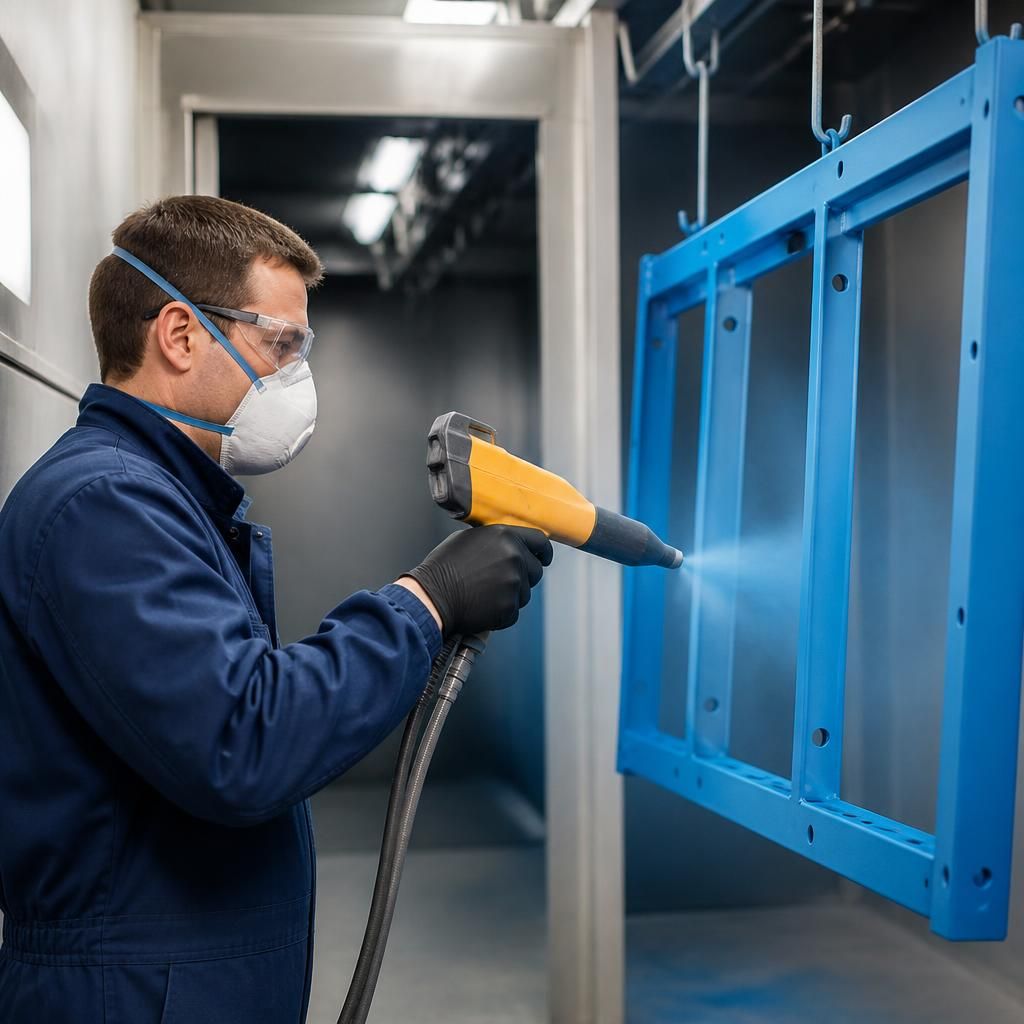
One reason electrostatic epoxy powder coating is durable is that the powder forms a cross-linked thermoset film during curing. Once this reaction is complete, the coating does not simply melt or dissolve again under normal service conditions. This helps it retain its protective film when exposed to handling, abrasion and many industrial substances.
Traditional paint performance varies more widely because different liquid formulations can soften, swell or lose adhesion when exposed to particular solvents, heat or chemicals. The comparison therefore depends on the specified paint chemistry as well as the application method. For either system, the coating should be selected against the actual operating environment, including chemical contact, temperature, impact and cleaning requirements.
Discuss Electrostatic Epoxy Powder Coating for Your Components
Discuss your component’s substrate, dimensions, service environment and production requirements to establish whether electrostatic epoxy powder coating or traditional paint is the more suitable specification. Powder-coatings.co.uk can help assess the coating approach for your metal parts and advise on the next stage.