

Why is chemical conversion coating important in the aluminium powder coat pretreatment process?
Chemical conversion coating creates a thin, adherent layer on aluminium that gives powder coating a more suitable surface to bond to. It also helps protect the metal from corrosion beneath the finish, supporting longer-lasting coating performance.
Chemical conversion coating is important because it changes the chemically active surface of aluminium into a controlled, receptive layer before powder is applied. This gives the pretreatment system a consistent foundation, helps manage aluminium’s natural reactivity and reduces the risk that surface chemistry will undermine the finished coating.
Aluminium rapidly develops a thin oxide film when exposed to air. That film is not necessarily uniform: its condition can vary with the alloy, fabrication method, storage, handling and previous exposure to moisture or contaminants. Oils, drawing compounds, fingerprints, machining residues and embedded dirt can further interfere with the surface. Cleaning removes these materials, but it does not by itself provide the same level of controlled surface preparation as a conversion stage.
During conversion treatment, the prepared aluminium reacts with the process chemistry to form a very thin inorganic layer. This layer is chemically integrated with the substrate rather than simply sitting on top of it. Its structure and surface energy help the subsequently applied powder form a more stable interface during curing. The result is less dependence on the inconsistent characteristics of the original aluminium surface.
The treatment also helps limit under-film corrosion. If moisture or corrosive contaminants reach a defect or an exposed edge, untreated aluminium can undergo localised corrosion beneath the coating. A suitable conversion layer can make the surface less vulnerable and help restrict the spread of corrosion from areas where the powder film has been damaged. It is not a substitute for a sound powder coating, correct edge coverage or suitable design, but it is an important part of the combined protection system.
Conversion coating is particularly valuable where components may face outdoor exposure, condensation, industrial pollutants, road salts or handling during assembly. It can also improve consistency across batches of aluminium parts, provided the treatment is matched to the alloy and the intended service conditions. The exact performance depends on the complete system, including cleaning, rinsing, conversion chemistry, drying, powder selection and curing.
Common conversion technologies include chromate-based and chrome-free systems. Chrome-free alternatives are widely considered where environmental, health and regulatory requirements make chromate chemistry unsuitable. The choice should be based on the aluminium grade, the required corrosion performance, the powder system and the coater’s process controls. A chemistry designed for one substrate or operating method should not be assumed to be suitable for every aluminium component.
Effective application requires control rather than simply adding another tank to the process. Important considerations include:
- Surface condition: oil, oxide deposits and other residues must be removed before conversion treatment can work evenly.
- Chemical concentration and pH: the bath must remain within the supplier’s specified operating range.
- Contact time and temperature: insufficient treatment may leave areas unprotected, while excessive treatment can produce an unsuitable or poorly controlled surface.
- Rinsing: residual process chemicals must be removed so they do not contaminate later stages or interfere with powder application.
- Coverage: recessed areas, joints, drilled holes and complex profiles need adequate contact with the treatment solution.
- Drying and handling: the treated surface should be dried without recontamination before powder coating begins.
Inspection and process records help identify problems before they become coating failures. Depending on the specification, checks may include visual examination, bath monitoring, water-break testing after cleaning, coating thickness checks and adhesion or corrosion testing. A defect that appears to be a powder application problem may instead originate from incomplete cleaning, poor rinsing or an incorrectly controlled conversion stage.
Chemical conversion coating therefore matters because it makes the aluminium surface more predictable for the rest of the powder coating process. It supports a stable coating interface and contributes to resistance against corrosion, but it must be treated as one part of a controlled pretreatment sequence rather than as a standalone guarantee of performance.
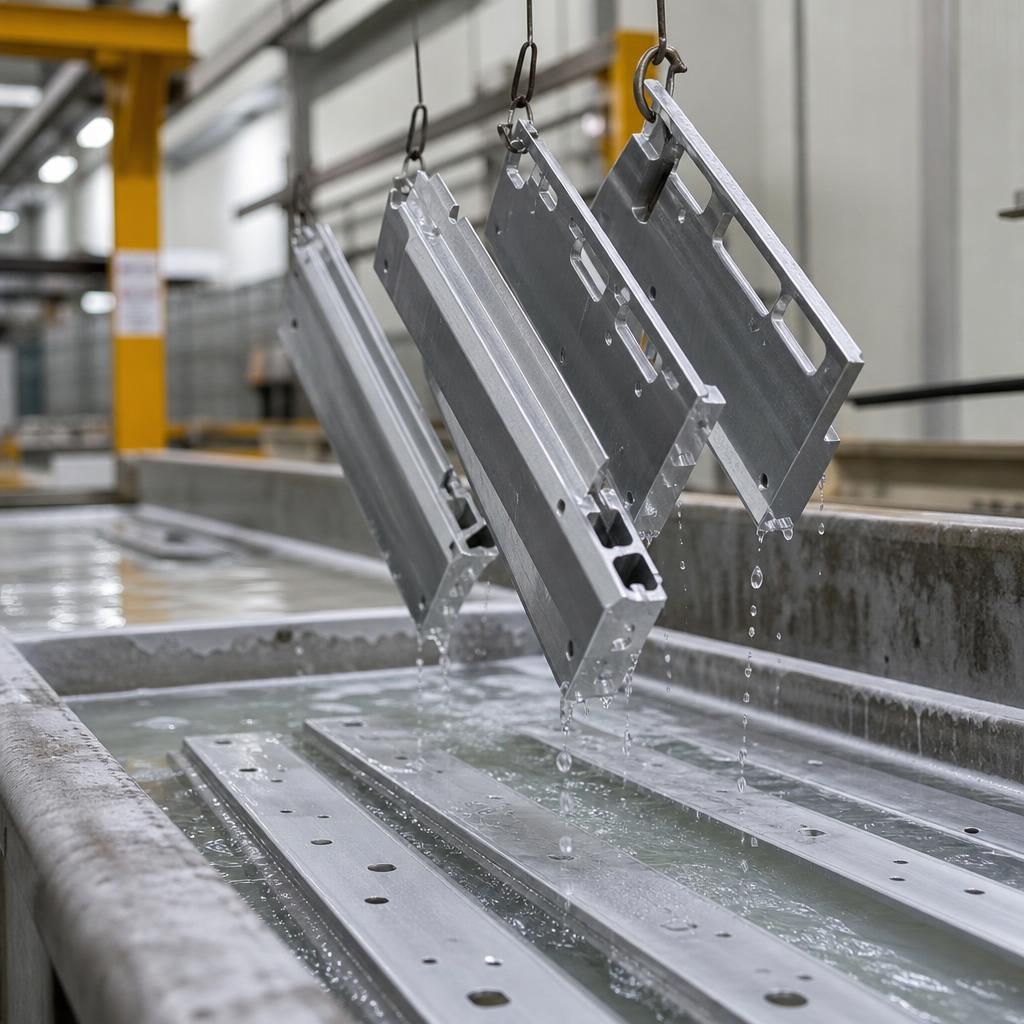
Chemical conversion coating is a very thin pretreatment layer, not a substitute for the powder coat itself. Because it adds minimal build compared with a liquid or powder finish, it can prepare aluminium components without materially changing their dimensions, profiles or surface detail.
This is important for parts with close-fitting interfaces, accurately formed edges or functional contact areas. The conversion layer helps establish a suitable surface for the powder film while allowing the coating system to retain the component’s intended geometry. It should therefore be viewed as an interface treatment: the conversion stage conditions the aluminium, while the cured powder provides the visible finish and primary barrier protection.