

How is powder coated perforated aluminium customised for specific projects?
Powder coated perforated aluminium is customised by selecting the sheet thickness, perforation pattern, panel dimensions, edge details, colour, gloss level and coating specification to suit the project. These choices are defined from the required appearance, fit, exposure conditions and performance of the finished component.
Powder coated perforated aluminium is customised by translating the project’s functional, visual and environmental requirements into a controlled component specification. The perforations must provide the required airflow, screening, drainage, acoustic or weight-reduction characteristics, while the coating system must suit the aluminium substrate, intended exposure and final appearance.
Customisation usually begins with the design information supplied by the manufacturer, fabricator or project consultant. This may include engineering drawings, CAD files, sample panels or a written schedule. The specification should identify the finished face, visible edges, fixing points, folds, returns and any areas that must remain free from coating. Clear drawings reduce the risk of coating interfering with assembly or covering surfaces that require electrical contact, bonding or tight dimensional control.
The perforation design can be adapted to the purpose of the panel rather than selected solely for appearance. Important considerations include:
- the shape and arrangement of the openings, such as round, square, slotted or decorative patterns;
- the open area required for ventilation, screening or drainage;
- the direction of a repeated pattern where the panel has a visible orientation;
- the remaining metal between perforations, which affects rigidity and handling; and
- the relationship between the pattern, folded edges, cut-outs and fixing holes.
Perforated aluminium can also be formed or fabricated before coating where the project requires trays, screens, façades, guards, grilles or enclosure panels. The fabrication sequence matters because sharp edges, burrs, welds, drilled areas and handling marks can affect the finished surface. Deburring, cleaning and suitable preparation help create a consistent base for the coating and prevent local defects from being carried into the final finish.
Coating customisation goes beyond choosing a colour. A project specification can define the coating family, surface appearance, gloss level, texture and required resistance to the service environment. Smooth, textured, matt or other finishes can alter both the visual character and the way minor surface marks are perceived. For external or industrial components, the coating choice should be considered alongside exposure to moisture, chemicals, abrasion, ultraviolet light and handling.
Some designs require selective coating rather than complete coverage. Masking can be used where threaded sections, locating faces, hinge points, contact surfaces or other interfaces must remain uncoated. Masking arrangements should be agreed before production because the position and removal of masking materials can influence the visible boundary and the usable dimensions of the part. Where a component is assembled from several panels, the specification should also consider how adjacent coated edges will meet.
Colour matching is normally controlled against an agreed reference, such as a recognised colour standard, an approved sample or an existing component. The reference should be identified before coating begins, particularly where several parts will be installed together. Perforated surfaces can appear different from solid sheet because the background, viewing angle and shadows within the openings affect how the colour is perceived. For critical architectural or display work, an approval sample can help confirm the intended finish before the full batch is processed.
Batch requirements are another important part of project-specific customisation. Parts should be grouped and identified so that components requiring the same finish are processed consistently. The coating specification, colour reference, orientation and any masking instructions should remain linked to the production drawing or job record. This is particularly relevant where panels are installed side by side or where replacement components may be required later.
Practical customisation also involves deciding how the coated panels will be inspected. Relevant checks may include coverage of the perforated areas, visible inclusions or blemishes, masking boundaries, colour consistency, edge condition and conformity with the agreed drawing. Dimensional checks are best considered in relation to the coating and the way the part will be assembled, rather than treating the coating as entirely separate from the component design.
For a project using powder coated perforated aluminium, the most useful specification therefore combines the part drawing with a coating schedule. It should record the material and fabricated form, perforation arrangement, required finish, areas to be protected, colour reference, exposure conditions, inspection requirements and any approved sample. A Midlands powder coating specialist can use this information to assess the component before processing and identify design details that may affect preparation, masking, handling or the consistency of the finished batch.
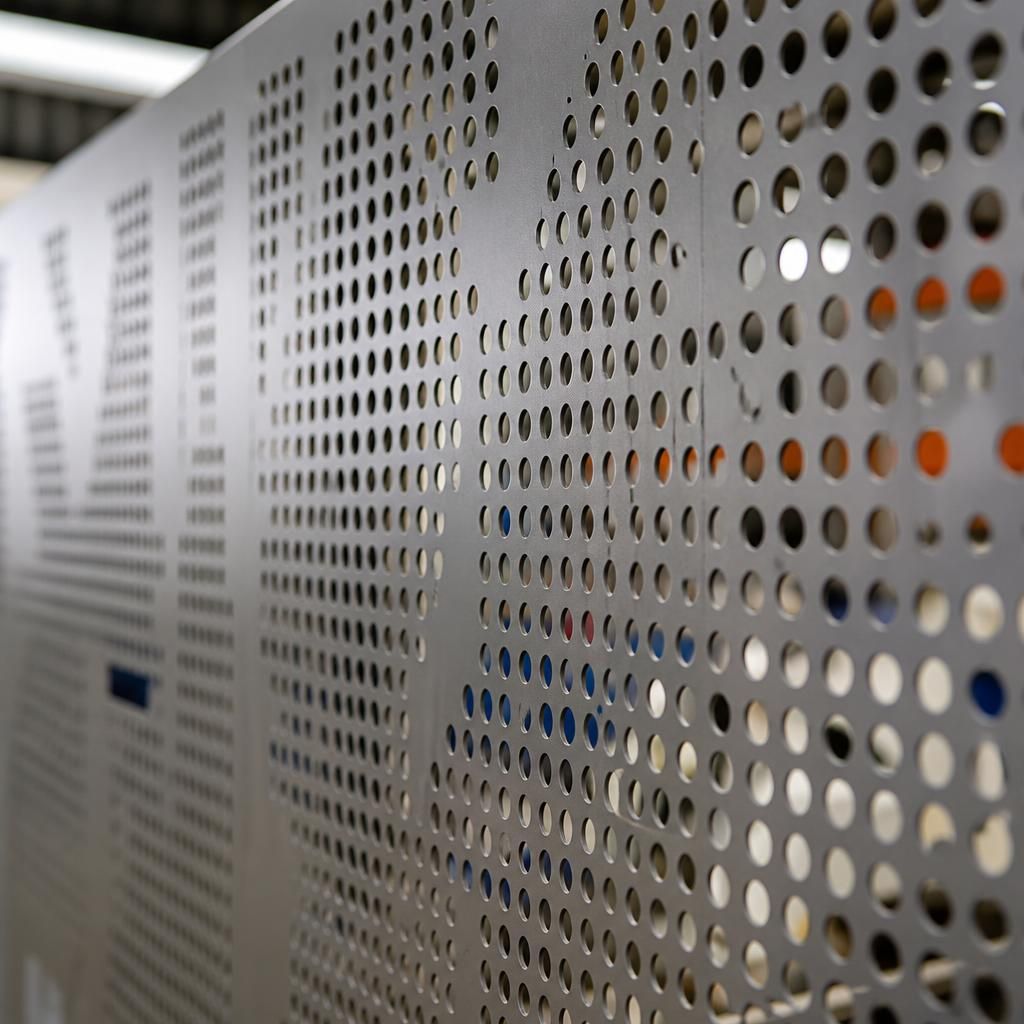
A project may require the perforation pattern to fulfil a visual role as well as a technical one. Bespoke layouts can create a repeated motif, logo-style feature or controlled screening effect, provided the openings remain sufficiently separated to preserve the panel’s structural integrity. The pattern should be reviewed at the intended viewing distance, since small openings can merge visually while larger openings create a more pronounced contrast between the aluminium and the space behind it.
For architectural or display panels, the design should also account for lighting and the background visible through the perforations. A dark backing, direct illumination or changing viewing angle can alter the apparent density of the pattern and the perceived character of the powder-coated surface. Reviewing a representative design in its intended setting helps confirm that the selected perforation arrangement and finish produce the required visual effect.