

What factors should be considered when selecting between matte clear and white powder coatings for aluminium components?
Select between matte clear and white powder coatings by considering the required appearance, exposure conditions, substrate preparation, durability expectations, maintenance needs and project specification. Matte clear retains more of the aluminium’s visual character, while white provides an opaque, consistent finish, so the choice should reflect both the design objective and the component’s working environment.
The choice between matte clear and white powder coating for aluminium components should be based on the complete coating specification, not colour preference alone. In addition to the intended visual result, assess colour control, powder chemistry, curing requirements, dimensional tolerances, masking, assembly, inspection criteria and the consistency required across the finished batch.
Define the required level of visual uniformity. Matte clear coatings allow more of the aluminium beneath them to influence the finished appearance. This makes the condition, alloy, surface texture and uniformity of the component more significant. If parts are supplied from different production runs or contain areas with slightly different surface characteristics, a clear finish may produce visible variation. White powder coating creates a more consistent base colour, which can be preferable where multiple components must look uniform when installed together.
Also establish the acceptable degree of mattness and texture. “Matt” can cover a range of surface effects, and the result may be judged differently under workshop lighting, daylight and artificial lighting. A written sample, approved reference panel or agreed inspection method helps prevent disputes over shade, texture or visible marks. This is particularly important where aluminium components are manufactured in batches or where coated parts will be positioned next to painted steel, plastics or existing building materials.
Check colour and specification requirements. White is not a single universal colour. The required shade may need to correspond with a project colour schedule, an established component range or adjacent materials. Confirm whether the specification requires a particular colour reference, gloss level, texture or coating classification. For matte clear, confirm whether the specification permits natural variation in the aluminium beneath the coating or requires a more controlled metallic appearance.
Where a project has multiple batches, retain an approved reference and ensure that the same powder specification is used throughout. A nominally similar clear or white finish can differ if the powder formulation, gloss level or application conditions change. The specification should identify the colour, finish, coating system and any acceptance criteria rather than relying on descriptions such as “clear matt” or “standard white”.
Consider the powder system and curing requirements. The resin system should be selected for the component’s intended service conditions and the required coating classification. The powder manufacturer’s technical data will set out the recommended film thickness, cure schedule and application limits. These details matter because aluminium components may vary considerably in section thickness, and the metal itself can heat differently during curing.
Ask the coater to confirm that the selected powder is suitable for the aluminium alloy and component design, and that the proposed cure schedule can be achieved consistently. If the component includes pressed sections, folded edges, inserts or areas with different mass, the specification should account for the way those features may affect coating formation and curing. The objective is a coherent, properly cured coating across the whole part rather than simply choosing a colour.
Review dimensional and assembly constraints. Powder coating adds a measurable film to the component. Before selecting the finish, identify holes, threads, bearing faces, sliding surfaces, electrical contact points and close-fitting joints that must remain within tolerance. These areas may require masking or a coating exclusion zone. The masking plan should be agreed before production, since an apparently minor coated edge can affect fit, earthing, movement or the installation of fixings.
White and clear finishes do not necessarily require different masking arrangements, but the consequences of an exposed or coated area may be more noticeable with one finish than the other. Provide drawings that mark critical surfaces and state whether masked edges, contact points or small uncoated areas are acceptable.
Assess the component’s role in the finished assembly. A finish can influence how parts are identified, oriented and inspected during assembly. If components are interchangeable, a consistent white finish may make visual checking simpler. If the aluminium itself forms part of the design language, matte clear may be appropriate, but the specification should distinguish between areas where natural metal character is intended and areas where a uniform coated surface is required.
Consider whether the component will be combined with rubber seals, adhesives, thermal breaks, protective films or other materials. Compatibility should be checked for any coating that will be bonded, sealed or clamped. Masking, adhesion and cure conditions may need to be coordinated with those downstream operations.
Set inspection and acceptance criteria before coating. Decide how the finished parts will be assessed for colour, gloss, texture, coverage, edge definition and visible defects. Inspection criteria should reflect the viewing distance and the function of the component. A close-view architectural or display-facing part may need tighter visual controls than a concealed bracket, while both still require the specified coating performance.
For repeat work, agree how samples will be approved and how non-conforming parts will be handled. A first-off or trial batch can confirm the selected powder, finish and masking arrangement before the full quantity is processed. This is useful where the aluminium surface, component geometry or required colour has not previously been coated.
Compare total process implications rather than powder price alone. The more suitable finish may be the one that reduces rejection risk, simplifies inspection and fits the component’s assembly requirements. Include powder specification, preparation, masking, hanging, curing, sample approval, packaging and any collection or delivery requirements in the project assessment. For larger or repeated orders, provide drawings, component quantities, rack orientation and critical tolerances so the coating process can be planned accurately.
A practical decision is therefore made by documenting the required colour and finish, approving a representative sample, checking the coating system and cure requirements, identifying critical surfaces and agreeing inspection standards. Matte clear is appropriate where controlled visibility of the aluminium is part of the specification; white is generally more suitable where a defined, opaque and repeatable colour is the priority. The final choice should be recorded as a complete technical specification for the particular component and application.
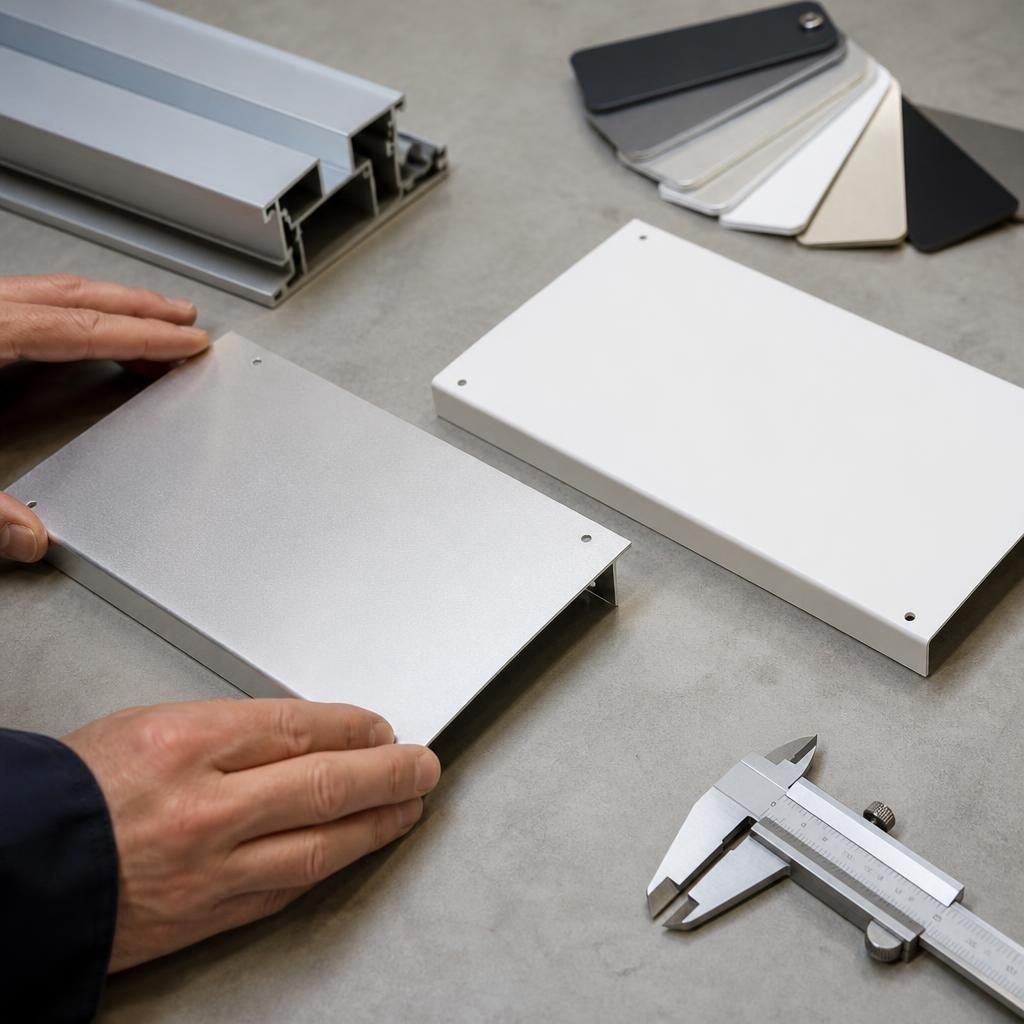
For aluminium components exposed to direct sunlight, consider the finish’s effect on solar heat absorption as well as its appearance. A white coating generally reflects more visible light than a clear finish, while a matte clear coating leaves the aluminium’s natural tone and surface character more apparent. This may be relevant for panels, covers, housings or assemblies where temperature, thermal movement or contact safety is part of the design assessment.
Coating colour alone does not determine the operating temperature of a component. Sun exposure, component geometry, ventilation, orientation and the surrounding materials also contribute. Where thermal performance matters, compare the proposed finishes as part of the complete assembly specification rather than selecting solely on visual preference.