

How does the electrostatic spraying process work in aluminium powder coating?
Electrostatic spraying applies dry powder to aluminium by giving the powder particles an electrical charge and grounding the metal component, so the particles are attracted to and adhere across its surface. The coated aluminium is then heated to melt and cure the powder into a continuous, durable finish.
Electrostatic spraying is a controlled application process in which an operator uses a powder spray gun, compressed air and an electrostatic field to build a consistent coating on prepared aluminium. The quality of the result depends on how the equipment is set up, how the component is positioned and how the powder is distributed across its surfaces—not simply on the presence of an electrical charge.
1. Preparing the spray equipment
Powder is held in a feed system and carried towards the spray gun using air. The gun regulates the powder flow and introduces the electrical charge as the particles pass through it. Air pressure must be sufficient to transport the powder, but excessive airflow can scatter it, create uneven coverage or disturb powder already deposited on the component.
The operator selects settings according to the aluminium part, its geometry, the powder specification and the required film build. Important variables include powder flow, air volume, voltage, current limitation and the distance between the gun and the workpiece. These settings are adjusted together: increasing voltage or powder output without considering the component shape can produce uneven deposition rather than a better finish.
2. Positioning the aluminium component
Aluminium components are placed so that the spray can reach the main faces, edges, recesses and returns as consistently as possible. The part may be rotated or moved through the spray zone to reduce shadowing and prevent one area receiving substantially more powder than another.
Complex shapes require particular care. Corners, internal angles, holes and boxed sections can behave differently from open, flat faces. A phenomenon known as the Faraday cage effect can restrict powder from entering a recessed area because the electrostatic field concentrates around the outer edges. The operator may address this by changing the gun angle, reducing the electrical intensity, altering the powder flow or applying powder to the recess before coating the surrounding face.
3. Controlling spray technique
The gun is moved at a steady speed and held at a suitable distance from the surface. A consistent technique helps avoid heavy bands, thin areas and visible overlap. The spray angle is varied where necessary so that edges and profiles are coated rather than relying on powder travelling directly towards the broadest face.
Spraying too close can create an excessive local film build and may cause back-ionisation, in which electrical effects interfere with the smooth deposition of powder. Spraying too far away can reduce transfer efficiency and make coverage less controlled. The correct working distance is therefore determined by the equipment, powder and component rather than by a single universal setting.
4. Managing film thickness
Film thickness is monitored during application because both under- and over-application can affect performance and appearance. Thin areas may provide insufficient protection, while an overly thick layer can obscure detail, affect dimensions, produce texture or create defects during curing.
Attention is especially important on mating faces, threaded areas, masking lines and parts that must fit together after coating. These areas may require masking or a deliberately controlled application. Hooks, racks and contact points must also be selected to maintain a reliable electrical path without leaving unacceptable uncoated marks.
5. Applying powder to difficult features
- Edges: The gun angle and travel direction are adjusted to prevent the powder from collecting mainly on one side.
- Recesses: Lower electrostatic intensity and a direct spray angle can help powder reach enclosed areas affected by the Faraday cage effect.
- Large flat faces: Overlapping passes are controlled to avoid striping and inconsistent texture.
- Thin profiles: Powder output and gun movement are reduced where excessive build could affect dimensions.
- Holes and apertures: Masking or a planned spray sequence may be needed to keep openings clear and maintain fit.
6. Checking the deposited coating
Before the aluminium enters the oven, the deposited powder is checked for visible gaps, contamination, uneven build and areas that have been missed. This inspection is important because defects identified at this stage can often be corrected more easily than defects found after curing.
The operator also checks that the powder has not been disturbed during handling or transfer. Poor racking, contact between components and unnecessary movement can mark the uncured layer. Components should therefore be supported securely while allowing the spray to reach the required surfaces.
Factors that affect consistency
Ambient conditions, powder storage, equipment cleanliness and the condition of the application system can all influence spraying. Moisture or contamination in the compressed air can disrupt powder flow, while contaminated hoses, guns or recovery equipment can affect colour and finish. Powder should be handled in accordance with its technical requirements, and different materials or colours should not be allowed to cross-contaminate one another.
For batch work, repeatability is improved by keeping the part orientation, racking method, gun movement and equipment settings consistent. Where aluminium components vary in size or design, each geometry may need its own application approach. The aim is not merely to cover the visible surface, but to produce controlled, continuous coverage on all specified areas while preserving dimensions and functional features.
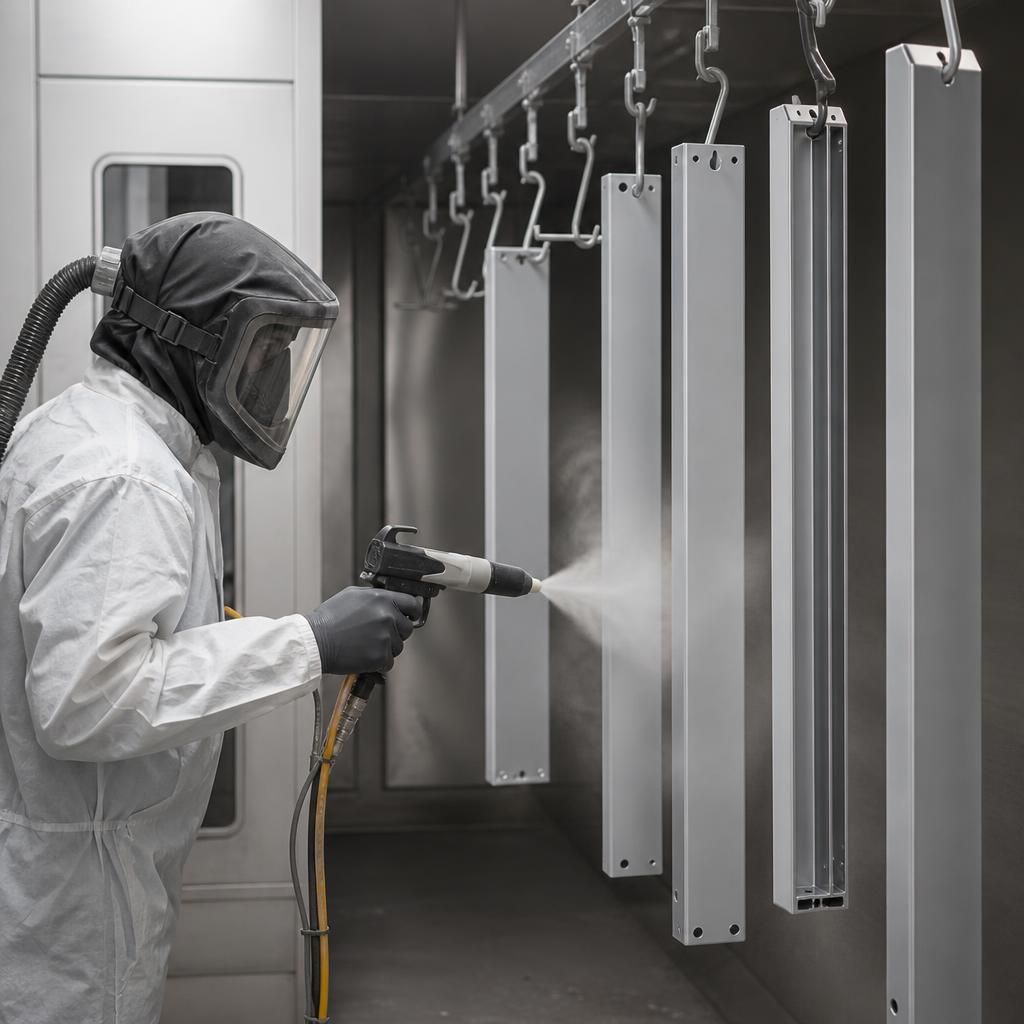
In electrostatic spraying, grounding is established through the rack, hook or fixture supporting the aluminium component. The electrical path must remain continuous from the component to the grounded equipment; simply hanging a part in the spray booth does not ensure this. Contact points therefore need to be positioned on suitable bare metal areas and kept free from accumulated powder.
This becomes particularly important during repeated batch coating. As powder builds up on hooks and racks, it can insulate the component from the grounding system. The resulting loss of electrical continuity reduces attraction between the charged powder and the aluminium, allowing more powder to remain airborne or settle outside the intended coating area. Checking and cleaning contact points is therefore a practical part of maintaining consistent electrostatic application.