

How do automated conveyor systems enhance the efficiency and quality of the powder coating process in large-scale operations?
Automated conveyor systems improve large-scale powder coating by moving components through preparation, application and curing stages at a controlled, repeatable rate. This reduces manual handling, supports consistent coating coverage and curing, and helps production lines maintain a more predictable flow.
In large-scale powder coating, an automated conveyor system improves efficiency and quality by coordinating component flow, process settings and production records across each stage of the line. Its value extends beyond transporting parts: when correctly designed, it links loading, preparation, coating, curing, cooling and inspection into a controlled production sequence.
More predictable production flow
A conveyor establishes a repeatable route through the plant, allowing operators and equipment to work to an agreed production sequence. Parts can be grouped by material, size, coating specification or colour, which makes planning more orderly and reduces unnecessary movement between work areas. Line speed and spacing can be adjusted to suit the required process, helping prevent one stage from becoming a bottleneck while other equipment is underused.
This is particularly important for batch work. A defined sequence makes it easier to identify which components belong to each job and to manage transitions between different coating requirements. Planned changeovers can also reduce the risk of unsuitable parts entering a booth or oven before the line has been adjusted.
Greater control over coating and curing
Quality depends on more than applying powder to a surface. Parts must receive suitable preparation, adequate coating coverage and the correct curing conditions for the powder specification and substrate. An automated line provides a consistent relationship between conveyor movement, spray equipment and oven exposure. This helps operators repeat an established process rather than relying solely on manual timing or judgement.
Conveyor speed is especially significant in the curing stage. If components move too quickly, the coating may not receive the required heat exposure; if they move too slowly, capacity can be reduced and the coating may be over-processed. A properly configured line supports controlled dwell time, while oven zoning can help accommodate differences in component mass and geometry. Cure verification and film-thickness checks remain necessary, because automation does not remove the need for process control.
Improved repeatability across varied components
Manual handling can introduce differences in how parts are positioned, presented to spray equipment or placed in the oven. Automated hanging and conveyor movement can reduce this variation when the fixtures are designed for the component range being processed. Consistent orientation helps expose comparable surfaces to the spray pattern and can improve access to edges, recesses and external faces.
Hanger design must reflect the part’s weight, shape, contact points and electrical requirements. Poorly selected hooks or frames may create shadowing, visible contact marks, inadequate earthing or difficulty removing the finished component. For this reason, automation is most effective when fixtures are treated as part of the coating system rather than as a separate handling detail.
Reduced handling and lower defect risk
Once components are correctly loaded, an automated conveyor can carry them through several stages with fewer manual transfers. This reduces opportunities for parts to be dropped, mixed between orders, contaminated or marked before inspection. It can also allow operators to concentrate on preparation, equipment checks, visual inspection and corrective actions rather than repeatedly moving heavy or awkward items.
Automation does not eliminate defects caused by oil, moisture, poor preparation, incorrect grounding or unsuitable powder application. It does, however, make the process easier to standardise and investigate. If a defect is found, production records and job sequencing can help identify the relevant batch, line settings and stage of processing.
More efficient use of powder and equipment
Automated booths and reciprocators can maintain a consistent spray path, reducing variation caused by hand application on suitable component types. Where the equipment supports powder recovery, overspray may be collected and managed according to the coating specification. Recovery arrangements must be carefully controlled, particularly when changing colours or using powders that should not be reclaimed, because contamination can affect the finish.
The conveyor also helps coordinate booth occupancy and oven capacity. Parts can be spaced to support effective spraying and adequate air circulation, while the line can be planned around the available curing capacity. This prevents the coating stage from operating independently of the rest of the process and makes the overall throughput easier to balance.
Better monitoring and traceability
Large operations benefit from recording the information associated with each job, including the component specification, powder reference, line settings, oven conditions and inspection results. An automated system can make these records easier to associate with a particular production run. Traceability is useful when a customer queries a finish, when a process setting needs reviewing or when repeat work must follow an established specification.
Useful control points may include:
- confirmation that the correct parts and fixtures have been loaded;
- checks on pretreatment condition and surface cleanliness;
- monitoring of conveyor speed and oven temperature;
- verification of powder application and electrical earthing;
- film-thickness, appearance and cure checks at defined stages; and
- recording of non-conforming parts and any corrective action.
Conditions for achieving the benefit
The efficiency and quality gains depend on matching the system to the work. Component dimensions, weight, geometry, required finish, batch variation and production volume all influence the suitable conveyor arrangement. The line must also allow practical access for loading, unloading, inspection, cleaning and maintenance.
Operators still have an important role. They need clear loading standards, approved process recipes, defined inspection points and procedures for handling changes in colour, powder type or component design. Regular checks of hooks, earthing points, spray equipment, filters, oven performance and conveyor components are essential because a small mechanical or process fault can affect a large number of parts when production is automated.
Overall, an automated conveyor system enhances large-scale powder coating by making the process more controlled, repeatable and measurable. It can improve the coordination of production stages, reduce avoidable handling, support consistent curing and provide stronger traceability, provided that the line design, fixtures, settings and quality checks are suitable for the components being coated.
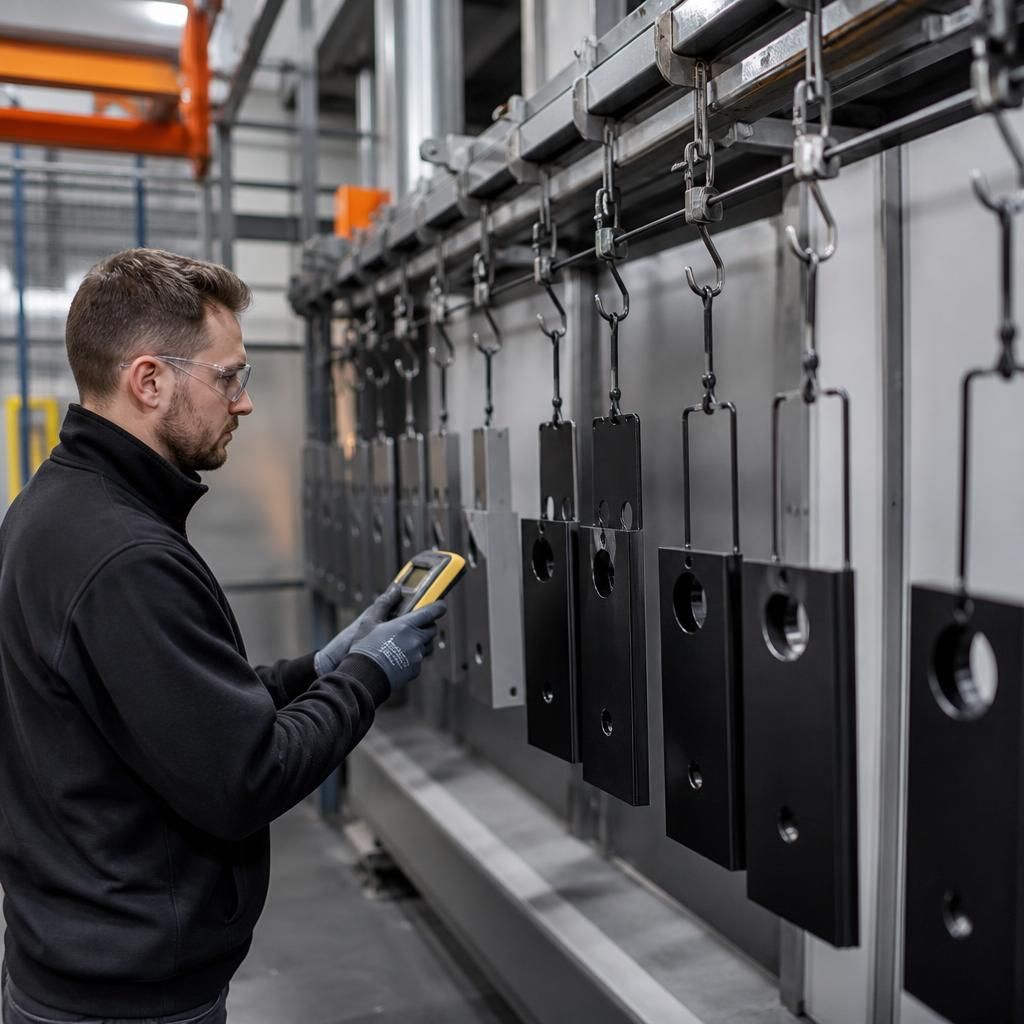
Automated conveyor systems support quality by allowing a first-off component to be assessed before a full batch proceeds. The initial part can be checked for coverage, appearance, film thickness, masking and curing, then the line setup can be adjusted if required. Once the result meets the agreed specification, subsequent components can follow the same validated arrangement rather than relying on repeated trial and error.
This approach is particularly useful when a coating defect could otherwise be reproduced across a large production run. It separates setup approval from batch production, helping operators identify issues with part presentation, spray access or process settings at an early stage and reducing the risk of continuing with an unsuitable configuration.