

How does the electrostatic powder spray gun work in the recoating process?
An electrostatic powder spray gun charges fine powder particles as they pass through the gun, while the metal part is electrically earthed. The charged powder is attracted to and held on the damaged surface, ready for curing into a continuous protective coating.
An electrostatic powder spray gun is a controlled delivery and charging device: it meters coating powder into a stream of compressed air, applies an electrical charge to the particles, and directs them towards the prepared component. In a recoating process, the operator uses the gun to rebuild an even film over the repaired surface while controlling powder flow, air movement, voltage and spray distance.
Inside the gun, powder is carried from a hopper or feed container through an injector and hose. Compressed air transports the powder and helps keep it suspended as it reaches the gun. The gun’s electrode generates the charging field. As particles pass through this field, they acquire an electrical charge before leaving the nozzle. Separate controls allow the operator to adjust the powder output and the air volume so that the coating is delivered as a consistent cloud rather than as heavy, uncontrolled deposits.
The component must be connected to earth through a suitable contact point. This provides the electrical reference needed for the charged particles to move towards the metal and remain on its surface before curing. A poor earth connection can cause weak transfer, uneven coverage and powder deposited on the operator or equipment instead of the part. For this reason, contact points should be clean and free from coating, grease and oxidation.
Recoating requires more control than simply covering the whole part with another layer. The existing finish may have been removed or abraded, and any corrosion, contamination or damaged substrate must be dealt with before spraying. Powder cannot correct deep pitting, distorted metal, sharp burrs or residue beneath the coating. The gun can apply the new film, but the quality of the result depends heavily on the condition and preparation of the surface underneath it.
A typical application sequence is:
- Inspection: identify the damaged areas, check the substrate and determine whether the old coating needs complete removal or local preparation.
- Cleaning and preparation: remove oil, dirt, corrosion and loose material, then provide a surface suitable for powder adhesion.
- Masking: protect threads, bores, electrical contact areas and other surfaces that must remain free from coating.
- Positioning and earthing: support the component so that all faces can be reached while maintaining a dependable earth path.
- Spraying: apply powder in controlled passes, normally working from less accessible areas towards the more exposed faces.
- Inspection and curing: check the uncured film for missed areas, excessive build or contamination before placing the part in the curing oven.
Gun distance and movement affect the amount of powder reaching the surface. Holding the gun too close can produce excessive film build and uneven edges, while holding it too far away can reduce transfer and increase overspray. A steady, overlapping movement helps maintain a uniform layer. The operator may use a lower output or altered settings around corners, recesses and edges, where powder behaviour differs from that on a broad, flat face.
Recesses illustrate an important limitation of electrostatic application. Charged particles are naturally drawn towards exposed areas, so a strong field around an outer edge can reduce the amount entering a deep corner. This is commonly referred to as the Faraday cage effect. It can be managed by changing the gun angle, reducing the electrical intensity where appropriate, using a suitable air setting and applying the powder in a deliberate sequence. Deep cavities may also need additional attention after the main surfaces have been coated.
Edges and corners need particular care during recoating. Powder can accumulate on an edge, leaving less material on the adjacent faces, or it can become too thick at a sharp transition. Smooth preparation, suitable gun movement and inspection between passes help prevent these defects. The aim is not simply to make the damaged area visually covered; the film must be continuous across the component and compatible with the required service conditions.
The controls on a powder gun are interdependent. Increasing powder flow does not automatically improve coverage, because excess material can disturb the spray pattern and create uneven thickness. Air settings influence transport and atomisation, while electrical settings influence particle behaviour and transfer. These controls should therefore be adjusted together, using the part geometry, powder characteristics and required finish as the basis for the setting rather than relying on maximum output.
After spraying, the deposited powder remains a dry layer. It is heated in a curing oven so that the particles melt, flow together and chemically cross-link into a continuous coating. The required curing schedule depends on the powder formulation and the metal component, so the powder supplier’s technical instructions and the actual metal temperature must be considered. Oven air temperature alone does not confirm that the component has reached the necessary curing condition.
In practical industrial recoating, the spray gun is only one part of the process. Powder delivery, electrical earthing, surface preparation, masking, booth conditions, operator technique and curing all affect the finished result. A correctly operated gun can place powder accurately, but it cannot compensate for contamination, inadequate preparation, poor contact or an unsuitable curing cycle.
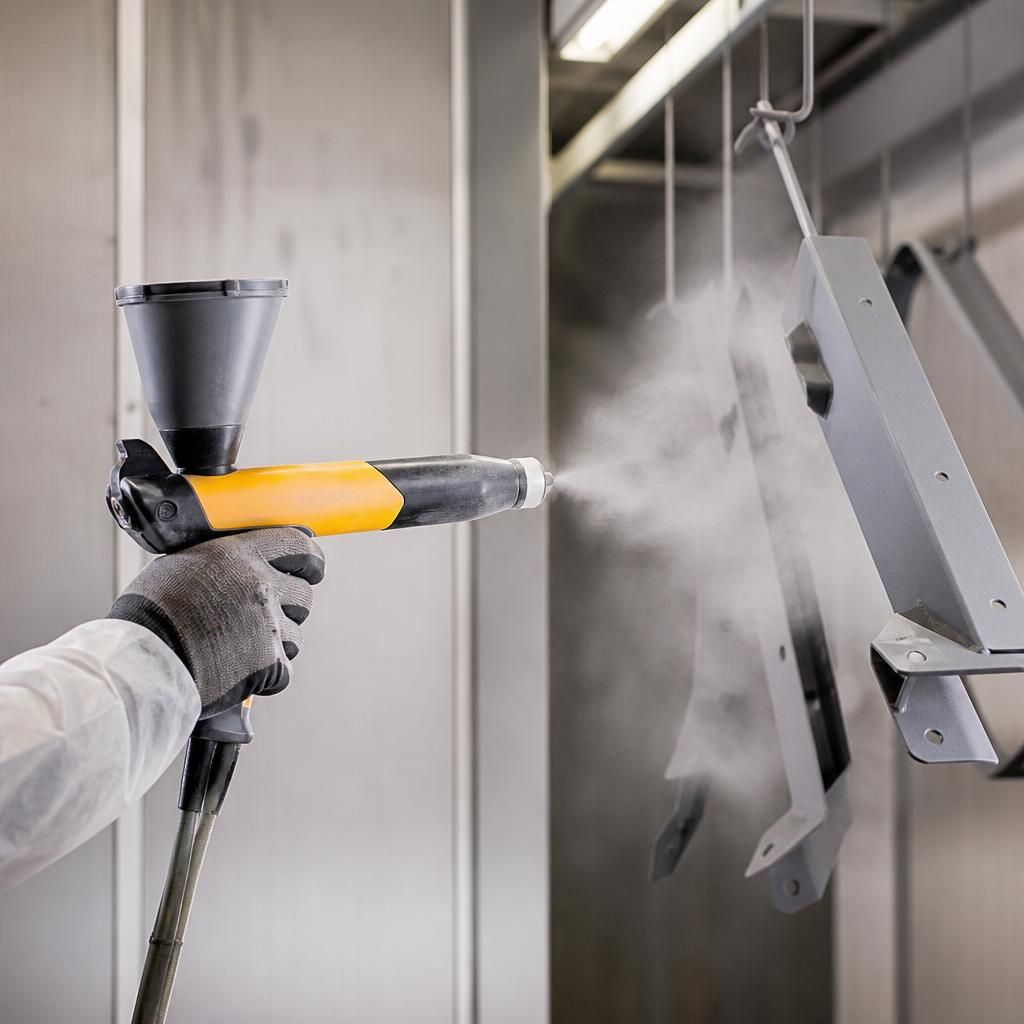
In a conventional corona-type powder gun, the electrode creates an ionised region at the nozzle. Powder particles passing through this region collect ions and become charged, allowing the electric field between the gun and the earthed component to influence their path. The powder remains dry during this stage; melting and bonding take place later in the curing oven.
Charging must be balanced with the component’s shape and the required film build. Excessive charge can reduce the quality of the deposited layer, particularly where powder has already accumulated, while insufficient charge can weaken transfer to the surface. The operator therefore assesses the spray pattern and deposited film while adjusting the gun’s electrical setting, powder delivery and air assistance for consistent coverage.