

How does surface preparation impact the effectiveness of the 2-coat powder coating repair process?
Surface preparation directly affects how well each coat adheres to the metal during a 2-coat powder coating repair. Removing contamination, corrosion and unsuitable existing coating, while creating a clean, suitable surface profile, helps the primer and topcoat bond effectively and provide consistent protection.
Surface preparation determines whether a 2-coat powder coating repair behaves as a continuous protective system or remains a localised patch. The preparation stage controls the condition of the repair area, the transition between the original coating and the exposed metal, and the suitability of the surface for the primer. These factors affect adhesion, film continuity, corrosion resistance and the appearance of the completed repair.
Preparation should begin with an assessment of the damage rather than with coating application. The affected area needs to be defined so that loose, blistered or poorly bonded material is not left beneath the repair. The surrounding original coating is also examined for lifting edges, impact damage, under-film corrosion and contamination that could interfere with the new system. If the boundary is not extended far enough, the new coats may bond to a failing edge instead of to a sound surface.
The repair edge is normally shaped gradually rather than left as a sharp step. This creates a smoother transition for both coats and reduces the risk of an abrupt film-thickness change. It also makes it easier for the primer and topcoat to cover the exposed area without leaving a thin line at the perimeter. Any sharp edges, burrs, weld spatter or rough projections are dealt with during this stage because they can create thin spots, pinholes or raised defects in the finished coating.
Different preparation methods produce different surface conditions. Abrasive blasting can provide a consistent surface profile on suitable steelwork and is useful where corrosion or a substantial amount of failed coating must be removed. Mechanical abrasion may be more appropriate for a controlled local repair or for components where blasting would affect adjacent areas. The method must be matched to the substrate: aggressive treatment that is suitable for heavy steel may distort, excessively roughen or otherwise damage thinner sections or softer metals.
The surface profile is important because it provides a mechanical key for the primer, but it must remain appropriate for the coating thickness and the component’s geometry. An excessively rough profile can leave peaks insufficiently covered by the powder film, while an inadequate profile may provide limited mechanical anchoring. Corners, recesses, holes and welded areas therefore require particular attention because they are more difficult to prepare evenly and are common locations for premature coating breakdown.
Cleaning is not simply a final wipe before spraying. Oils, grease, salts, dust, abrasive residue and handling marks can remain in surface irregularities or be redistributed across the repair area. The cleaning process must remove these residues without introducing a new contaminant. After preparation, the part should be handled in a way that avoids transferring oils from hands or equipment, and the prepared area should be protected from renewed exposure to moisture, dust and workshop contamination before coating.
Moisture control is especially important where corrosion has been exposed or where the component has a complex shape. Residual moisture in joints, seams, holes or recessed sections can affect the primer and may contribute to corrosion beneath the new system. Components should therefore be suitably dry before the first coat is applied. The condition of the metal, ambient conditions and the planned curing process all need to be considered when deciding whether the surface remains suitable for coating.
For a repair using a primer and a topcoat, preparation also supports compatibility between the two layers. The primer must be applied to a surface capable of accepting it, and the interval and curing requirements between coats must be followed. If the primer is contaminated, over-cured, damaged or outside the specified recoat condition, the topcoat may not form the intended bond with it even if the original metal preparation was satisfactory. Surface preparation therefore includes checking the primer-ready condition, not only treating the substrate.
- Soundness: the repair should extend to stable material and a firmly bonded surrounding coating.
- Profile: the prepared texture should provide an effective key without creating uncoated peaks or excessive roughness.
- Cleanliness: residues from oils, salts, dust, corrosion removal and handling should be controlled before coating.
- Geometry: edges, welds, corners, recesses and joints should receive preparation suited to their shape.
- Timing: the prepared surface should not be left exposed long enough for contamination or flash corrosion to develop.
- Verification: the area should be checked for visible defects and readiness before primer application.
Poor preparation can present as more than an immediate adhesion failure. It may cause lifting at the repair perimeter, blistering, rust migration, pinholing, uneven gloss or visible mapping of the original damage through the topcoat. These defects can allow moisture and corrosive agents to reach the metal, reducing the protective value of both coats. In contrast, controlled preparation gives the primer a stable foundation and allows the topcoat to form a more uniform, continuous finish.
For industrial components, the preparation method should be recorded alongside the coating specification, substrate type, damaged area and inspection findings. This makes the repair repeatable across batches and helps identify whether a defect arose from preparation, application or curing. A two-coat repair cannot compensate for an unstable or unsuitable foundation, so preparation is a functional part of the coating system rather than a cosmetic preliminary step.
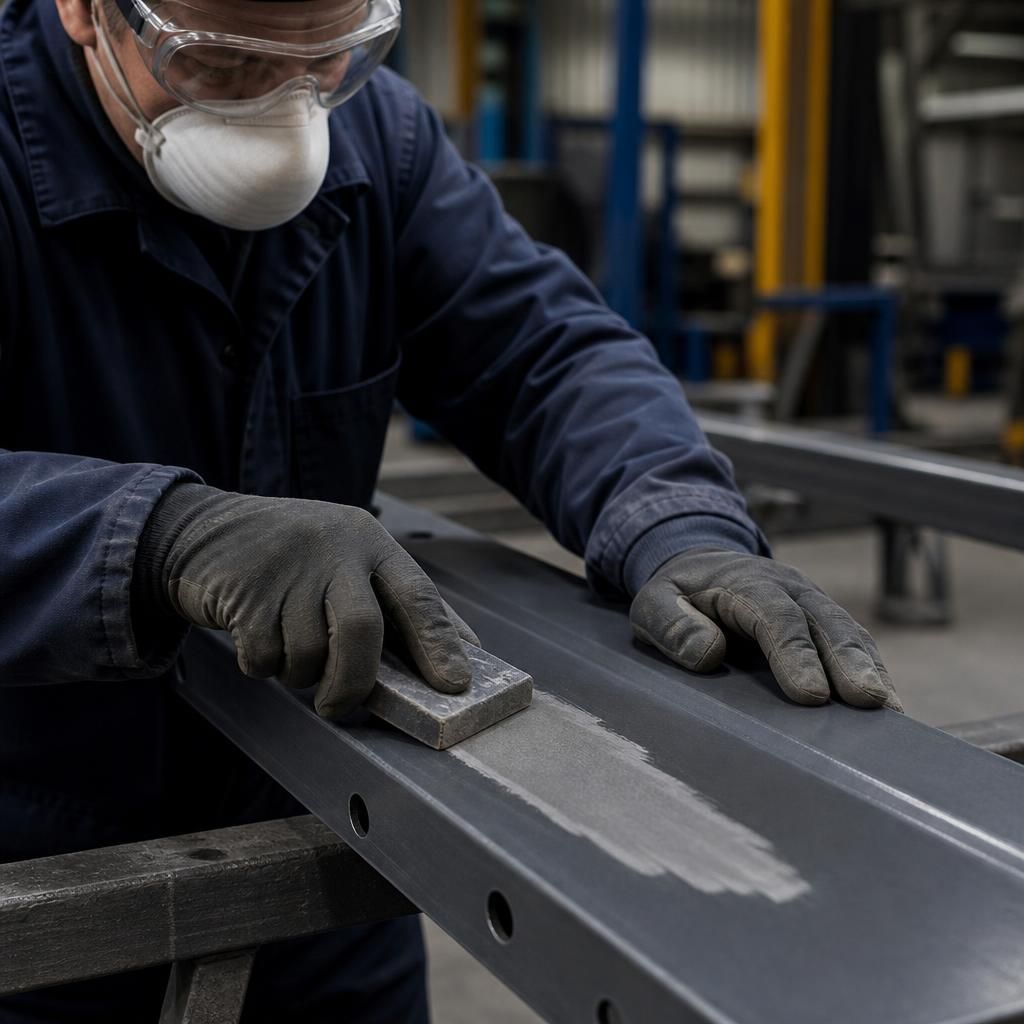
Surface preparation should be matched to the type of failure being repaired, because different defects leave different risks beneath the new two-coat system. Corrosion-related damage requires confirmation that active corrosion products have been removed, while impact damage may require the removal of fractured coating that still appears attached. Where contamination is suspected, cleaning must address the contaminant itself rather than simply roughening the surface.
- Corrosion: prepare back to stable metal and check that corrosion has not continued beneath the surrounding coating.
- Impact or abrasion: remove cracked, lifted or mechanically weakened coating before forming the repair boundary.
- Oil, grease or salts: use a cleaning approach suitable for the residue and prevent it being spread across the prepared area.
- Unknown damage: investigate the cause before coating, since covering an unresolved defect can lead to repeat failure beneath the repair.
This defect-led approach helps determine how far preparation should extend and which checks are needed before primer application. It prevents a two-coat repair from being applied over material that is visually intact but no longer a reliable foundation.