

How does sandblasting improve the powder coating adhesion process?
Sandblasting improves powder coating adhesion by removing rust, old coating, mill scale, oil and other contaminants from the metal surface. It also creates a controlled surface profile that gives the powder coating more area and texture to grip, helping form a stronger, more durable bond after curing.
Sandblasting improves powder coating adhesion by preparing a chemically clean, suitably keyed and consistently active metal surface before powder application. This allows the coating to wet the substrate evenly during curing and develop both mechanical and chemical attachment, rather than relying on a bond to a weak or unstable outer layer.
Adhesion depends on more than making the metal look clean. The condition of the surface affects how the powder spreads, melts and bonds when heated. Sandblasting exposes a more consistent substrate across the component, reducing variations that can lead to weak areas, lifting, flaking or premature corrosion beneath the coating.
The process improves adhesion in several important ways:
- It increases effective contact. The fine peaks and valleys produced by controlled blasting provide additional surface area for the cured coating to engage with. This helps the coating lock into the substrate as it forms a continuous film.
- It promotes even wetting. Powder must melt and flow across the prepared metal during curing. A consistent surface condition helps the molten coating spread rather than retreat from residues, oxidised areas or other localised defects.
- It removes weak boundary layers. Oxides, scale and aged coatings can appear firmly attached while remaining weaker than the underlying metal. Coating over these layers transfers the eventual stress to an unreliable interface. Removing them gives the new coating a more stable foundation.
- It creates a uniform starting point. Areas with different levels of oxidation, previous coating or contamination can cure and age differently. Consistent preparation reduces these changes across the component.
Surface profile is particularly important. The profile must be pronounced enough to support adhesion but controlled so that it does not create sharp peaks, excessive roughness or difficult-to-cover recesses. If the profile is too shallow, the coating has less texture to engage with. If it is too aggressive, powder coverage may become less even and the finished appearance may be affected. The correct result depends on the metal, the condition of the component, the blasting media, the equipment settings and the powder coating system being used.
Blasting technique also affects the final bond. Operators need to control the media type, air pressure, nozzle distance, angle and movement across the workpiece. Holding the nozzle too close or concentrating on one area can produce an inconsistent profile or distort thinner sections. Moving too quickly may leave areas insufficiently prepared. Complex fabrications require particular care around welds, corners, recesses, holes and joints, where residues and uneven preparation are more likely to remain.
After blasting, the prepared surface should be handled and coated without introducing new contamination. Bare metal can be affected by moisture, fingerprints, dust or airborne particles, all of which can interfere with the interface between the substrate and the powder. Where the metal is susceptible to rapid oxidation, the gap between preparation and coating should be carefully controlled. Any visible dust or residue should be removed using a method compatible with the coating specification, rather than allowing it to become trapped beneath the finish.
Adhesion is also influenced by the coating stage itself. Correct powder application must provide an even deposit over the prepared profile, including edges and less accessible areas. The component then needs to reach the specified curing conditions so that the powder develops its intended film properties. A well-prepared surface cannot compensate for an under-cured coating, excessive film variation or incorrect application.
Professional assessment should therefore consider the complete system rather than sandblasting in isolation. Relevant checks may include:
- the base metal and its previous service condition;
- the required level and uniformity of surface profile;
- the condition of welds, edges, holes and folded sections;
- the presence of moisture, dust or recontamination after blasting;
- powder coverage across both broad faces and detailed areas;
- curing conditions appropriate to the coating specification; and
- adhesion testing or visual inspection where the application requires verification.
For repairs, the quality of the transition between the prepared area and sound existing coating is also significant. Loose material must not be left at the boundary, and the edge should be prepared so the replacement coating does not terminate against a fragile lip. The repair coating must be compatible with the substrate and applied over a surface capable of supporting it; otherwise, failure can spread from the original damaged area.
Sandblasting is not automatically suitable for every component. Thin sections, delicate machined features, soft alloys and parts with tight dimensional tolerances may need a gentler preparation method or carefully adjusted blasting parameters. Masking may be required to protect threads, bearing seats, sealing faces and other areas where profile or media ingress could affect assembly. These decisions are part of adhesion control because damage or residue on a critical surface can undermine the coating system even when the broad visible areas appear satisfactory.
In practical terms, sandblasting provides the physical foundation for a reliable powder coating bond. Its effectiveness comes from combining an appropriate surface profile with controlled preparation, careful handling and correct curing. The strongest result is achieved when all of these stages are treated as one process, rather than assuming that the blasting step alone determines adhesion.
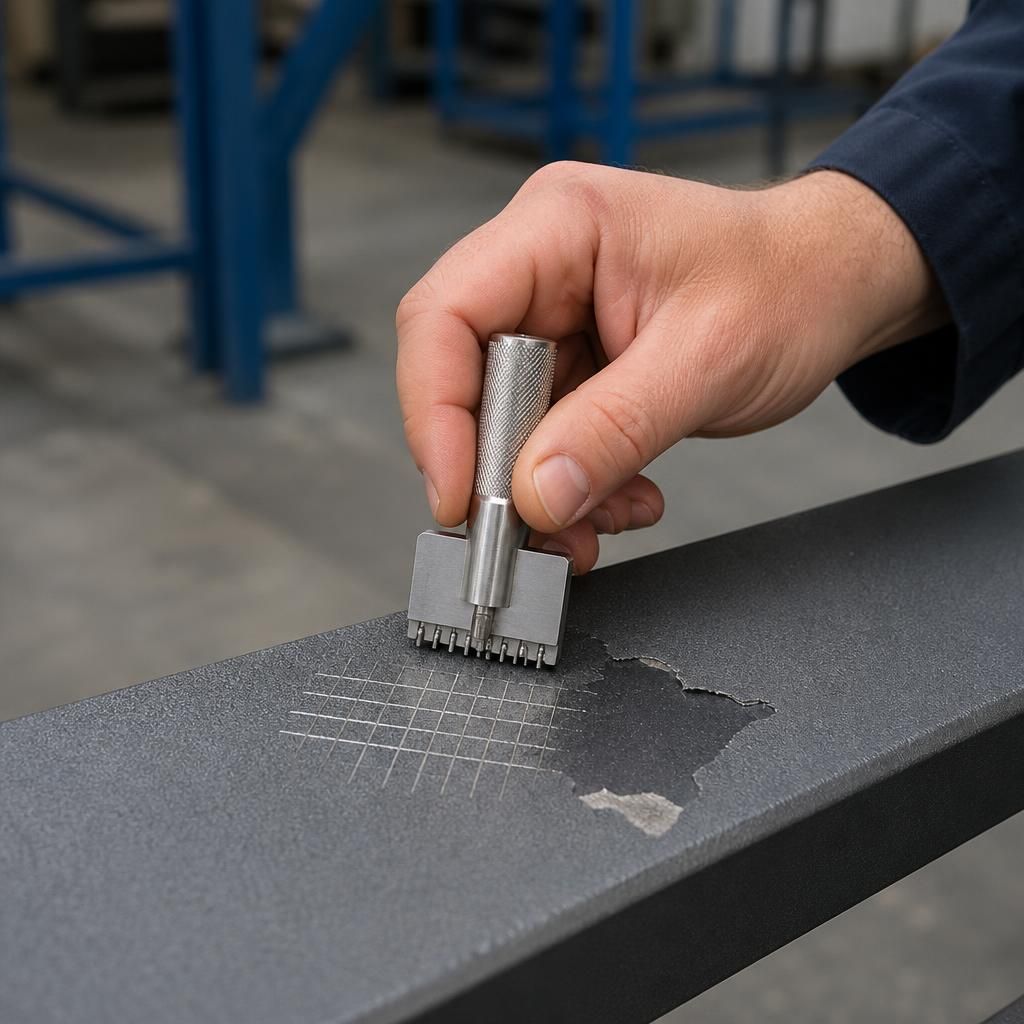
Adhesion testing can confirm whether the prepared surface has provided a sound foundation for the powder coating. A coating that separates cleanly at the metal interface may indicate inadequate preparation, contamination or an unsuitable surface profile, whereas failure within the coating itself points to a different problem in the powder or curing process.
For this reason, inspection should consider both the appearance of the blasted metal and the performance of the cured coating. Checking representative areas, including edges, welds and repaired sections, helps identify local preparation defects that may not be visible across the main surface. The results can then be used to refine blasting settings and coating controls for subsequent components in the batch.
Discuss your powder coating adhesion requirements
Discuss your powder coating adhesion requirements with powder-coatings.co.uk, including the component material, existing finish and any areas requiring careful preparation. This information helps establish a suitable blasting and coating approach for the repair.