

How can I ensure optimal adhesion of nylon coatings on irregular metal surfaces?
Ensure optimal adhesion by thoroughly degreasing the metal, removing rust and oxides, and applying a uniform mechanical key across faces, recesses, edges and other difficult-to-reach areas. Control the substrate temperature, nylon powder application and curing cycle so the coating reaches every part of the irregular profile without creating thin spots, runs or under-cured areas.
Optimal adhesion of nylon coatings on irregular metal surfaces depends on controlling the complete coating system rather than relying on surface roughness alone. The substrate, component geometry, pretreatment, application method, powder deposition and curing conditions must be compatible, with particular attention given to recesses, welds, holes, corners and changes in section.
Assess the component before choosing the coating process. A drawing or sample inspection should identify features that can interfere with powder coverage or create local adhesion risks. Deep recesses may shield areas from the powder cloud, while narrow cavities can retain air or cleaning residues. Sharp edges can produce a thinner film than adjacent faces, and enclosed sections may require suitable venting and drainage. Where the design permits, radiusing sharp edges, avoiding abrupt transitions and providing access for cleaning and coating will make a more consistent finish achievable.
Welded areas deserve separate consideration. Weld spatter, porous welds, flux residues and uneven weld profiles can interrupt the coating interface. Welds should be continuous where required, free from visible contamination and blended sufficiently for the intended finish. Any crevice that can hold moisture or processing residue may become a local weakness beneath the nylon layer, even when the surrounding metal is suitable for coating.
Match pretreatment to the metal and its condition. Different substrates, including steel, galvanised steel and aluminium, can require different chemical or mechanical preparation. The purpose is not simply to make the surface look clean; it is to create a stable, compatible interface that will not react adversely with the nylon coating. Pretreatment residues must be removed or properly converted according to the chosen system. If a component has previously been painted, plated, oiled or exposed to chemicals, the existing finish and contamination should be identified before processing rather than assuming that standard preparation will be sufficient.
Substrate history is particularly important for irregular parts. Oils can remain in seams, pores and machined pockets, while fabrication compounds may be concentrated around welds or formed sections. Components should therefore be inspected after preparation, including the less visible faces. A visually acceptable broad surface does not confirm that the base of a recess or the inside of a hole is ready for coating.
Control powder deposition around the profile. Electrostatic application can be affected by the shape of the part. Recessed areas and internal corners may receive less powder because of the Faraday cage effect, in which the electrical field concentrates around exposed edges and restricts powder penetration into enclosed areas. Application settings and gun positioning should be adapted to the geometry rather than treating every face identically. Angling the gun, changing the distance and applying powder progressively to difficult areas can help balance coverage across exposed and shielded surfaces.
Grounding and component presentation are also important. The part must make reliable electrical contact with the hanging system, and contact points should be selected so they do not prevent coating of a critical adhesion area. Fixtures should support the component without creating sheltered zones or allowing it to move during application. For complex batches, consistent orientation and repeatable hanging positions help prevent differences in coverage between nominally identical parts.
Some irregular components benefit from a staged application approach. Difficult internal faces may be addressed before the more accessible external faces, followed by a controlled pass to even out the overall deposit. Excessive powder build-up at edges, corners or low points should be avoided because a heavy deposit can flow unevenly or cure differently from the surrounding film. The target is a continuous, appropriately built coating rather than maximum powder deposition.
Keep the curing cycle consistent throughout the component. Nylon powder must reach the specified curing conditions at the metal surface, not merely at the oven air temperature. Thick sections, heavy welds and dense assemblies can heat more slowly than thin projections, while recessed areas may experience different heat transfer conditions. The coating specification should therefore define the required metal temperature and dwell period, with the oven process checked against the largest or most thermally demanding parts in the batch.
Loading patterns can influence this result. Parts packed too closely together may restrict airflow and create differences in heating, while large components can alter the thermal balance within the oven. Fixtures, masking materials and any inserts should also be suitable for the curing conditions and should not shield critical coating areas. Where the geometry is unusually complex, a trial component or representative test piece can help confirm that the selected process produces a sound finish across the full profile.
Verify adhesion on representative features, not only on flat panels. Inspection should include recesses, edges, welds, holes and areas close to hanging points. Depending on the specification, adhesion can be assessed using a cross-cut method, pull-off testing or another agreed procedure. Visual inspection should look for pinholes, exposed substrate, cratering, bubbling, uneven coverage and signs of poor flow. These checks are most useful when performed on parts or test pieces that reproduce the actual metal type, thickness and geometry.
If adhesion is inconsistent, the investigation should separate the possible causes: substrate contamination, unsuitable pretreatment, inadequate electrical contact, shielding during powder application, excessive or insufficient coating build, or an incomplete cure. Recording the component orientation, preparation route, application settings and oven conditions makes it easier to identify a recurring pattern and correct the process without changing several variables at once.
For manufacturers and fabricators, supplying accurate drawings, substrate details, previous coating information and representative samples is valuable when irregular parts are being assessed. Powder-coating specialists can then determine where the geometry presents an adhesion risk, recommend suitable preparation and confirm the inspection criteria before processing the full batch.
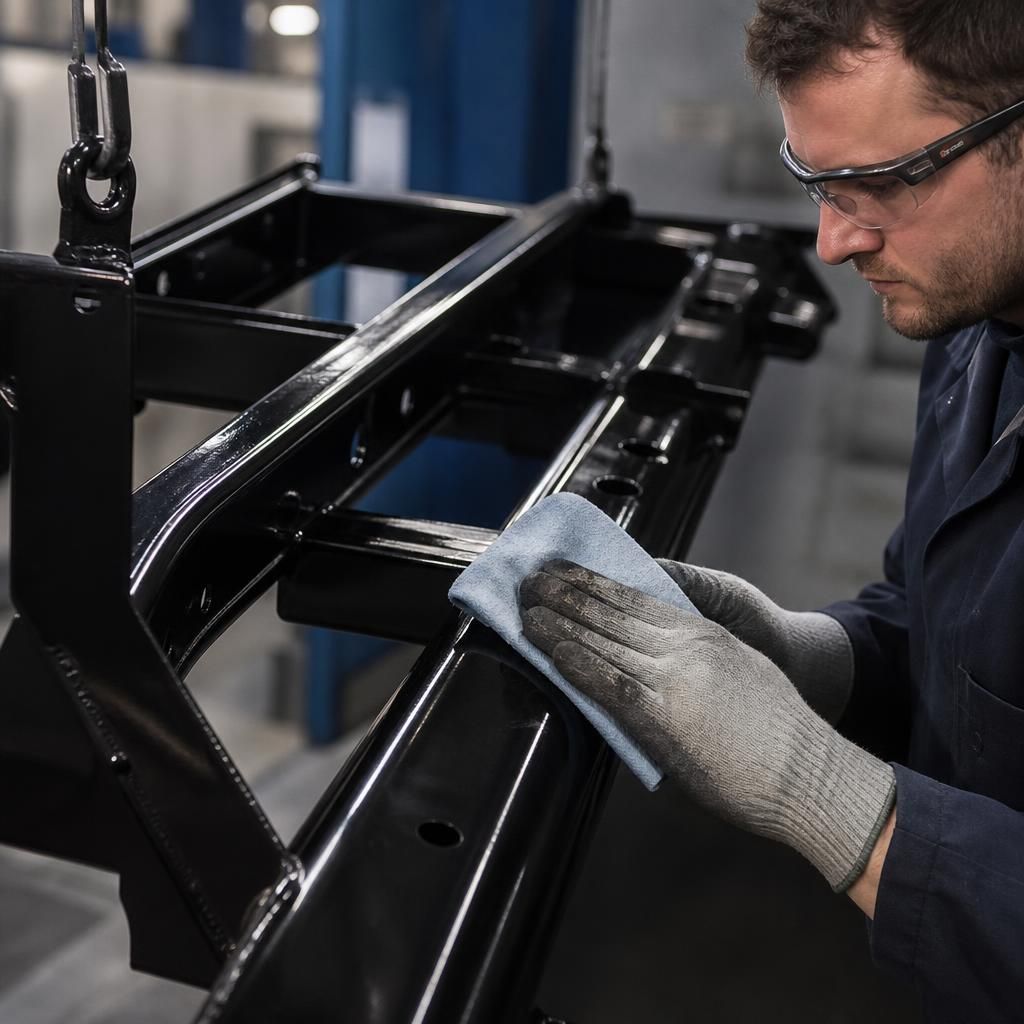
Maintaining the prepared surface between pretreatment and nylon application is essential for adhesion on irregular metalwork. Fingerprints, dust, silicone residue and condensation can settle in recesses, around welds or along edges where they are difficult to detect and remove once the component is assembled for coating.
Handle prepared parts with clean gloves and suitable fixtures, avoiding contact with areas that will receive the coating. Keep components protected from moisture and airborne contamination, and inspect them again immediately before powder application. If a part has been stored, transported or touched after preparation, its condition should be reassessed rather than assuming that the original cleaning remains effective. This simple control prevents local contamination from becoming a hidden weakness beneath an otherwise sound nylon finish.