

What colour options are available for nylon coatings and how do they affect the final appearance?
Nylon coatings are available in a range of solid colours, with the selected shade combined with finishes such as smooth, textured or low-gloss to create the required appearance. Colour and finish affect how uniform, reflective and visually substantial the coated metal looks, while the component’s shape, surface preparation and coating thickness can also influence the final result.
Nylon coating colour options are determined by the pigments and powder formulation used, while the final appearance depends on how those pigments interact with the coating’s surface characteristics and the underlying metal. A chosen colour can therefore look different according to its opacity, depth, gloss level, surface texture and the viewing conditions.
Common nylon coating colour choices
- Black and dark shades: These generally give components a solid, defined appearance and can make surface marks less visually prominent. On large or contoured parts, however, variations in reflection may still be noticeable.
- White and light shades: These create a brighter appearance and make the overall coverage easier to assess visually. Contamination, handling marks and uneven preparation can also be more apparent on pale colours.
- Mid-tone colours: Blues, greens, reds, greys and similar shades provide a balance between visual definition and practical concealment of minor handling marks. The same colour family can appear substantially different when its surface sheen changes.
- Custom or project-specific shades: Where a particular colour is needed for identification, coordination or an established visual standard, the reference should be agreed before coating. A physical sample is more reliable than judging a shade from a screen or printed image.
Opacity and colour depth
Opaque nylon coatings conceal the metal beneath them and produce the most consistent block-colour effect. The perceived depth of an opaque shade is influenced by the amount of light it absorbs or reflects. Dark colours can look flatter in low light and more reflective under strong lighting, while lighter colours often appear softer or brighter.
Some coating systems may offer a degree of translucency or a less dense visual effect, but these should be assessed carefully. The underlying metal, welds, machining marks or previous finish can remain visible and alter the apparent colour. This can be useful when the substrate is intended to contribute to the appearance, but it is unsuitable where a uniform, fully concealed finish is required.
How the surface changes the perceived shade
Two components coated with the same nylon colour can appear different if one has a more reflective surface and the other scatters light. A reflective surface tends to show highlights and stronger changes as the viewing angle moves. A less reflective surface usually presents a more consistent shade across the component, although its texture may make the colour appear lighter, darker or more muted.
Edges, corners, recesses and broad flat areas should be considered when selecting a colour and finish together. Light can collect on edges and reflect differently from recessed sections, creating apparent variation even when the coating colour is consistent. This is a visual effect rather than necessarily a colour defect.
Colour matching and approval
For production work, the required colour should be specified using an agreed reference, sample or coating standard. A sample panel or representative test piece can help confirm the result before a full batch is processed. It allows the colour, opacity and surface appearance to be assessed under lighting similar to that in the final installation or inspection area.
Colour matching should also account for the component’s intended use. Parts that must be visually identified may benefit from a distinct, high-contrast shade. Components intended to blend into machinery, architectural metalwork or existing equipment may require closer coordination with surrounding materials. If several parts are to be assembled together, they should be assessed as a group rather than separately.
Factors that can cause apparent variation
- Different lighting conditions, including daylight and artificial lighting, can change how a shade is perceived.
- Viewing angle can alter highlights on curved or reflective surfaces.
- Differences in the metal substrate or in previously repaired areas can affect the visual result where the coating is not fully opaque.
- Coating build and curing conditions need to remain consistent across a batch to help maintain a repeatable appearance.
- Adjacent colours can influence perception; a neutral shade may look warmer or cooler beside another colour.
For that reason, colour selection should be treated as a combination of shade, opacity and surface appearance rather than as a colour name alone. Providing the coating requirement, reference sample, component geometry and intended environment gives the applicator the information needed to assess whether the proposed nylon coating will produce the required final look.
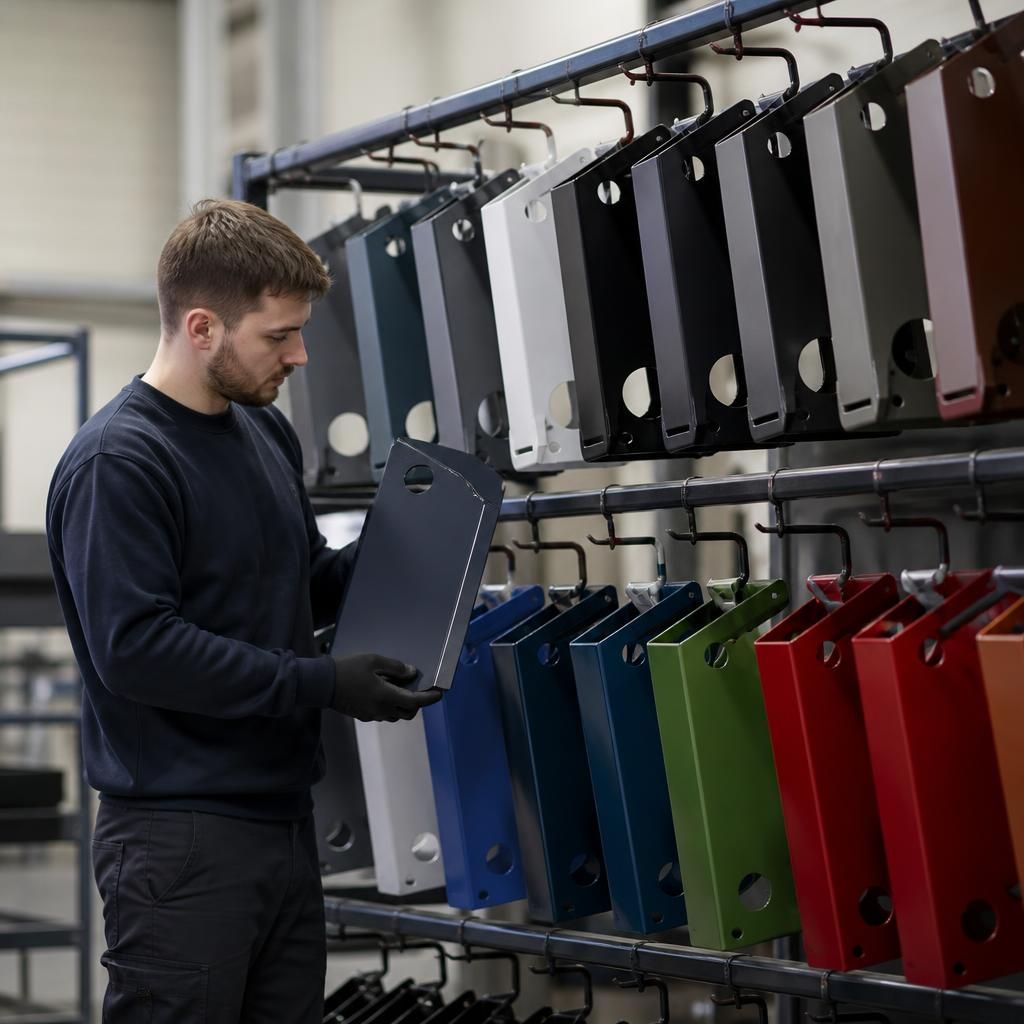
Nylon coating colour can affect how prominent a metal component appears within a larger assembly. Dark shades tend to recede visually, while lighter or more saturated shades attract attention and make the part easier to distinguish. This changes perception only; it does not alter the component’s physical dimensions.
For machinery, guards and fabricated assemblies, the colour can therefore be selected to control visual emphasis as well as appearance. A subdued shade may help the component blend with surrounding metalwork, whereas a contrasting shade can make a specific part easier to identify during inspection or maintenance.