

How does the curing process work in epoxy powder coating?
Epoxy powder coating cures after application when the coated metal is heated in an oven, causing the powder to melt, flow and chemically cross-link into a continuous protective film. The required curing schedule depends on the coating formulation, metal temperature, coating thickness and component geometry, so the part must reach the specified temperature for the required time.
Curing is the controlled thermal reaction that converts applied epoxy powder into a bonded coating film. In practice, this means controlling the part’s actual metal temperature, the time it remains at the coating manufacturer’s specified temperature, and the conditions that allow the coating to develop its intended mechanical and protective properties.
Before curing begins, the coated component is checked for suitable coverage, contamination, excessive powder build-up and correct masking. Any dirt, oil, moisture or preparation residue can interfere with the coating as it melts and forms a film. Components may also be positioned to prevent contact marks, trapped powder or areas that are shielded from the oven’s heat.
The oven is heated to the required operating condition, but the oven-air temperature is not the same as the curing temperature of the component. A metal part needs time to absorb heat, and thicker, heavier or more complex parts generally take longer to reach the required temperature than thin sections. The effective cure cycle is therefore based on the temperature of the metal rather than simply the time since the component entered the oven.
As the component heats, the epoxy particles soften and join together. The coating then levels across the surface, reducing the separate-particle appearance and forming a continuous film. The resin and curing agent react during this stage, creating a cross-linked structure. This chemical reaction is what gives the finished coating its hardness, adhesion and resistance properties; cooling the part alone does not create the same result if the required thermal cycle has not been completed.
Industrial coaters assess the curing schedule against the powder manufacturer’s technical data. The relevant information normally includes a specified metal temperature and a corresponding dwell period. These instructions must be interpreted alongside the component’s mass, wall thickness, shape, hanging arrangement and the amount of material loaded into the oven. A heavily loaded oven or closely spaced components can affect heat circulation and may require the process to be checked carefully.
Several process controls help confirm that curing has taken place consistently:
- Temperature monitoring: temperature-recording equipment or probes can be used to establish how quickly representative parts heat up and whether colder areas reach the required condition.
- Cycle control: the dwell period is measured from the point at which the metal reaches the specified temperature, not automatically from the moment the part enters the oven.
- Oven uniformity: airflow and temperature distribution are reviewed so that different positions within the oven do not produce materially different results.
- Part positioning: components are arranged to expose coated surfaces to the heated airflow while avoiding contact between wet or softened films.
- Finished-coating inspection: the cured surface is examined for visual defects, adhesion and other project-specific requirements.
Under-curing occurs when the coating does not receive enough heat or time for the cross-linking reaction to develop fully. Possible symptoms include reduced hardness, poor chemical resistance, weak adhesion or a finish that does not meet the required performance specification. Over-curing or excessive heat exposure can also be undesirable, particularly where the coating colour, gloss or substrate properties are sensitive to the process. The correct objective is not the highest possible oven temperature, but a controlled cycle matched to the powder and component.
Component design and substrate construction can affect the cure in practical ways. Heavy welded assemblies, enclosed sections, folded metal and parts with significant differences in thickness may heat unevenly. Recesses and internal faces can also receive less direct airflow. These areas should be considered when selecting monitoring points and deciding how the component is loaded and supported.
After the required cycle, the component is removed and allowed to cool under controlled conditions before handling, packing or further assembly. Handling a part while the film is still soft can create marks or damage the surface, even where the chemical cure is complete. If the coated item forms part of a larger assembly, the curing process must also account for masking, inserts, threaded areas, dimensional tolerances and any materials that cannot tolerate oven heat.
For a B2B coating project, the most useful information to establish before processing is the epoxy powder’s technical data, the metal specification, the thickest and heaviest sections, the required film build and any areas that must remain uncoated. Reviewing these details allows the curing cycle to be selected and checked against the actual components rather than relying on a nominal oven setting.
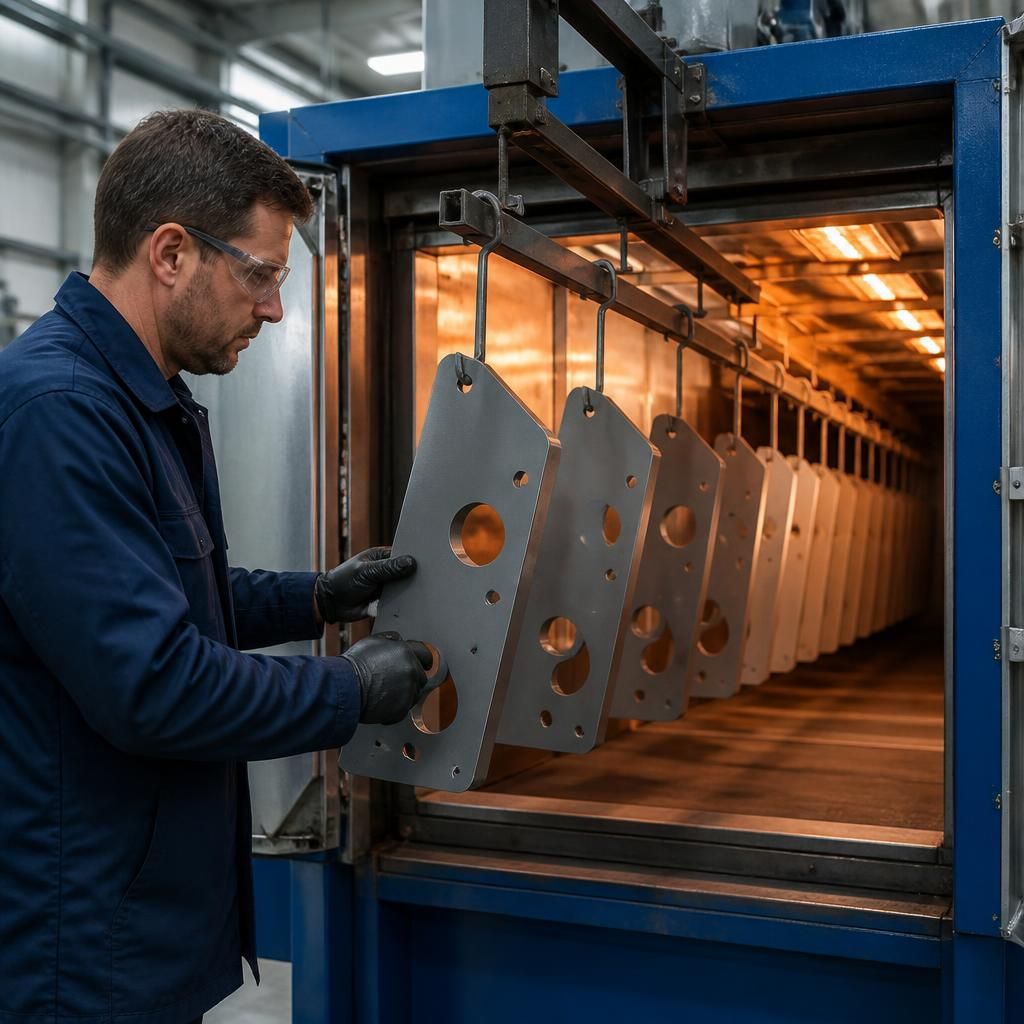
A practical consequence of epoxy powder coating curing is that the finished film cannot simply be melted and reset if a defect is found. Once the resin has cross-linked, correction normally involves removing the coating, preparing the exposed metal again and applying a new coating cycle. Inspection before curing is therefore important, particularly around edges, apertures and masked areas.
Cured film thickness can also affect fit and assembly. Threaded holes, mating faces, bearing seats and close-tolerance interfaces may need suitable masking or design allowance so that the coating does not obstruct assembly. These details should be identified before the component enters the oven, rather than treated as a correction after curing.