

How does the curing process enhance the durability of thermoset powder coatings?
Curing enhances thermoset powder coatings by heating the applied powder until it melts, flows across the metal surface and chemically crosslinks into a hard, continuous film. This crosslinked structure strengthens adhesion and improves resistance to impact, chemicals, corrosion and wear compared with uncured powder.
The curing stage enhances thermoset powder coating durability by converting the deposited powder into a stable, three-dimensional polymer network. A controlled thermal cycle allows the coating chemistry to complete its reaction, producing a film with consistent mechanical and protective properties rather than a layer that is merely melted onto the component.
Curing takes place in several overlapping stages. The powder first softens and becomes fluid, allowing the individual particles to merge. The coating then gels as the resin and curing agent begin to react. Further exposure to the required temperature develops the crosslinked structure throughout the film. Once the reaction is sufficiently advanced, the coating becomes a solid, continuous finish with limited ability to soften again when reheated. This is the defining behaviour of a thermoset coating.
The curing schedule must be matched to the specific powder formulation and the component being coated. The relevant temperature is normally the temperature reached by the metal itself, not simply the temperature displayed by the oven. The required combination of metal temperature and dwell time allows heat to penetrate the part and complete the reaction across the full coating thickness. If the surface reaches the target temperature but recessed areas, brackets or heavier sections remain cooler, the finish may not cure uniformly.
- Under-curing: insufficient heat or dwell time can leave the coating with reduced hardness, adhesion and resistance to chemicals, moisture and wear. It may also affect appearance and make the film more susceptible to marking during handling or service.
- Correct curing: the coating develops the intended balance of hardness, flexibility, impact resistance and protective performance for the chosen formulation.
- Over-curing: excessive temperature or prolonged exposure can alter colour and gloss and may make some coatings less flexible. This is particularly relevant where appearance, forming or impact performance is important.
Durability also depends on the coating reaching the substrate in a suitable condition before the cure begins. Oil, moisture, corrosion products, dust and other contaminants can interrupt contact between the coating and the metal. Curing cannot compensate for contamination, poor surface preparation or an unsuitable film thickness. The thermal cycle therefore forms one part of a wider process that includes preparation, application control and appropriate handling after the component leaves the oven.
Film thickness has a practical effect on curing. A heavy deposit may require more time for the heat to pass through the film, while an excessively thin or uneven deposit may provide insufficient protection at exposed edges and high-wear areas. The component’s shape also matters: enclosed sections, joints, folds and areas around fixings can heat differently from broad, exposed surfaces. Parts should be arranged so that air circulation and heat transfer are as consistent as possible, while avoiding contact marks before the coating has cooled and hardened.
For batch and industrial work, process control helps confirm that the intended cure has been achieved repeatedly. Useful checks may include:
- calibrating and monitoring oven temperature controls;
- checking the metal temperature and dwell time for representative components;
- inspecting coating coverage, thickness and visual uniformity;
- carrying out appropriate adhesion, hardness or solvent-resistance checks where the specification requires them; and
- reviewing the cure schedule when the powder formulation, component mass, loading pattern or coating thickness changes.
These controls are especially important when components vary considerably in size or mass. A schedule suitable for a light fabricated part may not deliver the same result on a large or thermally dense component. Establishing the process against the actual part, rather than relying only on nominal oven settings, reduces the risk of inconsistent performance between batches.
The result of a properly controlled cure is not simply a harder surface. The finished film has a more stable chemical structure, allowing it to retain its protective and decorative properties under the combination of handling, weathering, chemicals, impact and abrasion expected in service. The appropriate cure must still be selected alongside the right resin system, substrate preparation and coating specification, because thermal treatment can only develop the properties designed into that particular thermoset powder.
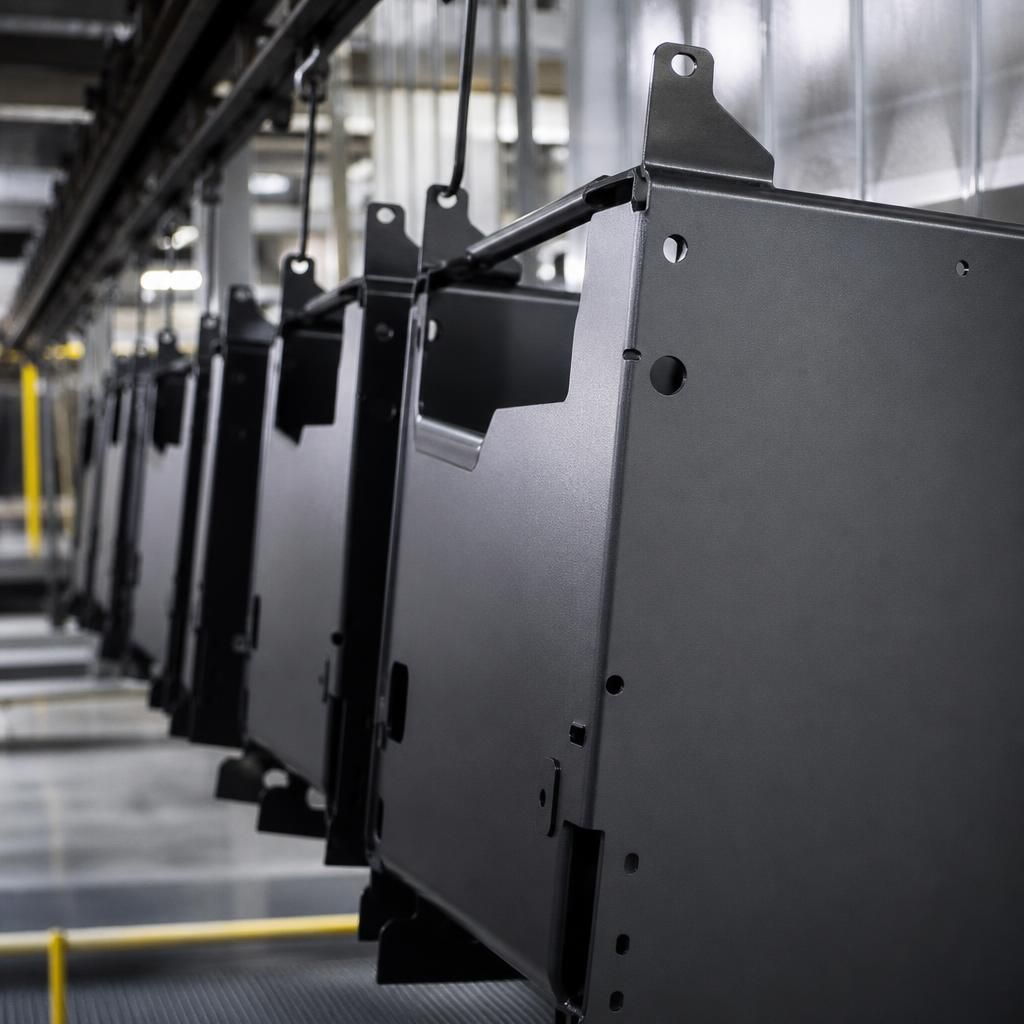
A properly cured thermoset coating also provides greater dimensional stability during service. The crosslinked film is less likely to soften, flow or become tacky when the coated component experiences moderate heat, helping it retain a consistent protective layer around edges, joints and formed sections. This is important for industrial parts exposed to changing temperatures, where repeated heating and cooling can otherwise contribute to surface movement or loss of film integrity. The actual temperature resistance still depends on the powder formulation and the conditions specified for the component.
Discuss your thermoset powder coating requirements
If you are assessing how a thermoset powder coating will perform on your components, discuss the part design, operating conditions and required finish with our team. Share your coating requirements to identify a suitable process and specification for your application.