

What are the main advantages of using epoxy powder coating for industrial steel applications?
Epoxy powder coating gives industrial steel a tough, well-adhered barrier against moisture, corrosion, abrasion and many chemicals. It also produces a consistent, uniform finish with efficient material application, making it suitable for components that require durable protection in demanding industrial environments.
For industrial steel, epoxy powder coating offers a hard, strongly bonded thermoset finish that protects the prepared substrate while providing useful electrical, mechanical and processing advantages. Its main value is that the coating becomes a continuous cross-linked film during curing, rather than remaining as a soft or easily re-dissolved layer.
Strong adhesion to prepared steel
Epoxy powder is designed to bond closely to correctly prepared steel. This helps the coating remain attached when components are handled, assembled or exposed to changes in operating conditions. The result depends heavily on preparation: oil, mill scale, rust, weld residues and other contaminants must be removed, and the surface profile must be suitable for the specified coating system. Correct curing is equally important, because insufficient or excessive heat can affect the final film properties.
Hardness and dimensional stability
Once cured, epoxy forms a hard film with good resistance to indentation and surface wear. This can be valuable for steel enclosures, brackets, machine components, frames and fabricated parts that need a protective finish without introducing a thick, soft or flexible layer. The cured coating is also dimensionally stable, so it is suitable where a predictable finished surface is required around holes, edges and mating components. Coating thickness still needs to be controlled around close-fitting assemblies and threaded areas.
Electrical insulation
Epoxy is electrically insulating, which can make it appropriate for certain steel housings, cabinets, supports and other components where the substrate should be isolated from an adjacent conductive part. This is not automatically equivalent to an approved electrical insulation system. The required coating formulation, film thickness, dielectric performance and test regime must be specified according to the component’s design and operating conditions.
Effective coverage of complex fabricated parts
Powder application can coat external faces, corners and recessed features without the runs and sags associated with poorly applied liquid finishes. However, geometry still affects the result. Deep recesses, narrow gaps, sharp edges, Faraday-cage areas and enclosed sections may receive less powder unless the application process is adjusted. Parts should therefore be reviewed before production, particularly when they contain folded sections, perforations, welds or difficult-to-reach surfaces.
Repeatable industrial processing
Powder coating supports a controlled production process. The coating is applied as a dry powder, then heated so the particles melt, flow and chemically cross-link. This allows the applicator to control key variables such as surface preparation, powder deposition, metal temperature, curing conditions and final film thickness. For batch work, these controls help produce repeatable results across comparable steel components, provided that the part dimensions and thermal mass are taken into account.
Reduced reliance on solvent-based application
Epoxy powder is supplied as a dry coating, so it does not require the same liquid solvent content as many conventional wet-paint systems. This can simplify handling and reduce solvent-related emissions during application. It does not remove the need for appropriate extraction, housekeeping and personal protective equipment: airborne powder must still be controlled, and the curing process requires suitable industrial equipment.
Useful finish options for functional components
Epoxy systems can be selected in formulations suited to different levels of hardness, flexibility, film build and service exposure. This makes the material useful for functional steelwork where protection and performance are more important than a decorative exterior finish. The selected grade should be matched to the component’s temperature, exposure, handling method and expected service conditions rather than chosen solely by colour or appearance.
Important limitation: exterior exposure
Epoxy’s principal limitation is its relatively poor resistance to prolonged ultraviolet exposure compared with coatings designed specifically for exterior weathering. Direct sunlight can lead to chalking, loss of gloss and colour change, even where the underlying steel remains protected. For outdoor steelwork, an epoxy primer or base layer may be combined with a compatible weather-resistant topcoat, often as part of a multi-layer specification. The correct system depends on the exposure and the required appearance.
In practice, epoxy powder coating is most advantageous when steel requires a hard, well-adhered and process-controlled finish for indoor, covered or suitably overcoated industrial service. A sound specification should define the steel condition, preparation standard, coating system, target thickness, curing requirements, component geometry and environmental exposure before production begins.
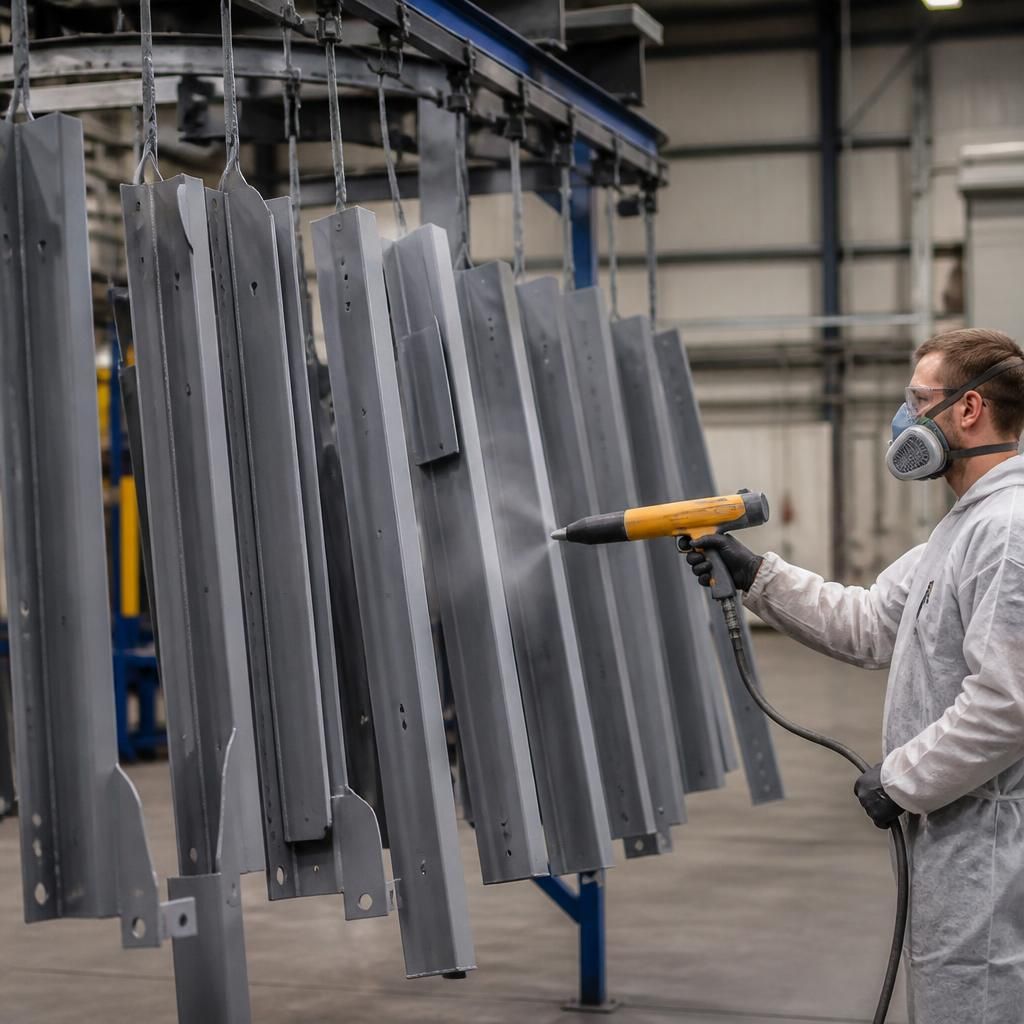
One practical advantage of epoxy powder coating is that the dry powder can be applied without mixing liquid components or managing solvent evaporation between coats. This supports a more controlled coating specification for repeat batches of steel parts, with the applicator able to define the preparation, powder grade, film thickness and curing requirements in advance. Unused powder may also be recoverable in suitably designed application systems, although recovery arrangements depend on the equipment and coating process.
Assess Epoxy Powder Coating for Your Industrial Steel
Discuss your steel components with Powder-coatings.co.uk to assess whether epoxy powder coating suits their geometry, service environment and required finish. The team can advise on a suitable coating specification and collection or delivery options for businesses across the Midlands.