

How do different black powder coat textures affect the performance and appearance of metal components?
Black powder coat texture affects both how a metal component looks and how it performs in service. Smooth, satin and textured finishes differ in light reflection, tactile character, ability to disguise minor surface irregularities and ease of cleaning, while the coating system and preparation remain important to overall durability.
Black powder coat texture affects performance mainly through the way the coating’s surface interacts with handling, abrasion, contamination and inspection; it does not, by itself, determine corrosion resistance or service life. A finely textured, heavily textured, wrinkle or lightly textured finish may change the component’s visual character and practical behaviour, but the complete coating system, metal preparation, film build and curing process remain decisive.
Fine-textured finishes provide a controlled surface pattern that is more visually forgiving than a completely level finish. They can reduce the prominence of minor substrate marks, small handling scuffs and slight variations in reflection. This makes them useful for housings, brackets, frames and other components where a uniform industrial appearance is required without a highly reflective surface. The texture should not, however, be used to conceal poor fabrication, contamination, weld defects or inadequate preparation. Surface imperfections that affect adhesion or corrosion protection must be corrected before coating.
Heavier textures and wrinkle finishes create a more pronounced tactile effect. Their irregular surface can make scratches and local wear less conspicuous from normal viewing distances, which may be useful on equipment subject to frequent handling. The same profile can retain more dust, oil or process residue than a relatively level finish, particularly around recesses in the texture. Components installed in dirty environments may therefore require more deliberate cleaning methods and closer attention to access around fixings, folds and joints.
Smooth or lightly textured black finishes generally give a cleaner, more precise visual definition to formed edges, apertures, logos and machined details. They are often easier to wipe and inspect because the surface has fewer recesses. This can be valuable where cleanliness, visual inspection or the identification of small surface defects matters. A level finish also makes variations in substrate condition more visible, so preparation quality becomes especially important.
Texture also influences how black is perceived. A more level surface can produce sharper highlights and a clearer reflection, whereas a pronounced texture breaks up reflected light and gives the component a softer, more diffuse appearance. Two coatings described as black may therefore appear different when viewed beside one another if their texture, gloss level, film build or curing history differs. For assemblies containing parts coated at different times, specifying the same colour alone may not produce a visually consistent result.
The effect of texture on durability needs to be assessed carefully. A textured powder coat is not automatically more resistant to impact, abrasion, chemicals or weathering than a smooth coating. Those properties depend on the resin chemistry, pretreatment, powder specification, applied film thickness and cure. A texture may help disguise superficial wear, but it cannot prevent damage that breaks through the coating. Once the metal is exposed, the risk of corrosion depends on the environment and the protection provided by the overall system.
Texture can also affect how damage develops and is assessed. On a smooth surface, a scratch, pinhole or loss of adhesion is usually easier to identify. On a coarse surface, small defects may be less obvious visually, while contamination or moisture may remain in surface recesses. For safety-critical, hygienic or tightly inspected components, the ability to examine the coating may be more important than the additional visual masking offered by a heavy texture.
For outdoor or demanding industrial use, the texture should be selected alongside the exposure conditions rather than as a purely decorative choice. Consider:
- Whether the component will be exposed to sunlight, moisture, salt, chemicals, abrasion or repeated handling.
- How easily the surface can be reached for inspection and cleaning once installed.
- Whether the application needs a deliberately low-reflection appearance or a sharper, more defined finish.
- Whether adjacent parts must match in colour, gloss and texture, including parts supplied in separate batches.
- Whether the metal has complex folds, edges, welds or recesses that require careful preparation and consistent coating coverage.
The coating specification should state more than “black powder coat”. It should identify the required colour reference, gloss or surface character, texture grade where relevant, substrate and preparation requirements, intended environment and acceptance standard. A physical sample or approved reference panel is useful when appearance is important, because terms such as fine texture, sand texture, wrinkle and matt can be interpreted differently between coating systems.
Before production, representative parts or test panels can be used to confirm that the selected texture covers the required areas consistently and provides the expected appearance after curing. This is particularly relevant for large components, visible assemblies and batches containing different metal thicknesses. Consistent preparation, application and oven curing help prevent variation that might otherwise be attributed incorrectly to the texture itself.
In practical terms, choose a fine or pronounced texture when visual masking and a subdued industrial appearance are useful, but check that its surface profile will not hinder cleaning or inspection. Choose a smoother finish where wipe-clean access, sharp detail and straightforward defect detection have greater importance. In every case, texture should be treated as one part of the specification; the coating chemistry and preparation system are what principally establish protection of the metal.
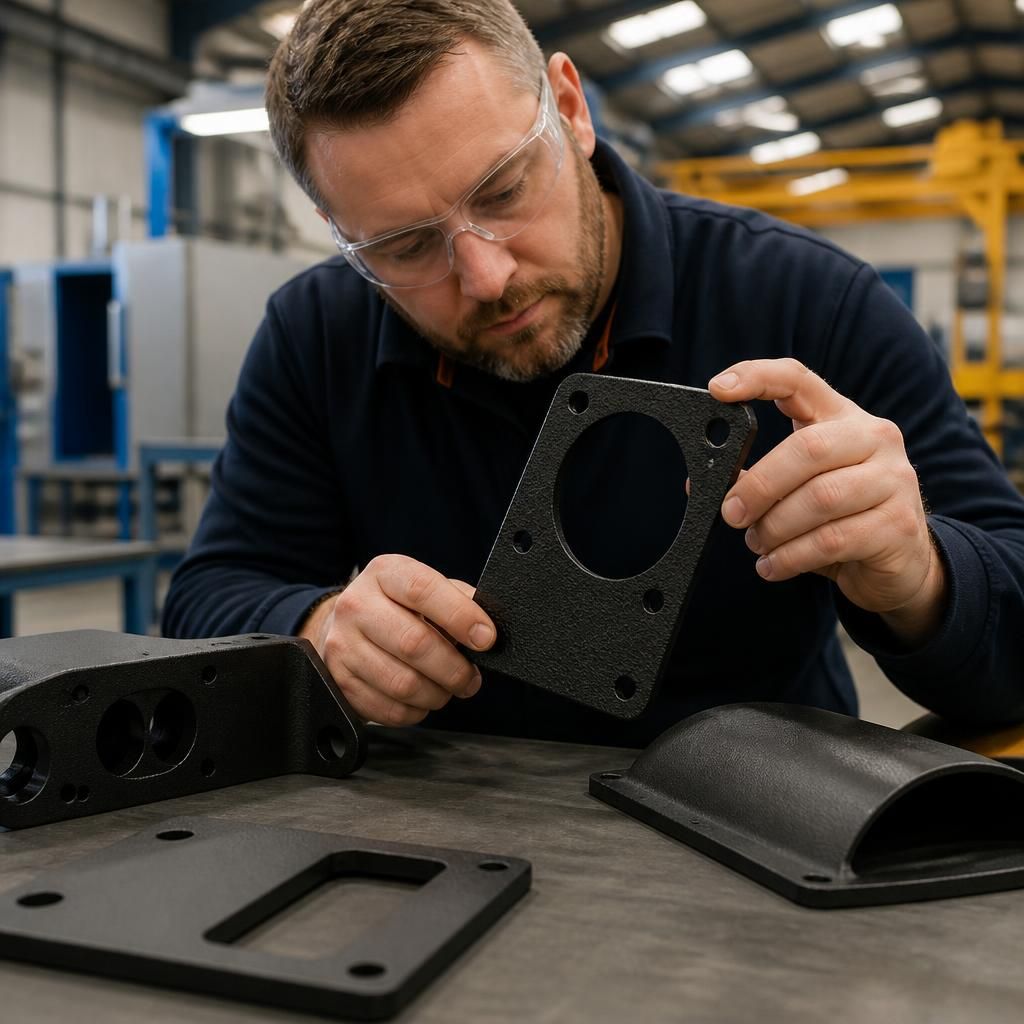
Black powder coat texture can affect the fit and operation of components where coated surfaces meet, move or connect. A pronounced texture creates a less uniform contact surface than a smooth finish and may be unsuitable across close-fitting interfaces, threaded sections, bearing seats, hinge points or electrical contact areas unless these regions are masked or otherwise allowed for in the specification.
Texture can also influence how coating builds up around edges, apertures, folds and recessed details. Before production, identify surfaces that must remain dimensionally precise and define the required masking, coating boundaries and permissible build. This helps preserve assembly tolerances while allowing the visible faces to use the required smooth, satin or textured black appearance.