

How do speciality powder coatings differ from standard powder coatings in terms of performance and application?
Standard powder coatings provide a general-purpose decorative and protective finish, while speciality powder coatings are formulated for specific performance requirements such as enhanced abrasion resistance, flexibility, chemical resistance, corrosion protection or high-temperature use. Their application may also require a more closely controlled choice of pre-treatment, coating thickness, curing conditions and equipment to suit the substrate, component design and selected coating chemistry.
Speciality powder coatings are differentiated by the service conditions they are engineered to withstand, whereas standard powder coatings are generally selected for broad decorative protection. The important distinction is not simply the powder’s appearance: it is the balance of mechanical, chemical, thermal, electrical and environmental properties required from the finished coating, together with the process needed to achieve those properties consistently.
Performance is usually more targeted. A standard coating may be suitable where the main requirements are an even colour, a clean appearance and general resistance to handling and everyday exposure. A speciality formulation may instead be chosen for a particular combination of demands, such as:
- repeated impact, abrasion or sliding contact;
- exposure to oils, fuels, solvents, cleaning agents or other chemicals;
- prolonged outdoor exposure, ultraviolet radiation or corrosive atmospheres;
- contact with moisture, salts or aggressive industrial contaminants;
- operation at elevated or fluctuating temperatures;
- electrical insulation, controlled friction or reduced surface damage; or
- greater flexibility where the component may flex, deform or experience vibration.
These characteristics are formulation-dependent. A coating designed for wear resistance may not provide the best ultraviolet stability, while a coating selected for high-temperature service may have different appearance, flexibility or processing requirements. The correct comparison therefore considers the complete operating environment rather than treating all speciality coatings as a single category.
Standard coatings are often easier to specify for general-purpose work. Their established use across common metal components can make colour, finish and routine production requirements relatively straightforward to define. Speciality coatings require a more precise specification: the substrate, expected loading, contact materials, exposure conditions, permissible coating build, operating temperature and cleaning regime can all affect the choice. A coating that performs well on a static enclosure may be unsuitable for a part subject to constant friction or chemical contact.
Application can differ because the powder and the component must be matched. Electrostatic spray is widely used for powder coating, but some speciality materials or component designs may be better suited to fluidised-bed coating, preheated application or another controlled method. Part size, shape, wall thickness, recesses and areas that must remain uncoated influence how the powder is deposited. Complex profiles can create Faraday-cage effects, where powder is more difficult to deposit evenly in internal corners and deep recesses. This makes gun settings, earthing, component positioning and operator technique particularly important.
Some speciality coatings are applied at a higher film build than a typical decorative finish, while others need a thinner, closely controlled layer to preserve dimensions, movement or electrical characteristics. Excessive build can affect fit, fasteners, threads and moving interfaces; insufficient build can reduce coverage and leave the metal less protected. Masking, racking and contact-point selection may therefore require more planning than for a simple flat component.
Curing requirements also vary between coating types. The relevant condition is the temperature reached by the metal part, not merely the temperature displayed by the oven. Component mass, geometry and loading pattern affect how heat travels through the workpiece. Under-curing can leave the coating with reduced hardness, adhesion or chemical resistance, while excessive heat can affect colour, substrate properties or the coating itself. For specialist work, the curing profile should be checked against the powder supplier’s technical data and confirmed for the actual part.
Application compatibility is equally important when the component includes welds, cast sections, sharp edges, threaded features or materials with different heat responses. Suitable preparation, clean handling and an appropriate pretreatment system help the coating bond reliably, but the selected system must also be compatible with the speciality chemistry and the intended use. Trial pieces or representative test panels can help identify problems with adhesion, coverage, appearance and curing before a full production batch is processed.
In practical terms, standard powder coating is often appropriate when the component needs a dependable general finish and its exposure is well understood. Speciality powder coating becomes more suitable when failure could result from a defined hazard such as wear, chemicals, heat, ultraviolet exposure, corrosion or repeated impact. The choice should be based on the component’s actual duty and validated application conditions, not solely on colour, gloss or the label applied to the powder.
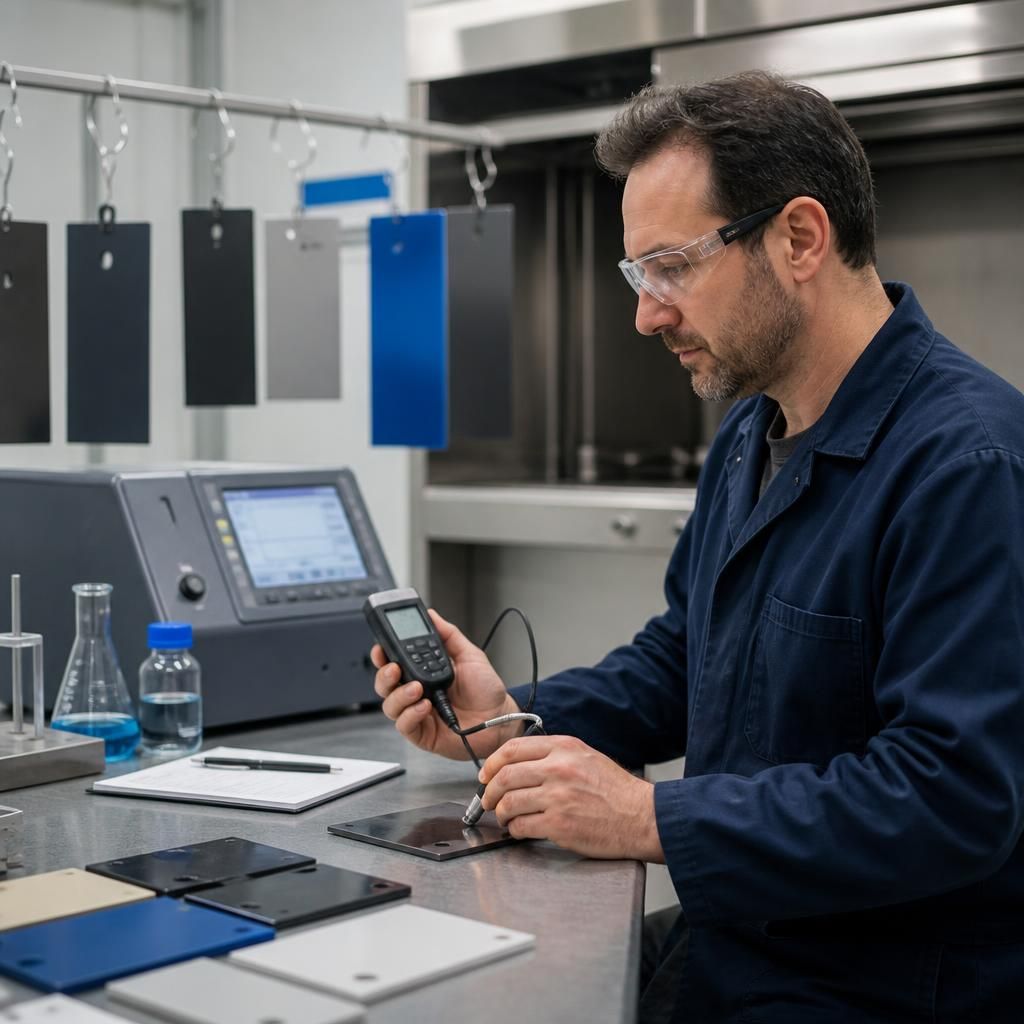
The difference between a standard and speciality powder coating should be assessed from verified performance data, not from the word “speciality” alone. Technical data sheets may report properties such as impact resistance, abrasion resistance, chemical resistance or temperature capability, but the test method, film thickness, substrate and curing conditions can affect the result.
Results should therefore be compared on a like-for-like basis. A high value in one test does not automatically mean that a coating is suitable for every demanding application, and results from different test methods may not be directly interchangeable. It is also important to consider whether the coating retains adhesion, appearance and protection after the relevant exposure rather than only how it performs in an initial test.
For production work, the specification should identify the property that is critical to service and the evidence needed to confirm it. Representative samples can then be assessed against the component’s dimensional, functional and environmental requirements before the selected system is adopted for a full batch.