

How do industrial powder coating services handle large-scale projects and ensure consistent quality across all components?
Industrial powder coating services handle large-scale projects by planning production in batches, standardising surface preparation and coating application, and coordinating collection and delivery for multiple components. Consistent quality is maintained by applying the specified coating system and checking components throughout the process so that parts receive a uniform, durable finish.
Large-scale industrial powder coating projects are controlled through a documented specification, repeatable production methods and inspection at defined stages. The objective is not simply to coat a high volume of parts, but to ensure that every component has the required appearance, coverage, adhesion and protection when the order is completed.
Before processing begins, the coating requirement should be translated into a clear job specification. This normally includes the substrate, component dimensions, required colour and gloss level, coating type, performance requirements, areas that must remain uncoated and any finish-related acceptance criteria. Resolving these points in advance is particularly important where a project contains several component designs, because apparently similar parts may need different hanging, masking or application arrangements.
Component control is another important part of maintaining consistency. Parts can be identified by batch, drawing reference or another agreed system so that different profiles and coating requirements are not mixed. A controlled sequence helps the coating team match each item to the correct preparation and powder specification, while also making it easier to investigate an isolated defect without placing an entire production run in question.
Large components and high-volume orders can introduce practical variables that do not arise in the same way on small parts. Weight, geometry, recessed areas, sharp edges, welds, holes and enclosed sections can all affect how a part is positioned and how powder reaches its surface. Suitable racking and hanging arrangements are therefore used to expose the required faces while limiting contact marks. Where necessary, masking protects threads, mating faces, bearing surfaces and other areas where powder could affect assembly or tolerances.
Surface condition remains fundamental to the finished result. Oil, dirt, rust, mill scale, weld residue and previous coatings can interfere with adhesion or create visible defects. The preparation method must suit the metal and the intended service conditions, rather than being selected solely for convenience. Parts also need to be handled and stored in a way that prevents prepared surfaces becoming contaminated before powder is applied.
Application settings are managed to suit the part rather than treating every component as identical. Surface area, shape, recesses and edge profiles influence powder coverage, while the specified film build must be achieved without excessive accumulation, runs or poor coverage. Particular attention is needed around Faraday areas, such as internal corners and deep recesses, where the electrostatic process can make powder penetration more difficult.
Curing is controlled according to the powder manufacturer’s requirements and the metal component’s characteristics. The relevant condition is the temperature reached by the part itself for the required time, not simply the temperature shown by the oven. Component mass, thickness and loading arrangement can affect heat transfer, so large or varied batches need suitable process control to prevent under-cure, over-cure or differences between sections of the same order.
Quality checks should be proportionate to the project and agreed before production. Typical checks may include:
- visual examination for missed areas, contamination, inclusions, craters, excessive texture and unacceptable colour or gloss variation;
- film-thickness checks at representative locations, taking account of component geometry;
- inspection of edges, recesses, holes, masked areas and contact points;
- confirmation that the coating has adhered correctly where an agreed test is required; and
- review of packing and handling to ensure that finished surfaces are not damaged before delivery.
Inspection records provide evidence that the agreed process has been followed and help separate a coating issue from a substrate, design or handling issue. If a problem is found, affected components can be isolated for assessment rather than allowing potentially unsuitable parts to move into assembly. The appropriate corrective action may involve additional preparation, local repair where technically suitable, or complete stripping and recoating. Rework decisions should consider dimensional tolerances, the coating specification and the component’s end use.
Consistency also depends on communication between the coating specialist and the customer. Drawings, sample parts, colour references, masking diagrams and acceptance standards can remove ambiguity before the first production batch. For repeat work, retaining an agreed specification and recording any approved changes creates a reliable reference for future orders without assuming that a previous finish is suitable for a new substrate or application.
For manufacturers, fabricators, construction businesses and automotive companies, the most useful measure of a large-scale coating service is therefore the strength of its control system. Clear requirements, suitable preparation, controlled application and curing, traceable handling and defined inspection points work together to deliver repeatable results across different component sizes and shapes.
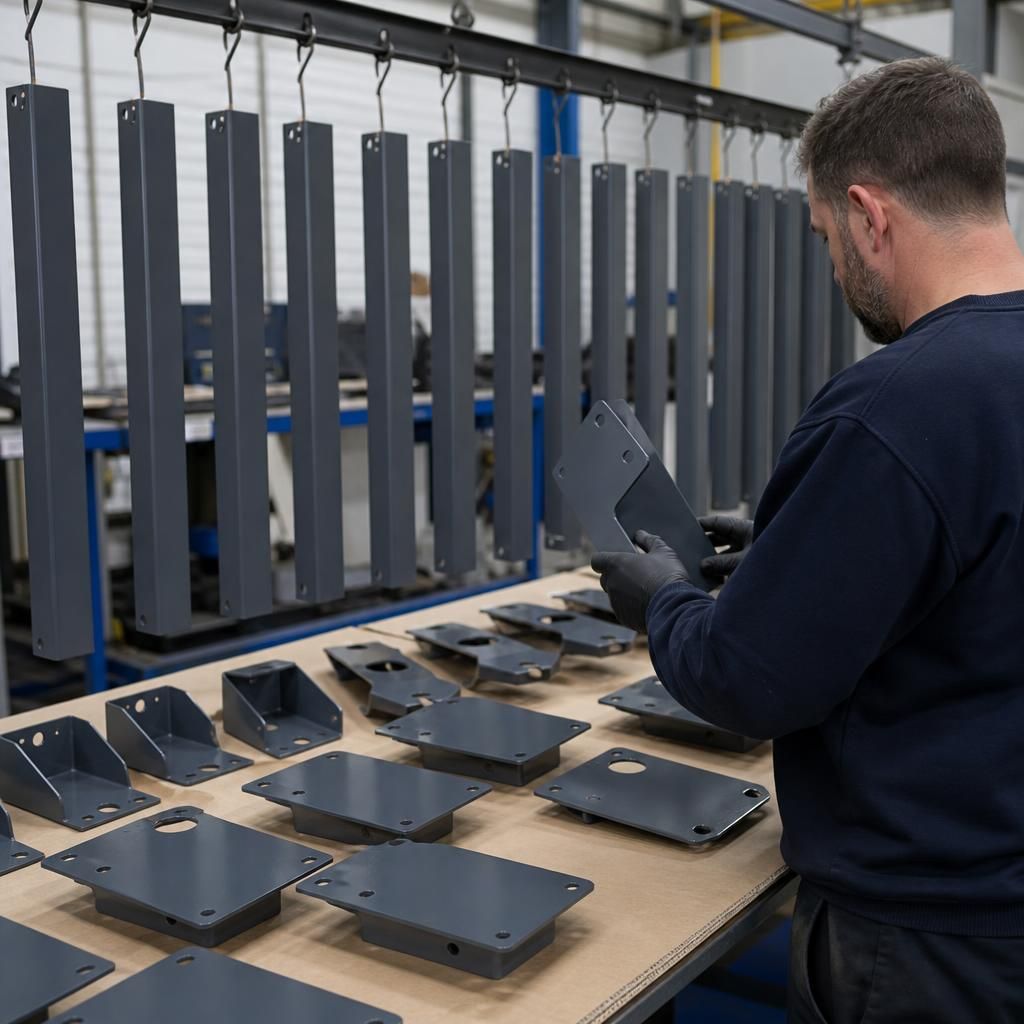
A first-off review can provide a practical reference for a large coating project containing several component designs. One representative part from each relevant type can be assessed against the agreed colour, gloss, coverage, masking and dimensional requirements before the wider batch is processed. This helps identify unsuitable racking, access problems or coating build-up at interfaces while changes are still limited to a small number of parts.
Once the reference finish is accepted, subsequent components can be compared with it during production. This is particularly useful where parts vary in size, shape or weight, because consistency is judged against an agreed standard rather than visual memory. Any approved adjustment should be recorded against the job specification so that later batches follow the same requirements.
Discuss Your Large-Scale Powder Coating Requirements
If you are planning a large-scale powder coating project, discuss your component requirements and intended application with the team. Providing relevant drawings, dimensions and finish details will help establish a suitable approach for your order.