

How do conveyorised powder coating lines ensure uniformity and quality in finishing applications?
Conveyorised powder coating lines ensure uniformity by moving components through a controlled, repeatable sequence of preparation, powder application and curing. Consistent conveyor speed, spray coverage, film thickness and oven conditions help produce durable finishes with fewer variations between parts and batches.
Conveyorised powder coating lines ensure uniformity and quality by controlling every variable that can affect the finished film, from the condition of the metal before coating to the way parts are cured, inspected and handled afterwards. The line provides a repeatable process, while suitable pretreatment, accurate equipment settings, consistent part presentation and documented checks prevent defects from being introduced between components or batches.
Surface preparation is the first quality control stage. Oil, grease, rust, mill scale, dust and residues can interfere with adhesion and create defects beneath the powder film. A suitable preparation process removes contamination and conditions the substrate so that the coating can bond correctly. Its performance depends on factors such as chemical concentration, contact time, rinsing quality and drying. These variables need to be monitored rather than assumed, because inadequate preparation may not become apparent until the coated part is tested or placed in service.
Parts must also be loaded in a way that supports consistent processing. Components should be correctly spaced, securely hung and presented so that all required surfaces are accessible. The loading method can affect contact with the line’s earth return, the areas reached by the powder and the likelihood of contact marks. Reusable hooks and fixtures need to remain clean enough to maintain reliable electrical contact. Where components vary in size or geometry, dedicated hanging arrangements can help keep their orientation consistent.
Powder application is made more repeatable when the line uses defined settings for the equipment, the powder and the component being coated. Important controls include:
- the condition and suitability of the powder material;
- the arrangement and cleanliness of spray equipment;
- the distance and position of application equipment relative to the part;
- the electrical settings used to help powder adhere to the substrate;
- powder feed and air settings; and
- the method used to manage complex shapes, recesses, edges and Faraday cage areas.
These controls reduce variation caused by operator adjustment or changing part orientation. They are particularly important where a batch contains folded sections, enclosed areas, sharp edges or a mixture of surface profiles. A process that works for a simple flat component may need different settings or application techniques for a fabricated assembly.
Quality also depends on keeping the powder material in a suitable condition. Powder should be stored and handled in line with its technical requirements, with contamination, moisture and unintended colour mixing prevented. When a colour or formulation is changed, the equipment and recovery arrangements need to be managed carefully so that residues from the previous material do not affect the next batch. Defined procedures for reclaiming or disposing of overspray help maintain finish consistency and reduce the risk of foreign material entering the coating.
Curing converts the applied powder into a durable coating, but the relevant condition is the temperature reached by the metal and the time it remains at the required cure level, not simply the air temperature shown by an oven controller. Parts with different mass or geometry may heat at different rates. For this reason, cure schedules should be established for the component and powder combination being processed. Where necessary, production checks can verify that the coating has achieved the required cure without relying solely on the line’s displayed settings.
Inspection should be built into the process rather than limited to a final visual check. Operators can examine the coating for missed areas, contamination, pinholes, craters, runs, poor edge coverage, colour variation and visible differences in texture or gloss. Depending on the specification, further checks may assess adhesion, film build, cure and corrosion protection. Measurements should be taken using suitable methods and at representative points, particularly on parts with varied geometry.
Documented process control makes the results easier to reproduce. A coating specification can record the substrate, preparation method, powder identification, application settings, cure requirements, approved hanging arrangement and inspection criteria. Batch records and equipment checks provide traceability when a result needs to be investigated. If a defect is found, reviewing these records helps identify whether the cause was related to preparation, material handling, loading, application, curing or post-coating handling.
Finally, coated components need protection after they leave the line. Contact between parts, careless stacking, unsuitable packaging and premature handling can damage an otherwise correctly applied finish. Separating components where necessary and allowing them to reach a suitable handling condition helps preserve the coating’s appearance and performance. In this way, uniformity is achieved not by the conveyor alone, but through a controlled system covering preparation, application, curing, inspection and handling.
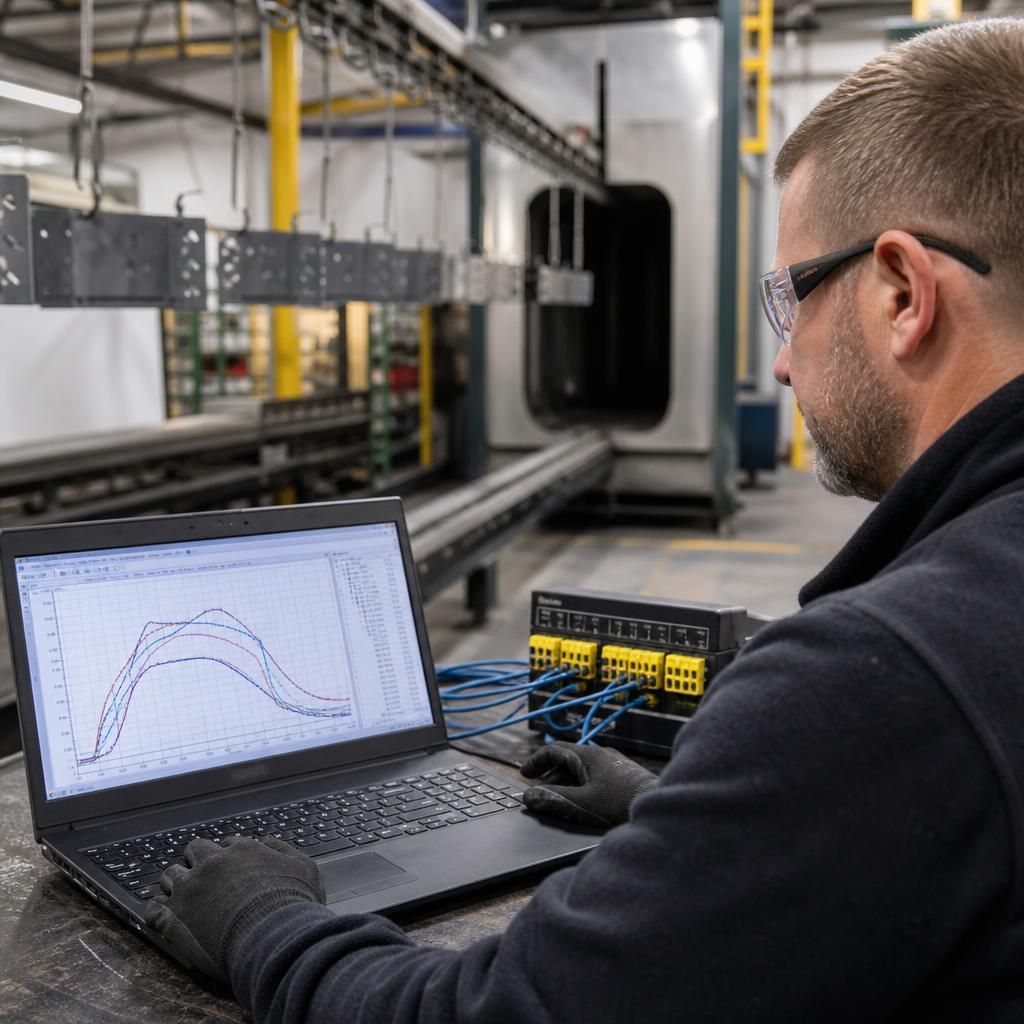
Oven profiling is a key method for confirming that a conveyorised powder coating line cures parts consistently. A temperature profile records how the metal heats as it travels through the oven, showing whether different areas of the load reach and maintain the required cure conditions.
This is particularly useful for components with varying thicknesses, enclosed sections or different loading densities. Profiling can identify cold spots, excessive heat or airflow effects that may not be visible from the oven control panel alone. Repeating the check after significant changes to the line, load arrangement or coating specification helps confirm that the process remains suitable for the finishing application.
Discuss your conveyorised coating requirements
Discuss your conveyorised coating requirements with our team, including component dimensions, production volumes, substrate and finish specification. We can help assess the process requirements for a consistent, quality-controlled powder coating application.