

How does blast cleaning enhance the adhesion of powder coatings on metal surfaces?
Blast cleaning improves powder coating adhesion by removing rust, mill scale, old coatings, oil and other contaminants from the metal surface. It also creates a controlled surface profile, giving the powder coating more area and texture to anchor to during curing, which supports a more durable finish.
Blast cleaning enhances powder-coating adhesion by producing a consistently clean, chemically suitable and correctly prepared metal surface for the coating to wet and cure against. The quality of this interface is critical: powder can be applied evenly, but weaknesses at the metal-to-coating boundary may still lead to lifting, blistering, peeling or premature corrosion if preparation is poorly controlled.
It improves the coating interface in several ways:
- It exposes sound metal. Removing weakly attached surface layers allows the powder coating to bond to the substrate rather than to a fragile layer that may detach later.
- It improves wetting. During curing, the molten powder must flow across the prepared surface. A consistent surface condition helps it make close contact with the metal and reduces areas where air or residue can remain trapped.
- It promotes uniform coating behaviour. Variations in surface condition can affect powder deposition, flow and cure. Consistent preparation helps the coating form a more even film across the component.
- It reduces localised adhesion weaknesses. Residual corrosion products, embedded debris or preparation marks can create isolated points where moisture reaches the substrate. Treating the entire part consistently reduces this risk.
Surface preparation must be matched to the coating system. The abrasive, blasting pressure, nozzle distance and working angle all influence the condition of the metal. Excessive blasting can roughen edges, distort thin sections or remove more material than necessary. Insufficient blasting may leave embedded contamination or poorly bonded material behind. The correct process creates an even, suitable surface without damaging dimensions, sharp features or areas that must remain particularly precise.
The substrate itself also matters. Steel, galvanised steel, aluminium and other metals vary in hardness, sensitivity to impact and response to abrasion. A method suitable for a robust steel fabrication may be inappropriate for a thin aluminium component. For this reason, preparation is normally assessed against the part specification, the intended service conditions and the powder-coating system rather than selected by abrasive strength alone.
Cleanliness after blasting is just as important as the blasting stage. Dust must be removed without introducing oil or moisture, and the prepared surface should be handled carefully so that fingerprints, workshop residue and other contamination do not compromise the interface. If blasted steel is exposed to damp conditions, flash rust can develop before coating. Any delay between preparation and coating therefore needs to be controlled according to the metal, environment and coating specification.
Inspection helps confirm that the prepared surface is suitable before powder is applied. Depending on the component and specification, checks may include visual uniformity, surface profile, dust, remaining corrosion, oil contamination and soluble salts. The purpose is not simply to make the metal look clean; it is to verify that no condition remains that could interfere with coating contact or encourage corrosion beneath the finish.
Good adhesion also depends on what happens after preparation. Powder must be applied at the specified film thickness and cured according to the product requirements. Under-curing can leave the coating insufficiently developed, while excessive heat or an unsuitable cure schedule can affect the finished film and the substrate. Blast cleaning provides the correct foundation, but it cannot compensate for poor application, contamination during handling or an incorrect curing process.
When adhesion fails, the cause is not always visible immediately. Peeling around welds, blistering in exposed areas or corrosion spreading beneath the coating may indicate inconsistent preparation, trapped contamination, moisture or an unsuitable blasting procedure. Reviewing the complete process—from substrate assessment and blasting through to cleaning, powder application and curing—usually gives a more reliable diagnosis than examining the coating alone.
For industrial metal components, the most dependable approach is therefore a controlled preparation specification. It should define the substrate condition, acceptable level of cleanliness, appropriate surface profile, abrasive selection, handling requirements and time allowed before coating. This process control makes adhesion more predictable and supports the long-term durability of the powder-coated finish.
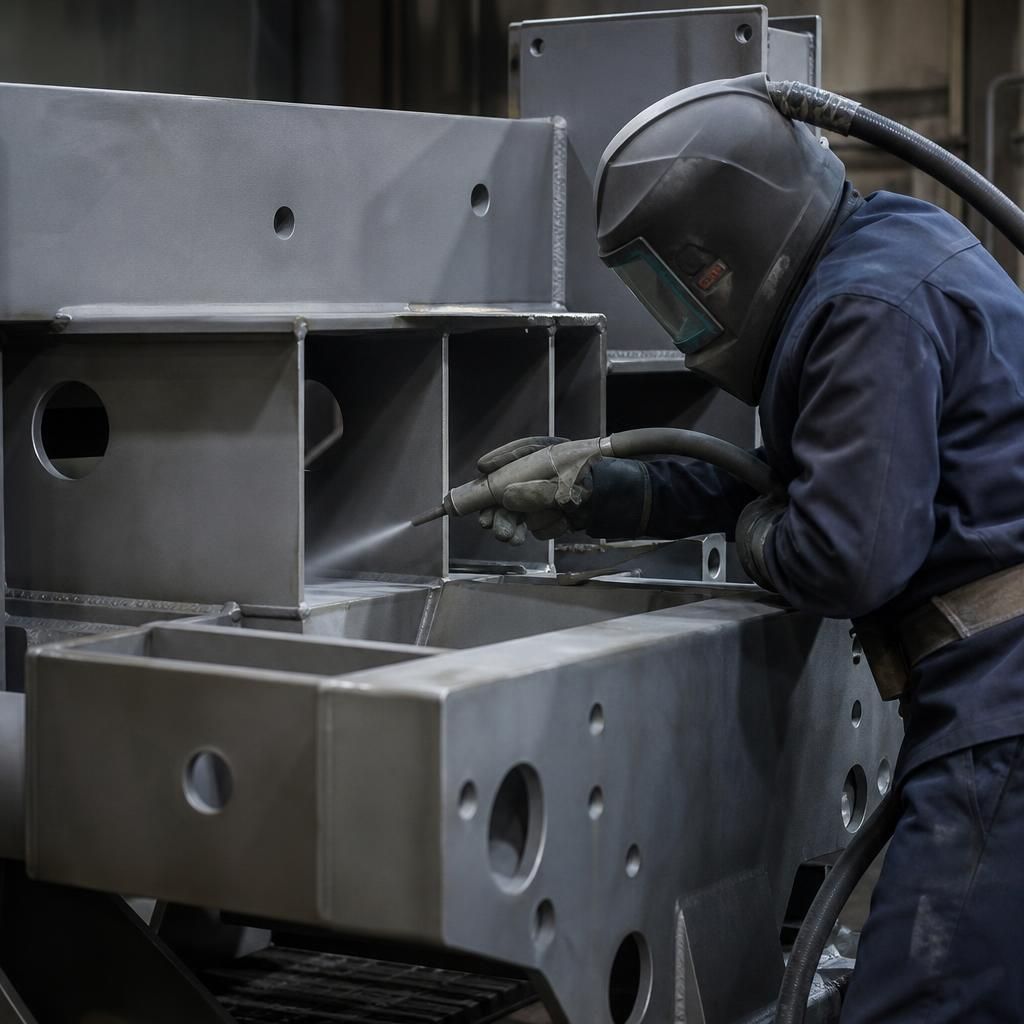
Blast cleaning only improves adhesion where the abrasive reaches the metal effectively. Complex fabrications, folded sections, deep corners and weld returns can create sheltered areas where the blast stream has limited impact. These areas may retain oxidation or residue even when the more accessible faces appear properly prepared.
Part orientation, nozzle angle and access to recessed surfaces therefore influence the consistency of the coating interface. Components should be assessed for shadowed areas before coating, with particular attention to corners, joints and edges where incomplete preparation can become an isolated point of coating failure.