

How does a fluidising hopper enhance the powder coating process for large-scale operations?
A fluidising hopper aerates powder coating with controlled air, keeping it loose and evenly flowing into the application system. In large-scale operations, this supports a more consistent powder feed, helping maintain uniform coverage and reducing interruptions caused by compacted or poorly flowing powder.
A fluidising hopper enhances large-scale powder coating by providing a controlled interface between bulk powder storage and the application equipment. It helps the coating line handle greater powder volumes in a predictable way, while supporting stable transfer, accurate application and more manageable production control.
It reduces the effect of bulk powder handling. Powder held in a large container can compact under its own weight, absorb moisture or develop inconsistent density during storage and transfer. A suitably specified hopper conditions the powder before it reaches the application equipment, reducing the risk that changes in the material’s physical state will disrupt the coating process.
It supports steadier application conditions. Spray guns and automatic application systems rely on a controlled supply of powder. If the supply varies, the operator may see changes in deposition, film build or coverage across a component. By presenting the powder to the feed system in a more controlled condition, a fluidising hopper makes it easier to maintain the application settings established for a particular job. This is especially relevant where large components, repeated batches or complex profiles require consistent operator and equipment settings.
It can improve process control across extended production runs. Large-scale coating often involves repeated loading, transfer and application stages. A hopper can act as a dedicated buffer, separating the handling of incoming powder from the immediate demands of the spray equipment. This gives production staff more control over material replenishment and can reduce the need for frequent manual intervention. The benefit is not simply a larger powder container; it is a more organised route from the prepared powder to the application point.
It helps protect finish uniformity. Powder coating quality depends on more than the curing stage. Variations in powder presentation can contribute to differences in coverage, edge build and the amount of material reaching the workpiece. A controlled hopper arrangement supports a repeatable powder supply, which helps the application system operate within its intended parameters. The oven, gun settings, earthing, line speed and powder characteristics must still be correctly managed, but the hopper removes one potential source of variation.
For manufacturers and fabricators processing metal parts in batches, this can make production easier to standardise. Once the hopper, powder feed equipment and application settings have been matched to the job, operators can follow a defined process rather than continually compensating for changes in powder behaviour. That is useful where components must maintain a consistent appearance and protective coating across a production run.
Powder recovery also needs to be considered. Where a system collects and returns overspray, the recovered material may have different characteristics from unused powder. The hopper and associated feed equipment should be compatible with the intended recovery arrangement, with suitable controls for the proportion and condition of reclaimed material. Poorly managed reclaim can affect colour, texture or application behaviour, so a fluidising hopper should be treated as part of the complete powder circuit rather than as an isolated vessel.
The hopper does not replace correct powder preparation. Powder should be stored in suitable conditions and kept free from contamination. The selected hopper must be appropriate for the powder type, required capacity and rate of use. Nylon powders and protective coatings, for example, may have different handling requirements from standard decorative powders. Particle size, moisture sensitivity, bulk density and the tendency to compact all influence how the hopper should be configured.
Integration is equally important in a large-scale operation. The hopper needs to work with the powder pumps, hoses, spray guns, control system and replenishment method already used on the line. Its outlet arrangement, air supply, sensors and access points should be positioned so that operators can inspect and service the equipment without creating unnecessary disruption. If the hopper is incorrectly sized or poorly matched to the rest of the system, it may introduce pressure, transfer or control problems instead of resolving them.
In practical terms, the main advantages are:
- more controlled handling of powder between storage and application;
- greater consistency in the conditions presented to the spray equipment;
- easier management of repeated batches and higher material demand;
- less reliance on continual manual correction during production;
- better scope for integrating unused and recovered powder into a defined process; and
- clearer separation between powder replenishment, application and routine checks.
These advantages are realised only when the hopper is correctly selected, installed and maintained. Air quality, fluidising settings, powder condition, cleaning practices and the relationship between the hopper and feed equipment all affect performance. For a large-scale coating line, the hopper should therefore be assessed as part of the entire material-handling system, with attention to the powder being used, the production pattern and the finish requirements of the coated components.
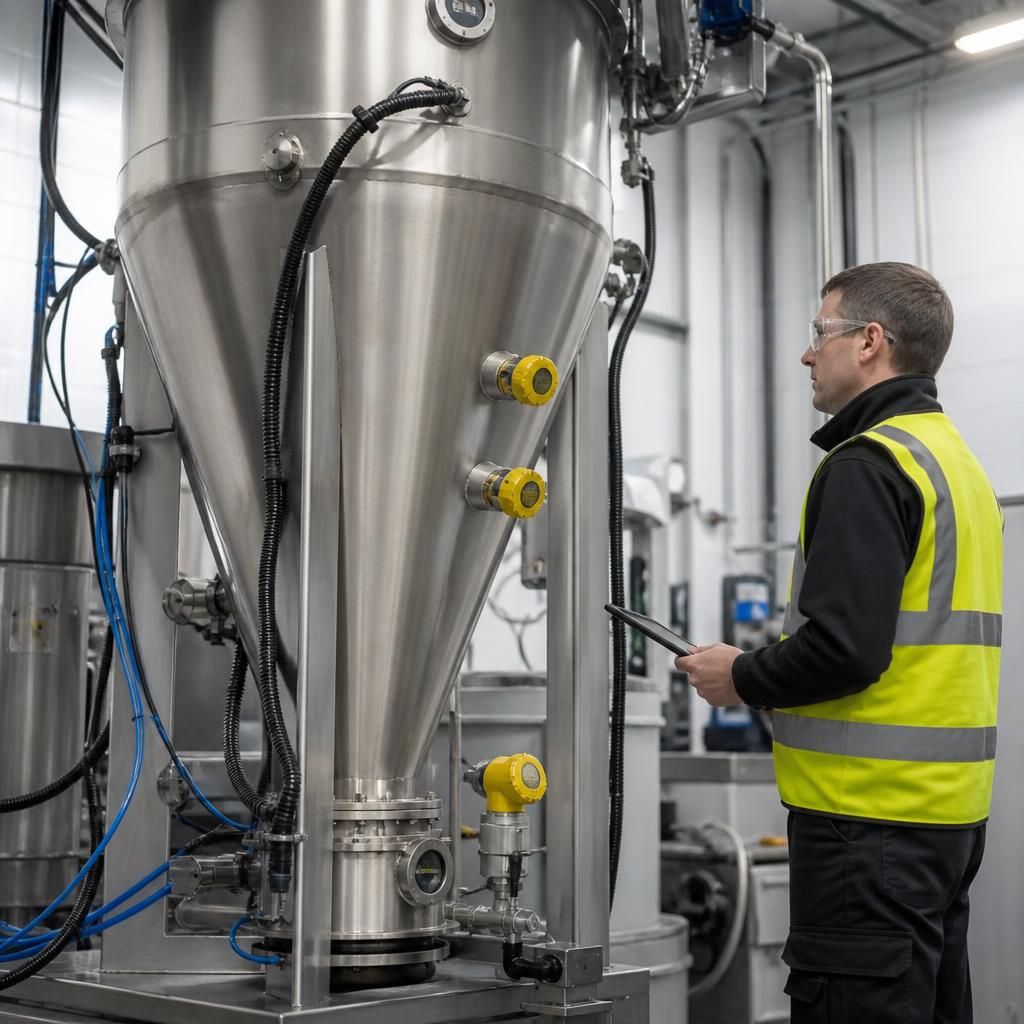
A fluidising hopper enhances a large-scale powder coating process by making aeration and powder level control more predictable. Clean, dry and regulated air passes through the hopper’s fluidising section to loosen the powder, while level monitoring helps operators keep an appropriate supply available for the feed equipment.
Air balance is important. Insufficient aeration may allow powder to bridge or compact above the outlet, while excessive aeration can make the material unstable and interfere with controlled pickup. The correct setting depends on the powder’s characteristics, including its bulk density, particle size and moisture sensitivity.
Level control also supports planned replenishment. Operators can identify when the hopper needs attention before the feed equipment is affected, rather than relying solely on visual checks or waiting for application behaviour to change. In a large-scale line, this makes the hopper a useful control point between powder preparation and application, provided its air system, sensors and outlet are correctly matched to the coating equipment.
Assess Your Fluidising Hopper Requirements
Review your required hopper capacity, powder type and existing feed equipment before specifying a fluidising hopper for your large-scale coating process. Contact Powder-coatings.co.uk to discuss the requirements of your application and assess a suitable configuration.