

What factors should I consider when selecting a powder coating setup?
When selecting a powder coating setup, assess the size, material and volume of your workpieces, required finish quality, available space and utilities, curing and extraction requirements, safety provisions, maintenance needs, total cost of ownership and scope for future expansion. The equipment should match your production process and provide consistent results without creating impractical demands on your premises, workforce or workflow.
Selecting a powder coating setup means matching the complete process, not simply choosing a spray booth or curing oven. The right setup must produce the required coating specification on the intended parts, integrate with the way those parts are prepared and handled, and be practical to operate, validate and support over its working life.
Start by defining the coating specification for each significant product group. Identify the powder chemistry, film thickness, colour range, gloss level, texture and corrosion-resistance requirement. Some applications require a decorative finish, while others need protection against abrasion, chemicals, weather or repeated handling. The specification should also state how the finished coating will be inspected, because the setup must be capable of delivering measurable and repeatable results rather than merely an acceptable appearance.
Consider the condition of the metal before coating. Oil, rust, mill scale, weld spatter and fabrication residue can affect adhesion and surface appearance, so the setup should fit the chosen preparation route. This may involve cleaning, rinsing, mechanical preparation, chemical pretreatment or a combination of methods. Check whether the proposed arrangement can accommodate the parts’ surface condition and whether preparation stages create additional requirements for drainage, drying, chemical handling or wastewater control.
The application method is another important consideration. Manual guns may suit varied, low-volume or awkward work, whereas automated application can improve repeatability on suitable product ranges. A mixed arrangement may be appropriate where standard components are coated automatically and unusual parts are completed manually. Assess gun access, operator visibility, earthing arrangements, powder delivery and the ease of adjusting application parameters for different parts.
Colour and powder changes deserve specific attention. If the business handles multiple colours or powder types, examine how quickly and thoroughly the booth, guns, hoses and recovery equipment can be cleaned. Inadequate changeover arrangements can cause contamination, wasted material and avoidable delays. Decide whether recovered powder is suitable for reuse, whether it must be separated by colour or type, and how unused powder will be stored and identified.
Part handling should be assessed as a process in its own right. Look at how components are loaded, suspended, transferred, coated, cured and unloaded. Hooks, jigs and contact points must support the part securely without masking important surfaces. The handling method should also prevent collisions, reduce unnecessary manual movement and maintain the orientation needed for consistent coverage. Large, delicate or geometrically complex components may need different fixtures from standard fabricated parts.
When reviewing an existing or used setup, inspect its condition rather than relying solely on its stated capacity. Check the oven interior, insulation, doors, burners or heating elements, fans, conveyor components, booth panels, filters, ducts, guns, pumps, hoses, electrical cabinets and control systems. Look for corrosion, heat damage, powder build-up, worn seals, obsolete controls and evidence of uneven heating. Request service records, wiring information, operating manuals and details of any modifications.
Controls and measurement features affect how reliably the process can be reproduced. Useful considerations include:
- Whether oven temperature is measured at the part rather than inferred only from the air setting.
- Whether temperature, dwell time and application settings can be recorded or checked.
- Whether alarms identify faults such as overheating, loss of airflow or equipment failure.
- Whether controls are clear enough for operators to use consistently.
- Whether settings can be locked or managed to reduce unintended changes.
Do not assess the oven solely by its nominal temperature. Confirm that it can deliver the required metal temperature and cure schedule across the relevant part geometry. Dense fabrications and thin sections may heat at different rates, and the powder manufacturer’s technical data should be used when establishing the cure requirement. A setup that reaches the required air temperature may still produce inconsistent curing if heat distribution, airflow or dwell time is unsuitable.
Serviceability is also part of the selection decision. Filters, burner components, heating elements, hoses, nozzles, seals and electrical parts should be accessible for inspection and replacement. Find out which consumables are standard, whether technical documentation is available and whether competent support can be obtained for commissioning, fault diagnosis and calibration. A technically capable setup can become difficult to operate if essential parts or process information are unavailable.
Evaluate the installation as a whole. Confirm the suitability of electrical supplies, gas arrangements where applicable, ventilation routes, extraction discharge points, access for delivery and future removal, and the structural requirements for suspended equipment. Any planning, building-control, fire-safety or environmental obligations should be established before committing to the equipment. Specialist advice may be needed where the installation changes the use of the premises or introduces combustible dust and heated processes.
Finally, compare quotations on a like-for-like basis. Establish what is included in dismantling, transport, installation, testing, commissioning, operator instruction, documentation and removal of waste. Separate the purchase price from ongoing costs such as energy, powder, filters, maintenance, calibration and rejected work. A lower initial price may not represent good value if the setup needs extensive refurbishment or cannot support the required coating specification.
A sound decision is therefore based on documented requirements, a physical inspection where relevant, a review of the proposed process flow and evidence that the equipment can produce the required finish consistently. For businesses that would rather avoid owning every stage of the process, a specialist powder coating service can provide an alternative for batch, large or technically demanding metal components while the required finish and quality checks are specified in advance.
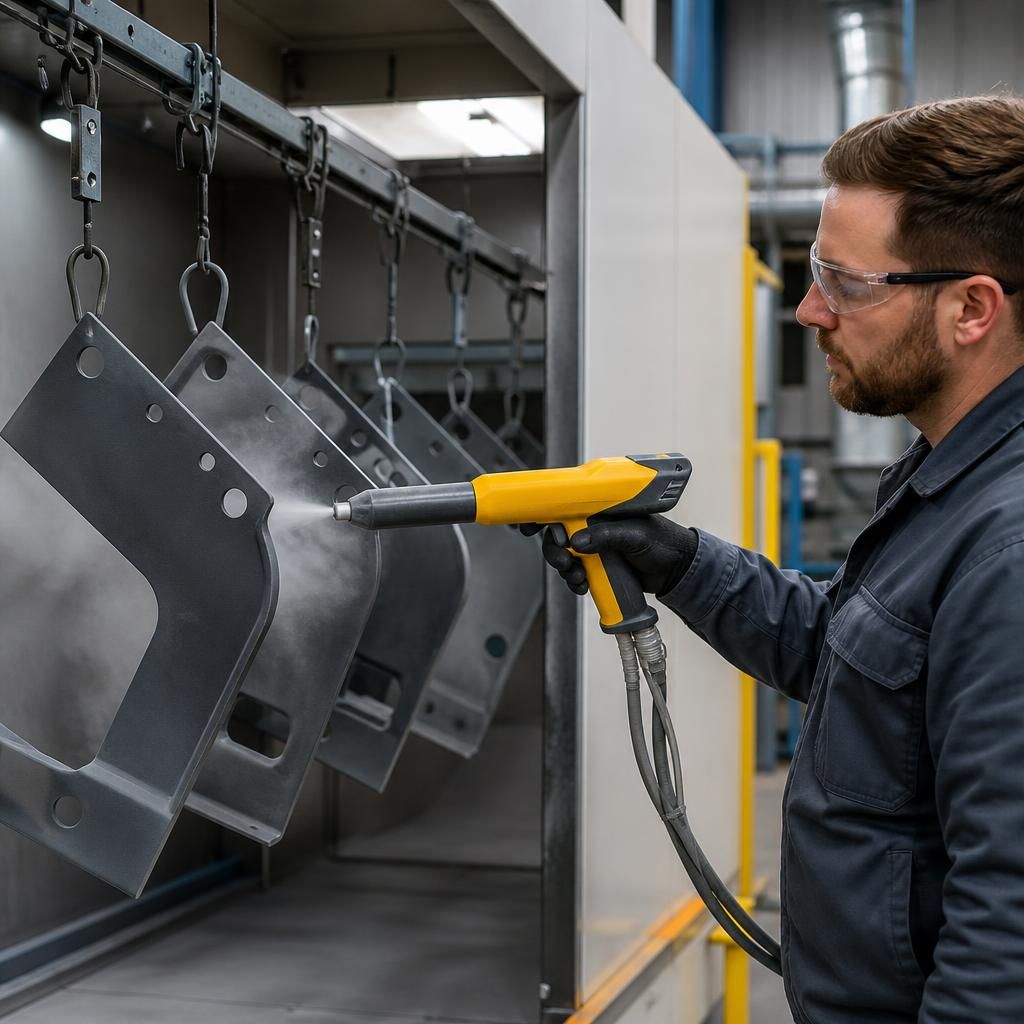
A representative coating trial is one of the most reliable ways to assess whether a powder coating setup is suitable before purchase. Test actual or equivalent components using the intended powder, preparation method, fixtures and production sequence, rather than judging the equipment from its specification alone.
The trial should examine more than the appearance of a single finished part. Check loading and unloading effort, access to recessed areas, masking of contact points, heat-up behaviour, curing results and the time needed to change between typical products. Record the settings and conditions used so the result can be compared with the coating specification and repeated during commissioning.
For used or refurbished equipment, agree practical acceptance criteria before the trial takes place. These might cover usable part dimensions, operating temperatures, extraction performance, control functions and the condition of key components. Any gap between the demonstrated performance and the proposed production requirements should be costed and resolved before the setup is accepted.