

What key considerations should I keep in mind when selecting a powder coating equipment package?
When selecting a powder coating equipment package, assess whether its application method, booth, curing capacity, controls and extraction arrangements suit your parts, coating specification and production volume. Also compare installation requirements, operator safety, maintenance access, energy use, future expansion and the total cost of ownership rather than focusing only on the purchase price.
The main considerations when selecting a powder coating equipment package are process compatibility, finish requirements, component quality, operator control, compliance, serviceability and the evidence that the system can produce consistent results on your actual parts. A suitable package should be assessed against the complete coating process, not as a collection of unrelated machines.
Start with the parts and coating specification
Define the characteristics of the components the equipment must handle. Record the substrate, dimensions, weight, surface condition, areas that must remain uncoated, required film thickness and the appearance or performance standard expected from the finished coating. Complex profiles, recesses, sharp edges and welded sections can affect powder access and coverage. If the package is intended for several product types, check that its operating range is suitable for the full mix rather than only the simplest component.
Powder chemistry also matters. Different powders can have different application, curing and reclaim requirements, while specialist protective or nylon coatings may need equipment configured for their particular handling characteristics. Confirm compatibility with the powders your process is expected to use before comparing equipment on price alone.
Examine application control
Application equipment should provide controlled adjustment of the variables that influence transfer and coverage. Important points include:
- stable powder delivery across the intended operating range;
- repeatable adjustment of voltage, current and powder output;
- consistent atomisation and spray pattern;
- access to suitable gun and nozzle arrangements for the part geometry; and
- clear indication of operating settings so that approved recipes can be reproduced.
Ask how easily an operator can change settings between jobs and how the system prevents accidental changes to an established recipe. A package that makes process settings repeatable is generally easier to qualify and troubleshoot than one that relies heavily on individual operator judgement.
Consider colour changes and powder recovery
Where several colours or powder types are processed, the design of the powder path is a significant selection factor. Check which components require cleaning during a colour change, how readily they can be removed, and whether powder can remain in hoses, pumps or collection areas. Difficult cleaning can increase changeover work and create a risk of colour contamination.
If overspray is recovered, establish how reclaimed powder is separated, stored, screened and reintroduced. Reclaim arrangements should suit the coating manufacturer’s requirements and the finish standard for the work. For products where colour purity or appearance is critical, the cost and practicality of using virgin powder rather than reclaim may influence the package specification.
Check part handling and process flow
The equipment must work with the way parts move through the operation. Review loading and unloading arrangements, conveyor or jig compatibility, clearance around the components, and whether the handling method protects coated surfaces from contact damage. Jigs should provide reliable electrical contact where required and should be designed to minimise areas that cannot be coated.
Consider the whole route from prepared metal to finished component. Bottlenecks can arise at loading, masking, inspection, cooling, packing or colour change even when the spray equipment itself has adequate output. Mapping the workflow before selecting the package helps identify interfaces that may otherwise require later modification.
Verify environmental and utility requirements
Obtain a complete schedule of the utilities needed by the proposed package. This may include electrical supply, compressed air quality and capacity, ventilation connections, floor loading, access for delivery and space for ancillary equipment. The specification should identify connection points and operating requirements rather than leaving these to be resolved after purchase.
Powder handling also warrants attention. Ask how the system contains airborne powder, how collection areas are cleaned, and how waste is removed. The arrangements should support a controlled workplace and align with the applicable health, safety and environmental duties for the installation. Request the relevant technical documentation, risk information and operating instructions as part of the selection process.
Assess measurement, records and quality assurance
A package is more useful when it supports objective checks rather than visual inspection alone. Determine how operators will verify coating thickness, cure and appearance, and whether the equipment can record or display the process information needed for traceability. The exact inspection tools may sit outside the core package, so confirm what is included and what must be sourced separately.
For repeat production, document approved settings for each product or powder system. Before committing to an installation, ask for a practical demonstration or trial using representative parts. Examine coverage in difficult areas, finish uniformity, adhesion and the ability to repeat the result after a change of operator or batch. Testing on real components is more informative than relying solely on a general catalogue specification.
Review service, spares and documentation
Selection should include the practical requirements for keeping the equipment usable over its working life. Check the availability of wear parts, filters, hoses, nozzles, seals and other consumables, together with the identification of items that need regular replacement. Clear maintenance instructions, parts lists, electrical drawings and fault-finding guidance reduce dependence on informal knowledge.
Also establish who is responsible for commissioning, operator instruction and process handover, and what technical support is available for calibration, fault diagnosis and future modifications. These details should be recorded in the quotation or specification so that the package can be compared on more than its initial equipment list.
Compare proposals on a like-for-like basis
Prepare a written requirement covering parts, powders, finishes, handling, quality checks, utilities, cleaning and documentation. Then compare each proposal against that requirement. Identify exclusions such as installation work, ducting, jigs, inspection equipment, spare parts, training or software, since a lower headline price may reflect omitted elements rather than a more efficient solution.
Finally, confirm the acceptance criteria before ordering. These might cover coating appearance, repeatability, powder compatibility, safe operation, documentation and successful trials on representative components. A clearly defined specification gives the equipment package a measurable purpose and provides a sound basis for evaluating whether it is appropriate for the intended industrial process.
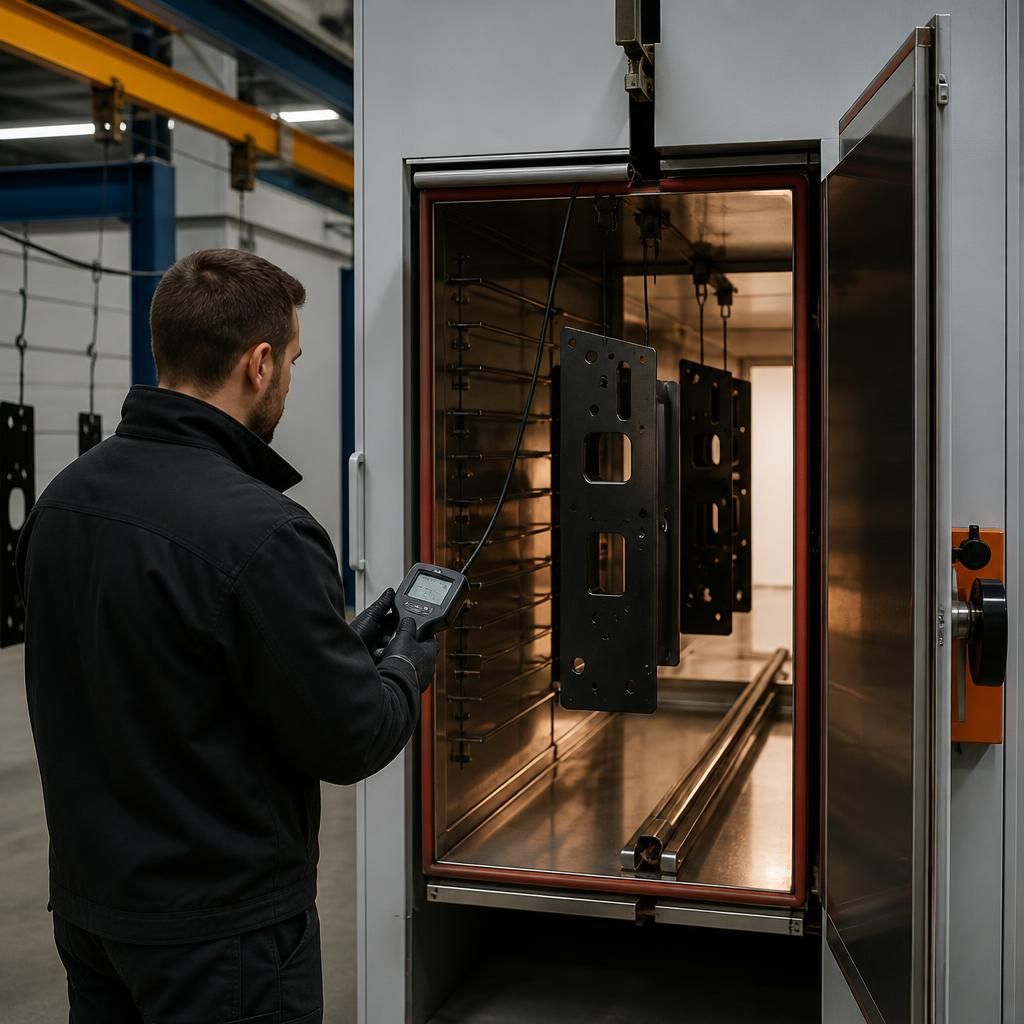
A powder coating equipment package should be selected with curing performance assessed against the temperature reached by the metal parts, not solely the temperature displayed inside the oven. Part thickness, material, loading density and component arrangement can all affect how consistently the coating cures.
- Check whether the oven provides sufficiently even heat distribution across the usable working area.
- Consider how changes in batch size, component thickness or loading pattern may alter the time needed to reach the required part temperature.
- Ask how cure performance can be checked during commissioning and when the process or product range changes.
- Confirm that the proposed oven dimensions and airflow arrangements suit the largest and most thermally demanding components, rather than only typical parts.
Where production includes varied components, a package that supports thermal profiling and documented cure verification gives a more reliable basis for approving process settings. This can help distinguish a genuinely suitable curing system from one that only appears adequate under a limited set of operating conditions.
Discuss Your Powder Coating Equipment Package Requirements
Discuss your powder coating equipment package requirements with Powder-coatings.co.uk, including the parts, powders and production arrangements the system must accommodate. This provides a practical basis for identifying a suitable package specification before requesting a quotation.