

How long does the powder coating on steel tubes typically last in industrial applications?
Powder coating on steel tubes typically lasts for many years in industrial applications when the steel is properly prepared and the coating is correctly applied and maintained. Its service life depends on factors including exposure to moisture, chemicals, UV light, abrasion, temperature changes and mechanical damage.
Powder coating on steel tubes can provide a long industrial service life, but there is no universal number of years that applies to every installation. The most reliable estimate comes from the specified durability class, the corrosivity of the service environment, the steel preparation standard and the quality of application. A coating designed for an indoor fabrication may have a very different lifespan from one used on external infrastructure or process equipment.
In practice, service life should be assessed against the point at which the coating requires significant remedial work, rather than the first minor change in appearance. A gradual reduction in gloss or colour intensity does not necessarily mean that the steel is no longer protected. More important signs include:
- Coating lifting, blistering or flaking
- Corrosion emerging from scratches, cut ends, welds or joints
- Cracking caused by movement, impact or an unsuitable coating film
- Loss of adhesion when inspected or tested
- Exposed steel around poorly covered edges, holes and recesses
Steel tube geometry has a direct bearing on longevity. Long, narrow sections, perforations, folded areas and hollow profiles can be difficult to coat uniformly. The external faces may appear sound while the inside of an open tube, a drilled hole or a cut end has less protection. Good component design, suitable racking and attention to drainage help prevent untreated areas and retain the coating’s protective continuity.
Surface preparation is also central to the expected life of the finish. Oil, mill scale, rust, weld residue and other contaminants can prevent proper adhesion even when the powder application itself is consistent. For demanding industrial work, the coating specification should identify the required cleaning method, pretreatment, surface condition and film thickness. A suitable pretreatment system creates a better bond between the steel and powder layer and reduces the risk of premature under-film corrosion.
The powder chemistry and specification must match the intended use. A standard architectural or general-purpose grade may not be suitable for aggressive industrial conditions, while a specialist protective system may be unnecessary for a controlled internal environment. The specification should consider the required colour and gloss retention, resistance to the identified service conditions, edge coverage, repair method and whether the tubes will be handled, assembled or exposed to repeated contact.
Application control affects life just as much as material selection. The coating provider should control gun settings, grounding, curing conditions, film thickness and contamination between batches. Under-curing can leave the finish with inadequate performance, while excessive film build can contribute to defects such as cracking or poor appearance. On complex tube assemblies, checking coverage at corners, welds, edges and recessed areas is particularly important.
For a realistic project estimate, the purchaser should provide details of the intended environment and ask for a coating system matched to it. Useful information includes:
- Whether the tubes will be installed internally or externally
- The surrounding industrial atmosphere and any specified corrosivity classification
- Whether the steel will be exposed to standing water, deposits or difficult-to-clean areas
- The required appearance and acceptable change in colour or gloss
- Expected handling, assembly and inspection conditions
- Any applicable standards, test requirements or project documentation
A coating specification should distinguish between decorative life and protective life. Appearance may change before the coating loses its ability to shield the steel, whereas local damage can expose the substrate without causing an obvious overall change in colour. This distinction prevents premature replacement while ensuring that genuine corrosion risks are not overlooked.
Routine inspection extends usable life by identifying local damage before corrosion spreads beneath the surrounding film. Inspectors should pay particular attention to edges, fastener areas, welds, tube ends and places where dirt or water can collect. Small defects should be cleaned, prepared and repaired using a compatible system recommended for the original coating. Large areas of delamination or widespread corrosion normally require a more extensive assessment and may need stripping and recoating.
For industrial steel tubes, the best answer is therefore a documented service-life estimate based on the complete coating system, not powder coating in isolation. A provider assessing the steel grade, tube design, preparation requirements, intended environment and inspection criteria can recommend a specification that gives a more dependable result than relying on a generic lifespan claim.
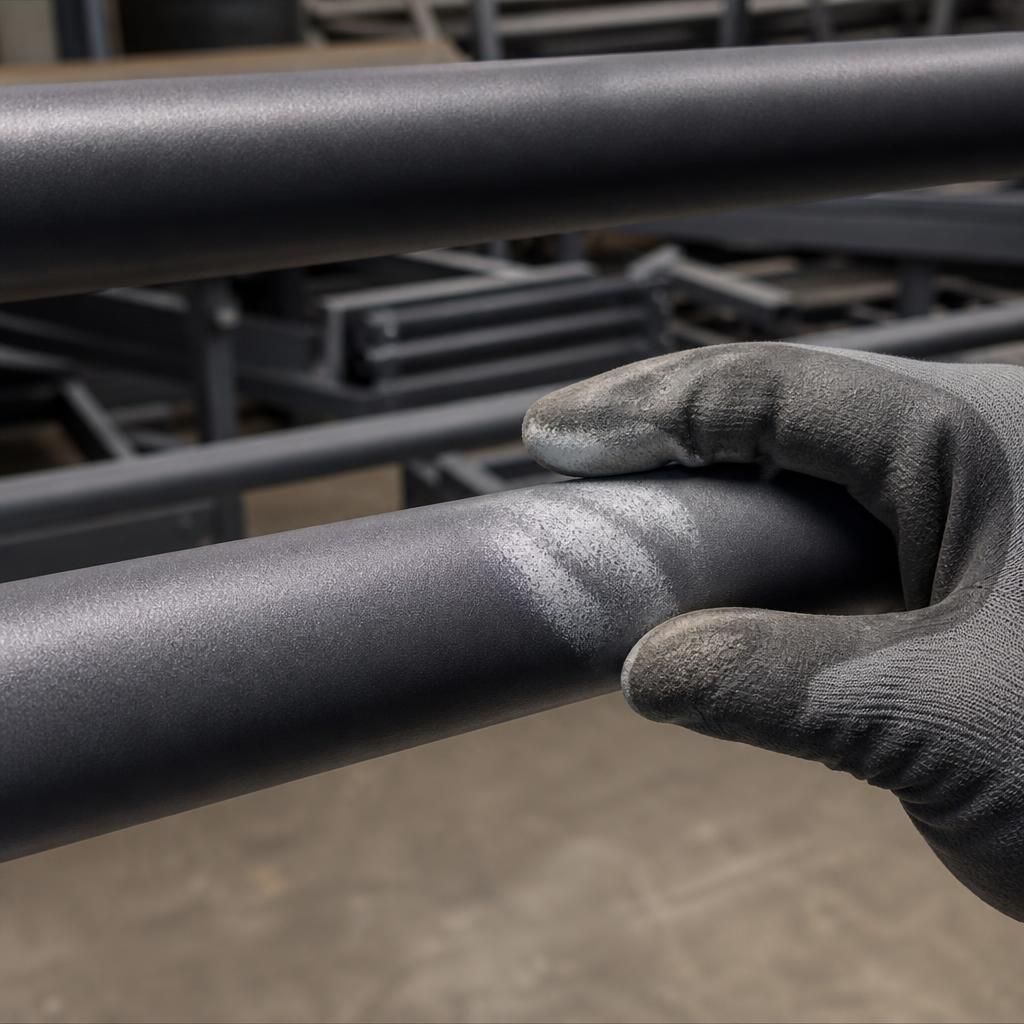
Chalking is an important indicator of weathering, but it does not by itself mean that a powder-coated steel tube has reached the end of its service life. Chalking occurs when ultraviolet exposure gradually breaks down the coating’s surface binder, leaving a fine, powdery residue that can transfer onto a cloth or glove. It is mainly an appearance change; the steel may remain protected if the coating is still continuous, firmly attached and free from corrosion.
During inspection, clean a small area and check for more serious defects beneath or around the chalked surface. Blistering, exposed steel, rust staining, flaking or loss of adhesion requires greater attention than a uniform reduction in gloss. Where appearance is critical, the coating specification should include suitable exterior durability requirements rather than relying on a general-purpose powder coating.