

What are the stages involved in the pre treatment plant powder coating process?
The pre-treatment plant powder coating process typically involves degreasing and cleaning the metal, rinsing, applying a chemical conversion treatment, drying, powder application and oven curing. Final inspection then checks the coating’s coverage, adhesion and finish before the components are released for use.
The stages in a pre-treatment plant powder coating process form a controlled sequence that prepares the metal surface, creates suitable conditions for powder application and confirms that the finished coating meets the required specification. Each stage has a distinct purpose, and the route may be adjusted according to the substrate, contamination present, component geometry and performance requirements.
1. Job assessment and component preparation
Before components enter the plant, the coater reviews the metal type, existing surface condition, dimensions, areas that must remain uncoated and the required finish. Oil, grease, cutting fluids, storage residues, rust, mill scale and old coatings can all affect the process. Components are therefore inspected and arranged on suitable racks or hooks so that treatment liquids can contact the relevant surfaces and drain away afterwards.
Racking is particularly important for complex fabrications. Poor positioning can leave shaded areas, trapped liquid or contact marks, while inadequate electrical contact can interfere with the later powder application. Drainage holes, threaded sections and enclosed profiles may also need consideration before processing.
2. Alkaline or specialist cleaning
The first treatment removes organic contamination and loose surface residues. An alkaline cleaner is commonly used for general oils and grease, while a more specialist preparation may be selected where the contamination or substrate requires it. The treatment must reach recesses, corners and internal surfaces rather than only the visible faces.
Cleaning strength, temperature, contact time and chemical concentration are controlled to suit the material. Excessive treatment can attack certain substrates, whereas insufficient treatment may leave residues that interfere with subsequent stages. The component should leave this stage with a consistently clean surface, not merely a surface that appears clean from a distance.
3. Intermediate rinsing
Rinsing removes cleaner and loosened contamination before the next chemical stage. This prevents carry-over between tanks and reduces the risk of unwanted residues being deposited on the component. Good drainage and adequate coverage are essential, especially around joints, returns and enclosed sections.
The condition of the rinse water is also relevant. If rinse water becomes contaminated, it can transfer chemicals back onto the metal instead of removing them. Plant operators therefore monitor the process and maintain the rinse stages as part of overall surface preparation.
4. Surface conditioning and conversion treatment
A conversion treatment changes the character of the prepared metal surface, providing a more suitable base for the powder film. Depending on the substrate and specification, the plant may use a phosphate-based or alternative conversion system. Aluminium and steel do not respond identically, so the chemical route must be compatible with the material being processed.
This stage is not intended to create a decorative coating. It produces a thin, controlled surface layer that can improve powder adhesion and provide additional protection at the interface between the metal and the applied finish. Concentration, pH, temperature, exposure time and solution cleanliness all influence the result.
5. Final rinsing
After conversion, further rinsing removes excess treatment chemicals. The final rinse is important because salts or residues left on the surface can contribute to coating defects and may affect long-term performance. Water quality and drainage are considered alongside the specified chemical system, with particular attention paid to recesses where liquid can collect.
6. Dry-off and moisture removal
Components are dried before powder is applied. Any remaining water can cause surface defects, interfere with electrical charging or become trapped beneath the powder film. Drying conditions must suit the component’s mass and shape; heavy sections and enclosed areas generally require more attention than thin, open sections.
At this point, the surface is checked for visible contamination, flash rust, incomplete preparation or damage revealed during cleaning. If the condition is unsuitable, the item may need additional preparation rather than proceeding to powder application.
7. Powder application
Once dry, the component is moved into the powder application area. Powder particles are electrostatically charged and directed towards the earthed metal, allowing the material to form an even deposit over the accessible surfaces. Operators select the powder type, colour, texture and film requirement in accordance with the job specification.
Gun settings, component position, earthing, application distance and powder recovery controls affect coverage. Edges, corners, recesses and Faraday areas can behave differently from broad open faces, so application technique must account for the component’s geometry. The target is a consistent, correctly deposited layer rather than simply a visibly covered surface.
8. Oven curing
The coated component then enters a curing oven. Heat causes the powder to melt, flow and chemically cross-link into a continuous film. The required cure depends on the powder system and the component’s actual metal temperature, not only the air temperature shown by the oven controls.
Plant control therefore considers oven profile, loading arrangement, component thickness and time at temperature. Insufficient cure can leave the film short of its specified properties, while unsuitable heating can affect appearance or the substrate. Large or thermally dense fabrications need particular care because they may heat more slowly than smaller sections.
9. Cooling, inspection and release
After curing, components are allowed to cool sufficiently for safe handling and inspection. Checks commonly cover colour, gloss, texture, coverage, visible defects, film uniformity and damage from handling. Depending on the specification, additional checks may assess film thickness, adhesion or cure characteristics.
Inspection also considers areas that are difficult to see, such as edges, undersides, joints and internal faces. Any non-conformance is recorded and assessed against the agreed requirements. Components are only packed or returned for collection and delivery once the finish has been reviewed and the job documentation is complete.
In practice, the process is governed by the relationship between stages rather than by any single chemical or machine. Correct racking supports effective coverage, cleaning enables conversion treatment, rinsing controls residue, drying protects the powder application and curing determines how the applied film develops. For this reason, a pre-treatment plant must be operated as an integrated system with controls matched to the metal components being processed.
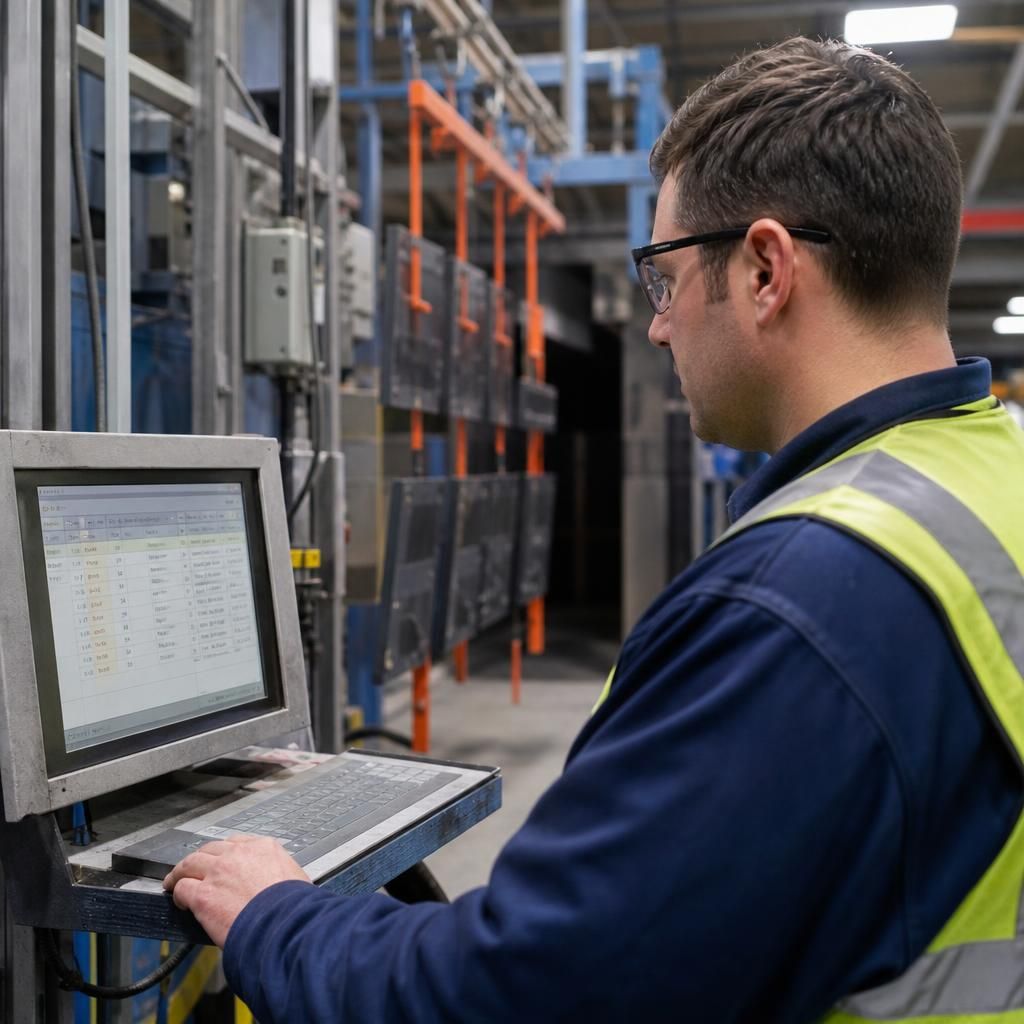
Process records link each stage of the pre-treatment plant powder coating process together. Operators can record the treatment route, chemical conditions, rinse status, drying requirements, powder specification and curing profile for each job. This creates a traceable record of how the component was processed, rather than relying only on the appearance of the finished coating.
These records also help identify the source of a defect if an inspection reveals a problem. For example, an issue may relate to surface preparation, application or curing, and reviewing the process information helps separate these possibilities. This is particularly useful for repeat batches, where consistent settings and documented checks support the same specified finish across successive production runs.