

What factors should be considered when choosing the appropriate pretreatment chemicals for a specific metal type?
Choose pretreatment chemicals according to the metal’s composition and surface condition, including whether it is steel, galvanised steel, aluminium or another alloy, and the type of oils, oxides or contaminants present. Also consider the required corrosion protection, powder-coating system, application process, rinsing and waste-treatment facilities, and any environmental or health-and-safety requirements.
The appropriate pretreatment chemical is selected by matching the treatment sequence to the substrate’s metallurgy, manufacturing history, coating specification and production controls. The metal name alone is not enough: welds, cast areas, heat-affected zones, existing conversion layers and variations between batches can all affect how a surface reacts.
Consider the substrate’s condition and manufacturing history. A newly fabricated component may carry drawing compounds, stamping lubricants, welding residues, marking inks or handling contamination. A laser-cut or welded part may also contain heat scale, embedded iron or oxidised areas that respond differently from the surrounding sheet. Components that have previously been painted, stored outdoors or exposed to cutting fluids require a different assessment from clean, recently manufactured metal. The treatment must be capable of producing a consistent surface across all of these areas, or the part may show uneven adhesion and finish after coating.
Check whether the metal contains features that alter chemical reactivity. Castings, mixed-metal assemblies, high-silicon aluminium, zinc-rich surfaces and components with exposed weld material may not react uniformly with a general-purpose treatment. Dissimilar metals assembled together can also create localised differences in the treatment response. In such cases, the chemical supplier’s technical data and a representative trial should be used to confirm that the process does not produce staining, excessive etching, powdery residues or an unsuitable conversion layer.
Match the pretreatment to the required performance specification. A component used indoors may have different requirements from one exposed to moisture, road salts, industrial pollution or repeated cleaning. The intended service conditions, edge exposure, joint design and contact with other materials should therefore be reviewed before choosing the chemistry. Where a formal coating specification applies, the pretreatment should be assessed against its test methods and acceptance criteria rather than selected solely because it is described as suitable for a particular metal.
Assess compatibility with the complete coating build-up. Pretreatment chemicals can influence the surface energy, roughness and residual cleanliness on which the powder film depends. The chosen process should be compatible with the powder chemistry, film thickness, curing conditions and any subsequent assembly or sealing operations. A treatment that performs well beneath one coating system may not be the best choice beneath another, particularly where appearance, flexibility, impact resistance or chemical exposure are important.
Review the production equipment and process window. Chemical selection must suit how components are processed, whether by immersion, spray, automated stages or a manual operation. Part size, shape, recesses, overlapping joints and drainage points affect how thoroughly each stage reaches the surface and how completely it can be removed afterwards. The line should provide sufficient control of contact time, temperature, chemical strength and replenishment. A theoretically suitable product is not appropriate if the available equipment cannot apply it consistently.
Pay particular attention to rinsing and drying behaviour. Residues trapped in seams, hollow sections or folded edges can interfere with powder application and may cause later corrosion. The selected sequence should allow rinse water to drain effectively and the components to dry fully before powder is applied. Water quality also matters: dissolved salts, hardness and carry-over from earlier stages can affect the cleanliness and stability of the treated surface. Rinse stages should therefore be checked as part of the selection process, not treated as an unrelated utility issue.
Consider process control and verification. A reliable pretreatment is one that can be monitored, not simply one that works during an initial trial. Suitable control measures may include checking bath condition, treatment temperature, contact time, rinse quality and the appearance of the treated surface. Test panels or representative components can help identify adhesion problems, staining or inconsistent coverage before full production. Records of these checks make it easier to distinguish a chemical-selection issue from a cleaning, application or curing problem.
Evaluate the effect on plant operation and waste handling. Different chemistries can place different demands on dosing, filtration, storage, extraction and effluent treatment. The choice should take account of the facility’s ability to manage spent baths, contaminated rinse water and sludge in accordance with applicable requirements. It is also sensible to consider chemical handling instructions, operator exposure controls, storage compatibility and the consequences of spills when comparing otherwise suitable options.
A practical selection process is:
- identify the exact substrate and any mixed-metal construction;
- record forming, welding, casting, heat treatment, storage and contamination history;
- define the exposure conditions and coating performance specification;
- confirm compatibility with the powder system and available pretreatment equipment;
- obtain technical guidance and run trials on representative components, including difficult areas;
- set measurable operating controls for the treatment and rinse stages; and
- verify the finished coating through appropriate adhesion, appearance and corrosion-resistance testing.
For industrial batches, this evidence-based approach is more dependable than choosing a chemical solely by substrate name. It identifies whether the proposed treatment is suitable for the actual component, the process used to manufacture it and the conditions in which the finished powder coating must perform.
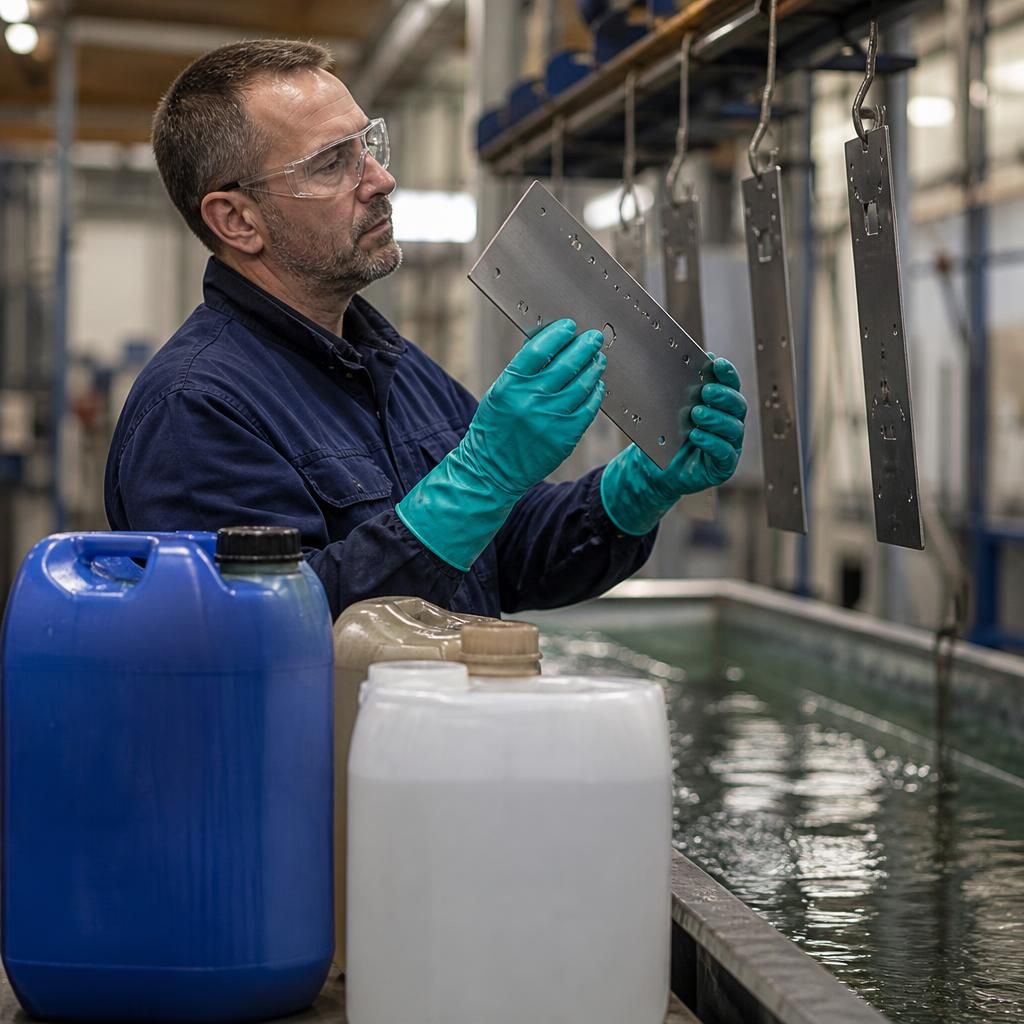
Pretreatment chemicals should be selected according to the specific preparation task required, rather than treated as interchangeable cleaning products. Degreasers remove oils and processing residues, acidic products may remove oxidation or mineral deposits, and conversion treatments create a chemically receptive surface for the powder coating. These stages may need to be used separately because a product that removes contamination is not necessarily suitable for forming the required conversion layer.
This distinction is particularly important where a component has more than one surface problem. For example, a part may require effective degreasing before a controlled oxide-removal stage, followed by a conversion treatment designed for the substrate. The sequence should be checked for carry-over between stages, since residues from one chemical can reduce the effectiveness of the next or leave an unsuitable surface for powder application.
When comparing products, review the technical information for the intended substrate, preparation function, operating conditions and required rinsing. A representative trial should confirm that each stage performs its intended role without causing visible attack, residue or loss of surface uniformity.
Discuss the Right Pretreatment Chemicals for Your Metal Type
Share your component drawings, substrate details and coating specification with Powder-coatings.co.uk to discuss a suitable pretreatment approach for your metal type. A technical review can help identify any substrate-specific risks before production coating begins.