

How does sandblasting improve the adhesion of powder coatings on metal surfaces?
Sandblasting improves powder coating adhesion by removing rust, old coatings, mill scale, oil and other contaminants from the metal surface. It also creates a controlled textured profile, giving the powder coating more surface area and a stronger mechanical key when it is applied and cured.
Sandblasting improves powder coating adhesion by creating a controlled, clean and suitably receptive surface before the powder is applied. Good adhesion depends not only on the powder and curing conditions, but also on the condition of the metal, the blasting specification and the time between preparation and coating.
Powder coating bonds to metal through a combination of physical and chemical adhesion. During curing, the powder melts, flows across the prepared surface and forms a continuous film. The condition of the interface beneath that film affects whether the coating remains attached when exposed to impact, handling, moisture, temperature changes or corrosion stresses. Sandblasting helps make that interface consistent rather than leaving areas with different levels of contamination, roughness or oxidation.
The blasting specification must be matched to the component. Abrasive type, particle size, air pressure, nozzle distance and travel speed all influence the resulting surface. Excessive pressure or prolonged blasting can produce an uneven finish, round sharp edges, distort thin sections or remove more material than intended. Insufficient treatment can leave poorly prepared areas that behave differently from the rest of the component. A controlled process is therefore more important than simply making the surface appear visibly rough.
Surface preparation also supports consistent powder application. A uniform surface helps the powder form an even film rather than creating localised defects around damaged, oxidised or incompatible areas. It can improve the reliability of electrostatic application by reducing variation across the component, although powder attraction and final adhesion also depend on the equipment settings, the powder formulation and the metal itself.
Several preparation and handling stages are important after blasting:
- Remove loose abrasive: Dust and detached particles should not remain on the component, as they can become trapped beneath the coating or interfere with contact between the powder and the substrate.
- Prevent recontamination: Prepared parts should be handled with suitable clean gloves and protected from oils, moisture and workshop debris.
- Control the interval before coating: Bare prepared steel can begin to oxidise if exposed to humid conditions. Coating soon after preparation, using appropriate storage and controlling the environment helps preserve the prepared condition.
- Check for soluble residues: Salts and other residues may not be obvious by sight but can contribute to blistering or corrosion beneath the coating. Where the application demands it, additional inspection or cleaning may be required.
- Confirm the surface condition: Operators may inspect cleanliness, surface roughness, edge treatment and areas that were difficult to reach during blasting before releasing the part for coating.
Adhesion can still be poor if the powder is incompatible with the substrate or if the curing cycle is incorrect. Powder that is under-cured may not develop its intended properties, while excessive heat or time can affect the finish and the substrate. The component’s material, thickness, design and service environment should therefore be considered when selecting the preparation and coating process. Welds, folds, recesses and sharp edges may require particular attention because they can retain residues or receive a different blast treatment from broad flat areas.
Blasting media also affects adhesion indirectly. The media must be suitable for the metal and the required finish, and it should not leave harmful residues or become embedded in a way that compromises the coating system. Selecting a media solely for speed can produce an unsuitable surface profile or unnecessary substrate damage. A specialist coating provider should define the preparation standard in relation to the component and its intended use rather than applying one identical setting to every batch.
The effectiveness of the preparation is normally assessed as part of wider quality control. Visual inspection can identify obvious defects, while surface-profile checks help establish whether the finish is within the required range. After coating and curing, adhesion may be evaluated using an appropriate test method, such as a cross-cut or pull-off assessment, depending on the specification and the component. These checks help distinguish a preparation problem from issues associated with application, curing or the powder itself.
For industrial metal components, the most reliable results come from treating sandblasting as one stage in a defined coating system. The metal should be assessed before preparation, the blasting conditions recorded or controlled, the prepared surface protected from recontamination, and the powder applied and cured in accordance with its technical requirements. This approach gives the coating a sound interface and makes adhesion more predictable across individual parts and production batches.
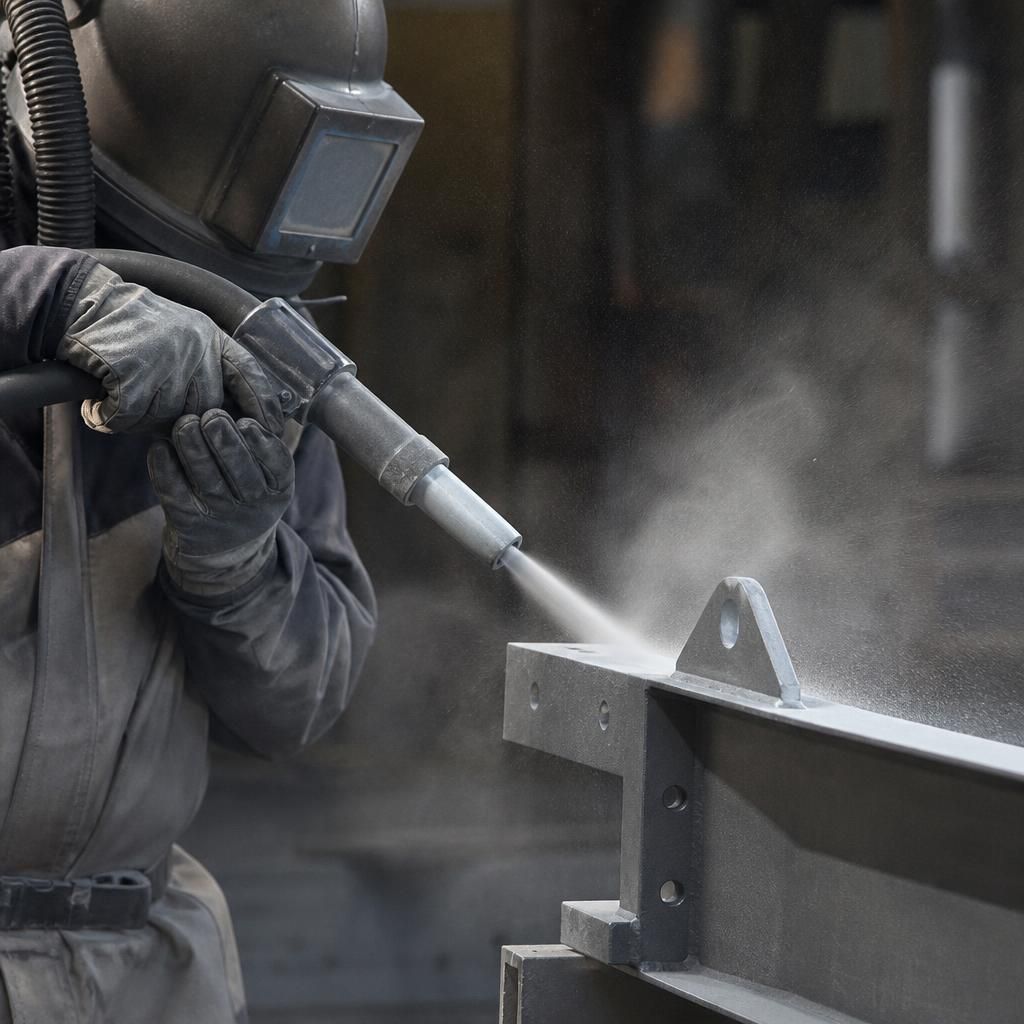
Sandblasting improves powder coating adhesion most effectively when the resulting surface profile is appropriate for the coating system and the component. The profile consists of the peaks and valleys formed in the metal by the abrasive, creating an interface for the cured coating to grip.
The profile must be considered alongside the intended coating thickness. If the abrasive creates excessively pronounced peaks, the powder may form a thinner film over their tips, leaving them more vulnerable to wear or corrosion. If the profile is too shallow, it may provide insufficient mechanical keying. Matching the blasting specification to the metal, powder system and required finish therefore helps produce a more secure and continuous coating interface.
Discuss surface preparation for your powder coating project
Discuss your powder coating project with a specialist to establish the appropriate blasting specification, surface profile and coating system for your metal components. Share the substrate, component design and intended service conditions so the preparation requirements can be assessed accurately.