

What specific conversion coatings are recommended for enhancing the adhesion of powder coatings in electrostatic applications?
The most suitable conversion coatings are typically iron phosphate for general steel, zinc phosphate where greater corrosion resistance is required, and chromate-free trivalent chromium or silane treatments for aluminium and other non-ferrous metals. Selection should reflect the substrate, required corrosion performance and powder system, with thorough rinsing and drying after treatment to provide a clean, chemically receptive surface for electrostatic powder adhesion.
Conversion coatings are thin, chemically formed layers that alter the metal surface before powder is applied. Their purpose is to replace a poorly receptive or chemically inconsistent surface with one that provides stronger mechanical and chemical attachment for the cured powder film. The most appropriate treatment depends on the metal, its existing oxide condition, the required corrosion resistance and the powder system being used.
For steelwork, the treatment should be matched to the exposure conditions and the way the component will be used. A lighter-duty conversion process may be suitable for indoor parts where corrosion demands are limited, while a more substantial phosphate-based system is generally considered where the coating must provide greater resistance to underfilm corrosion. The latter is particularly relevant when components may be exposed to condensation, road contamination, industrial atmospheres or damage at edges and handling points.
Aluminium requires a different approach because its naturally forming oxide layer can interfere with consistent powder adhesion. The pre-treatment must produce a stable, receptive surface without leaving residues that could cause blistering, poor wetting or uneven film formation. Non-ferrous treatments are therefore selected according to the alloy, the condition of the oxide layer and whether the part will experience outdoor exposure or contact with dissimilar metals.
Chromium-free systems are often considered where environmental, waste-handling or specification requirements restrict conventional chemistries. They can provide an effective basis for powder adhesion, but their performance depends heavily on correct bath control, contact time, rinsing and drying. A treatment should not be judged by its name alone: the complete process and the powder manufacturer’s requirements are equally important.
Silane and other thin-film technologies can be appropriate where a low-residue process is required or where the substrate mix includes aluminium and other non-ferrous metals. These treatments form a very thin coupling layer rather than a visibly substantial deposit. They are sensitive to contamination and application conditions, so cleaning quality and process control are especially important.
- Substrate: Identify the exact metal and alloy, including whether steel, galvanised material, aluminium or mixed-metal assemblies are present.
- Exposure: Consider indoor or outdoor use, humidity, salt, chemicals, abrasion and the likelihood of coating damage in service.
- Powder chemistry: Check compatibility with the intended powder resin and curing schedule. A pre-treatment that works well with one system may not be the best choice for another.
- Component design: Account for welds, folded areas, crevices, sharp edges and hollow sections, since these can retain cleaning solution or receive less consistent treatment.
- Specification: Where a project has a recognised corrosion or coating standard, select a process that can be verified against that requirement rather than relying on appearance alone.
Process discipline is critical. Degreasing and rinsing must remove oils, salts and cleaning residues before the conversion stage. The treated surface should then be rinsed adequately and dried without allowing flash rusting, water marks or recontamination. Excessive delay between pre-treatment and powder application can also allow the surface to absorb contamination or develop a new oxide layer.
Quality checks should include visual inspection for staining, bare areas, powdery deposits and water marks, together with checks that the treatment is reaching recessed and less accessible areas. Where the specification demands it, adhesion and corrosion testing should be carried out on representative panels or components. Testing is most useful when it reproduces the actual substrate, pre-treatment, powder and curing conditions rather than assessing each element in isolation.
Conversion coating is not a substitute for sound preparation. Heavy oxidation, mill scale, weld contamination, embedded abrasive or silicone residue must be removed by an appropriate preceding process. Likewise, a good conversion layer cannot compensate for poor powder application, inadequate film coverage or incorrect curing. The most reliable recommendation is therefore the chemistry that fits the substrate and service environment, supported by a controlled preparation sequence and verification of the finished system.
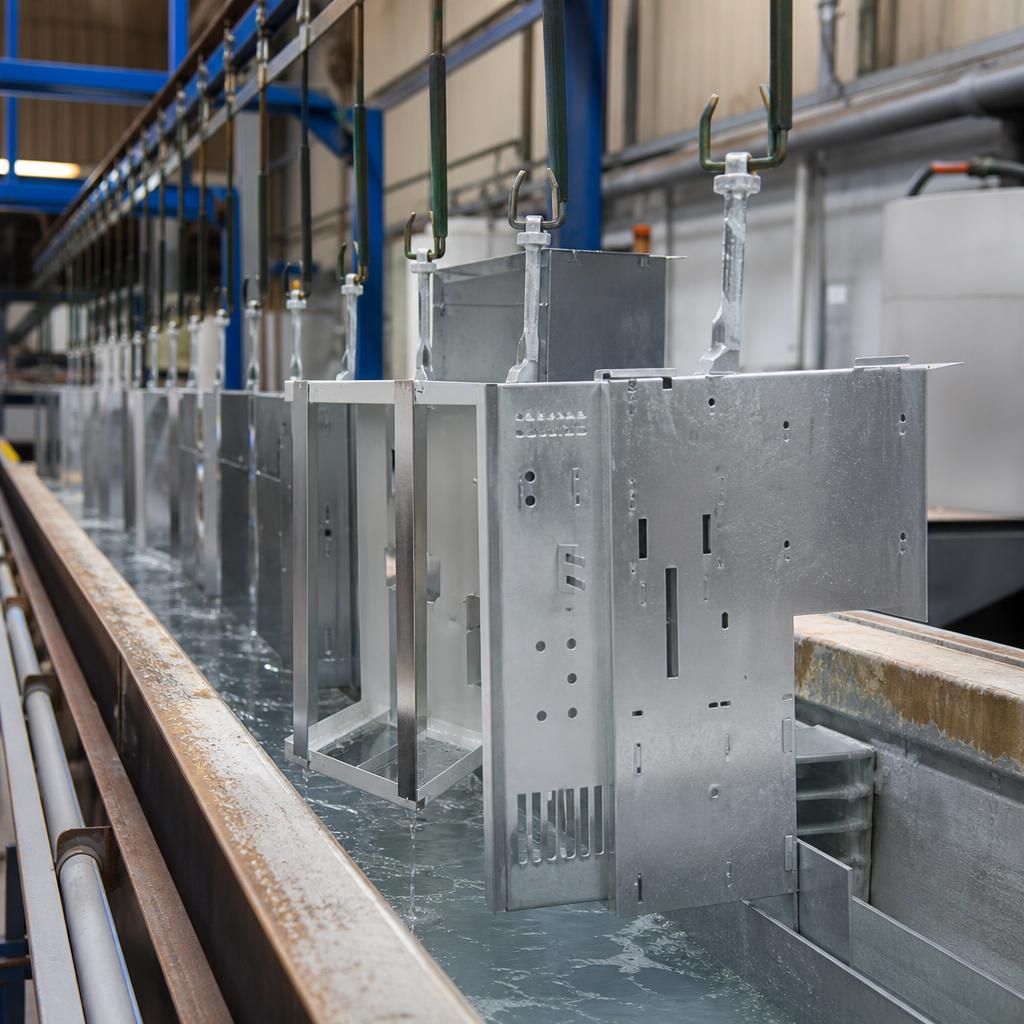
Galvanised steel needs particular care because the zinc surface does not respond in the same way as bare steel. A treatment selected for mild steel should not be assumed to provide equivalent adhesion on zinc-coated material. Zinc phosphate or a chromium-free passivation system may be appropriate, but the choice must be validated against the zinc coating, the powder chemistry and the required corrosion performance.
Mixed-metal assemblies create an additional complication: steel, galvanised sections and aluminium may react differently within the same pre-treatment sequence. Where practical, the process should be assessed on representative parts rather than a single test panel. This helps confirm that the conversion layer is consistent across each metal and that joints, overlaps and contact areas do not introduce adhesion or corrosion weaknesses.