

What are the key steps involved in preparing metal surfaces for powder coating?
Preparing metal surfaces for powder coating involves removing dirt, oil, rust and existing residues, followed by rinsing and drying to create a clean, stable surface. Depending on the metal and required finish, the component may then be mechanically abraded or blasted, chemically pre-treated and inspected before powder is applied and cured.
Preparing a metal component for powder coating is a controlled sequence that takes it from an assessed raw condition to a stable, coating-ready surface. The key stages are defining the coating requirements, correcting physical defects, selecting a compatible preparation route, protecting areas that must remain uncoated, establishing suitable fixturing and completing final quality checks before the component enters the spray process.
- Review the component and coating specification. Preparation should begin with the part’s material, dimensions, intended service conditions and required finish. The specification should identify areas that need full coverage, surfaces that must remain bare, threaded or close-tolerance features, electrical contact points and any permissible rack marks. This prevents a preparation method being chosen without considering how the finished component will be assembled or used.
- Identify the substrate and its existing condition. Steel, stainless steel, aluminium, galvanised metal and cast components can react differently during preparation and coating. The inspection should look for corrosion, mill scale, casting residue, embedded debris, previous coatings, oil trapped in seams, weld spatter, burrs, pits and sharp edges. Components with mixed materials or repair areas require particular care because different surfaces may need compatible treatment within the same process.
- Correct physical defects before the final surface treatment. Powder coating will follow the profile beneath it rather than conceal substantial fabrication defects. Burrs should be removed, weld spatter eliminated and rough transitions blended where the design permits. Welds should be continuous and suitably finished, while deep pits, porosity and damaged areas may require repair before coating. Sharp edges are especially important because powder tends to pull away from an acute edge during application and curing, leaving a thinner protective film at that point.
- Prepare edges, joints and drainage features. Enclosed sections, lap joints and folded areas can retain process liquids or release contamination during curing. Components should therefore be designed or modified to allow drainage and ventilation where appropriate. Holes, slots and hollow sections need to be checked for trapped moisture, while inaccessible crevices should be assessed for their effect on long-term corrosion protection. Edge radii, joint sealants and weld finishing should also be compatible with the specified coating system.
- Select the preparation route for the particular metal. The treatment sequence is determined by the substrate, its condition and the performance expected from the coating. Ferrous materials may need a different approach from aluminium or zinc-coated components, and castings can present pores that retain contaminants or release gas when heated. The chosen route should remove unwanted residues without distorting the component, excessively changing its profile or damaging areas that must remain dimensionally accurate.
- Control masking and contact points. Masking is part of preparation rather than an afterthought. Threads, bores, bearing seats, machined faces, hinges and electrical earth points may need suitable plugs, caps or other protection. Masking materials must tolerate the preparation and curing conditions and should not leave residue on the coating surface. Rack contact points also need to be planned so that the component is securely supported while limiting visible marks and maintaining a reliable electrical path during powder application.
- Manage handling between preparation stages. A correctly prepared surface can be compromised by fingerprints, dirty gloves, workshop dust, condensation or contact with contaminated handling equipment. Parts should be moved using clean methods and supported without allowing prepared faces to rest on unsuitable surfaces. Particular attention is needed after treatment of edges, apertures and recessed features, where residue or moisture may remain unseen.
- Carry out final process checks. Before coating, the component should be checked for remaining visible contamination, flash corrosion, abrasive residue, damaged masking, blocked holes and incomplete treatment. Depending on the process, practical checks may include examining the surface under suitable lighting, confirming that the final rinse condition is controlled and checking that no residue remains in recesses. The part should also be verified against the drawing or job specification so that preparation has not affected critical dimensions or functional surfaces.
- Release the component in a coating-ready condition. The final decision is not simply whether the metal looks clean. It must be sufficiently stable, dry, correctly masked, properly supported and compatible with the powder system and curing requirements. Any deviation, such as an inaccessible area, repaired weld or surface that cannot be treated conventionally, should be recorded and agreed before coating rather than discovered after the finish has been applied.
Good preparation also depends on communication between the fabricator and the coating provider. Drawings should identify masking limits, contact points and surfaces with tight tolerances, while the coating specification should state the required appearance and service performance. This information allows the preparation sequence to be matched to the component instead of applying the same treatment indiscriminately to every metal part.
For batch work, consistency is an additional consideration. Components should enter the process in a comparable condition, with the same preparation requirements identified for each item. This makes differences in substrate, fabrication quality or geometry easier to detect and helps prevent isolated defects being mistaken for coating failure. For specialist finishes or demanding industrial applications, the preparation method should be assessed as part of the complete coating system, since surface condition, masking, application and curing all influence the final result.
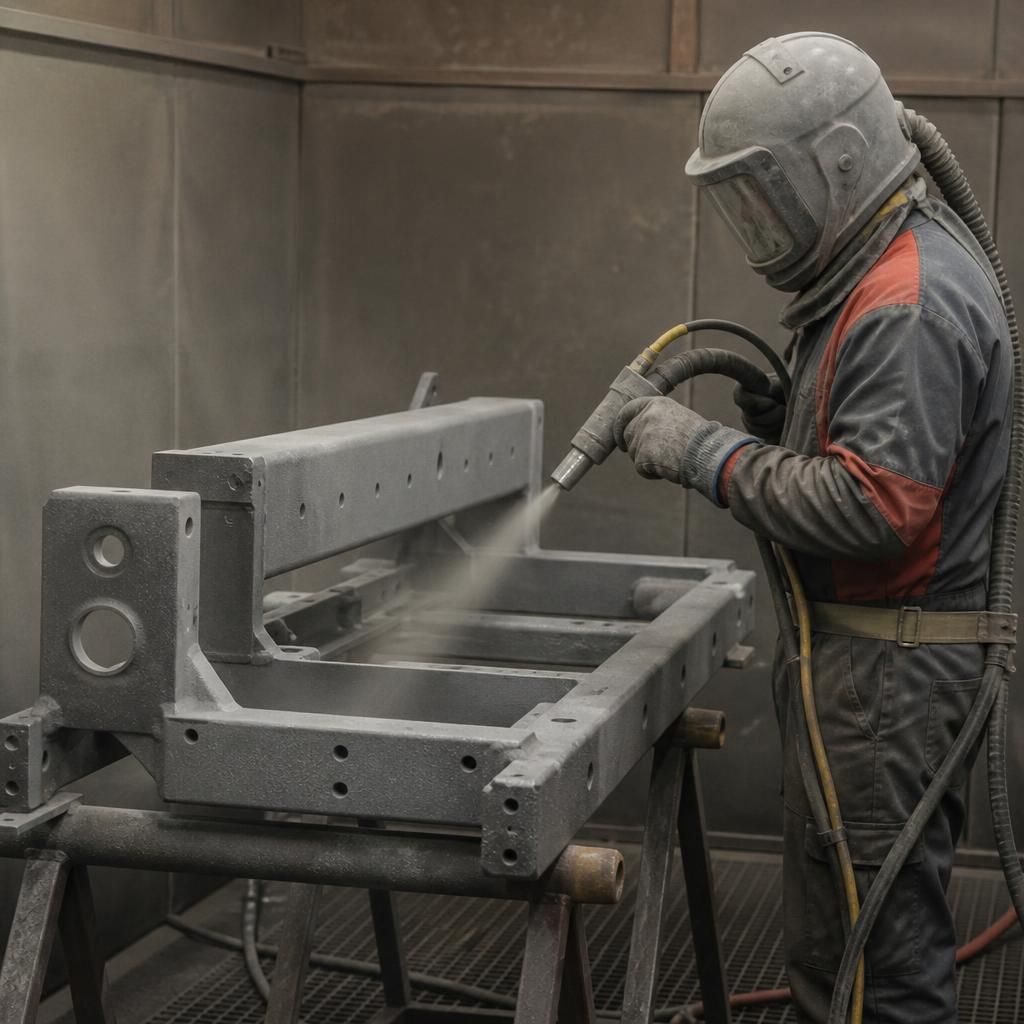
Mechanical abrasion or blasting can prepare a metal surface by removing tightly bonded scale, corrosion and previous coating while creating a controlled profile for the powder film to grip. The aim is not to make the surface as rough as possible, but to produce an even texture that suits the metal, coating system and required appearance.
After abrasion, the component should be examined for embedded abrasive, uneven treatment, exposed defects and areas that remain contaminated. Excessive blasting can alter edges, dimensions or the appearance of softer metals, while insufficient treatment may leave weakly bonded residues beneath the powder. The prepared surface must therefore be clean, consistent and free from loose material before any further chemical treatment or coating takes place.