

What are the advantages of choosing black powder coated sheet metal for industrial applications?
Black powder coated sheet metal provides a durable, corrosion-resistant surface with a consistent professional finish for industrial components and enclosures. It can withstand regular handling and environmental exposure while offering a clean appearance and reduced need for frequent recoating compared with many conventional painted finishes.
Black powder coated sheet metal offers industrial users a combination of design flexibility, finish consistency, dimensional practicality and long-term surface performance. Its advantages extend beyond appearance: the coating can help standardise manufactured components, support a professional product specification and provide a finish suited to enclosures, panels, guards, brackets, cabinets and fabricated assemblies.
Consistent appearance across batches
Powder coating is applied as a controlled dry film and then cured to form a continuous finish. This allows sheet metal parts manufactured at different stages to share a similar surface appearance, provided the same powder specification, preparation method and curing conditions are used. A consistent black finish can make assemblies look more uniform when they contain panels, covers and smaller ancillary components produced separately.
Black is also a practical colour for industrial products because it gives a neutral, understated appearance and works with many equipment designs. It can help create visual consistency across a product range without drawing attention to minor differences in the underlying metal or to variations between different component types.
Useful finish options for different designs
Black powder coating is available in different surface textures and gloss levels, subject to the coating specification. A smoother finish may suit equipment panels and enclosures, while a textured finish can provide a different tactile effect and may be useful where a less reflective surface is preferred. The choice should be made with the intended environment, cleaning method, appearance requirements and handling conditions in mind.
The finish can also be applied to components with formed profiles, folded edges and other sheet metal features. This makes it suitable for parts where a bare-metal appearance would not provide the required visual or specification benefits. The design still needs to account for coating build-up at edges, apertures and mating points, particularly where parts must fit together accurately.
Suitable for repeatable industrial production
For manufacturers and fabricators, powder coating can fit well into batch production because multiple similar components can be processed to the same agreed specification. A documented coating requirement can define the colour, gloss, texture, substrate preparation and inspection criteria. This helps reduce ambiguity when a component is reordered or incorporated into a larger assembly.
The coating is applied after fabrication, so the sheet metal can first be cut, folded, perforated, welded or otherwise formed. This supports efficient separation of metalwork and finishing operations. Parts should be designed and prepared with coating in mind: weld spatter, sharp burrs, oil, scale and contamination can affect the final result if they are not removed before coating.
Improved product presentation and identification
A black finish can give industrial equipment a defined visual identity and help distinguish finished assemblies from unfinished stock. On cabinets, machine guards and fabricated housings, it can provide a more complete appearance than untreated sheet metal. Where an assembly includes several visible panels, using one coating specification can make the finished product appear deliberately designed rather than assembled from visually mismatched parts.
Surface texture also affects how visible fingerprints, minor marks and reflections may be during normal use. The most suitable choice depends on whether the part is primarily decorative, frequently handled, exposed to strong lighting or subject to regular cleaning. A sample or trial piece can be useful where appearance is critical, since the result is influenced by the substrate, coating type, film thickness and curing process.
Practical performance in industrial assemblies
Powder coated sheet metal can be specified for components that experience routine contact, cleaning and general industrial use. The coating forms a bonded surface rather than a separate loose covering, which helps it function as part of the finished component. Its suitability still depends on the powder chemistry and the conditions involved, including exposure to chemicals, solvents, high temperatures, moisture, abrasion or impact.
Black coating can also make inspection and maintenance issues easier to identify in some applications. Loose contamination, light-coloured dust or exposed bright metal at a damaged area may be more noticeable against a dark surface. This can support visual checks, although a black finish should not be selected as a substitute for a defined inspection and maintenance procedure.
Points to assess before specifying it
- Confirm the sheet metal substrate and ensure the chosen coating system is suitable for it.
- Define the required black shade, gloss level and surface texture rather than specifying only “black”.
- Check dimensional tolerances at holes, threads, joints and close-fitting parts, because coating adds a film to the prepared surface.
- Identify exposure to chemicals, heat, ultraviolet light, moisture and abrasion so that the powder type is appropriate.
- Consider whether the part will be frequently touched or cleaned, as these factors influence the preferred texture and gloss.
- Agree preparation and inspection requirements for welds, edges, recesses and concealed faces.
Black powder coated sheet metal is therefore most advantageous where a manufacturer needs a repeatable, well-defined finish that combines a controlled industrial appearance with practical suitability for fabricated components. The best outcome comes from treating the coating as part of the component specification, rather than selecting colour separately from the substrate, design tolerances, preparation method and service environment.
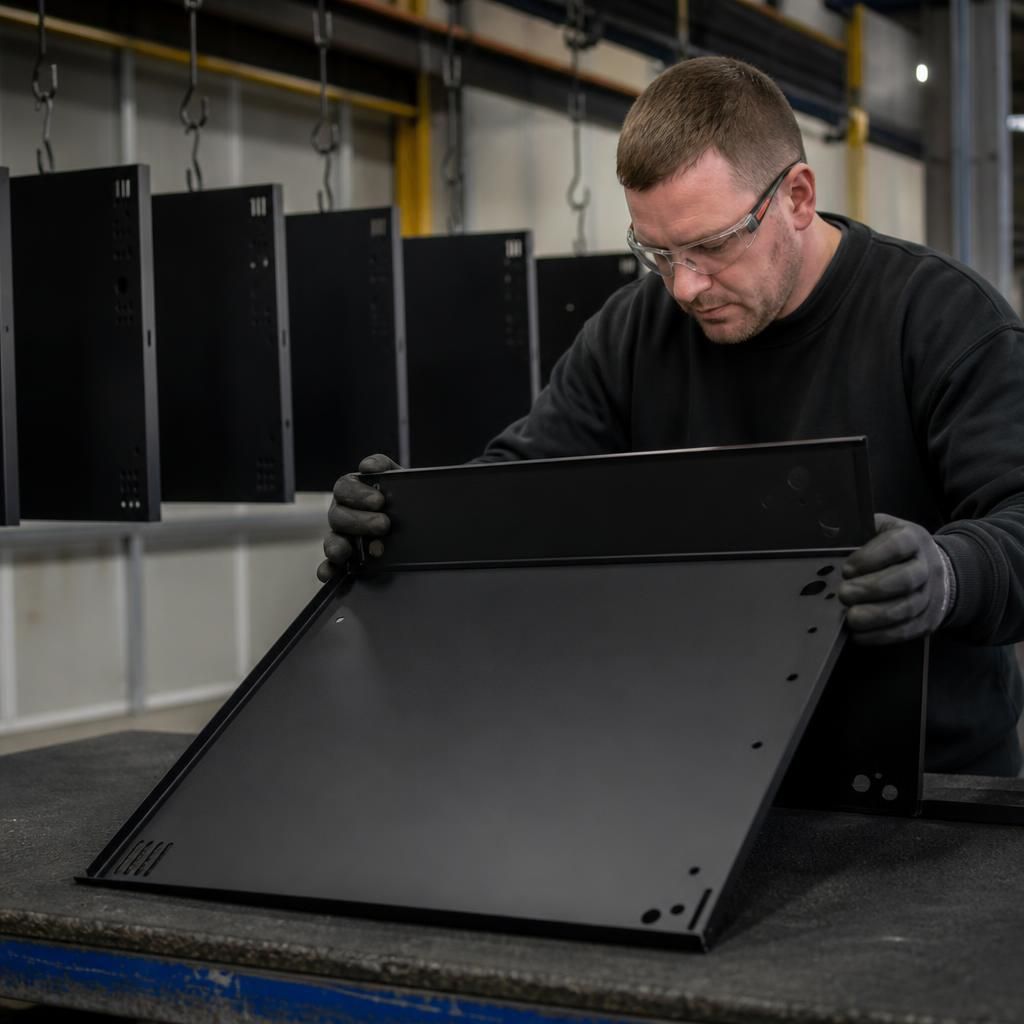
One practical advantage of black powder coated sheet metal is that the finish is fully cured before the component enters downstream assembly. Unlike a wet coating that must release liquid carrier as it dries, cured powder forms a dry, bonded surface that can be handled without transferring wet paint to adjacent parts. This can help protect the finish during fitting, packaging and installation, provided the specified cure has been achieved.
The benefit is particularly relevant to cabinets, panels and fabricated assemblies that pass through several handling stages. Parts can be inspected for coating defects before they are incorporated into a larger product, while the hard, continuous surface helps maintain the specified appearance during normal assembly work. Cure requirements, film thickness and the powder chemistry should still be matched to the sheet metal and intended service conditions.
Discuss your black powder coated sheet metal requirements
Discuss your black powder coated sheet metal requirements with our team, including the sheet metal specification, finish, expected service conditions and component dimensions. This helps identify a suitable coating approach for your industrial application.