

What are the advantages of using large-scale powder coating for industrial applications?
Large-scale powder coating provides durable, consistent finishes for high volumes of metal components while supporting efficient batch processing. The dry, electrostatically applied powder can also reduce material waste compared with conventional liquid coating, making it suitable for repeat industrial production.
Large-scale powder coating gives industrial manufacturers a robust, repeatable and adaptable method for finishing substantial quantities of metal components. Its main advantages extend beyond the appearance of the finished part: the correct powder system and pretreatment can improve resistance to wear, corrosion, chemicals and weathering while supporting controlled production and straightforward quality inspection.
Improved protection in demanding environments
A cured powder film forms a continuous coating over the prepared metal surface. Depending on the powder chemistry and specification, this can provide resistance to abrasion, impact, moisture, chemicals and ultraviolet exposure. That makes powder coating suitable for components used in manufacturing equipment, construction products, vehicle-related applications, enclosures, frames and fabricated assemblies.
Protection depends on more than the powder itself. Degreasing, removal of mill scale or corrosion, suitable conversion treatment and correct curing all affect the performance of the finished coating. For components exposed to outdoor conditions, corrosive atmospheres or repeated handling, the coating specification should therefore be selected alongside the required pretreatment rather than treated as a purely cosmetic choice.
Lower maintenance demands
A suitably specified coating can help protect the underlying metal from moisture and everyday mechanical contact. This may reduce the need for frequent recoating or touch-up work during the service life of the component. The practical benefit is particularly relevant where parts are installed in difficult-to-access locations or where removing equipment for refurbishment would disrupt production.
Consistent specification across product ranges
Industrial projects often involve multiple components that must share a defined colour, gloss level, texture or performance grade. Powder coating allows these requirements to be recorded as part of a coating specification and applied across repeat production. This supports easier comparison between batches and helps purchasing, production and quality teams work to the same documented requirements.
Consistency still requires suitable controls. The substrate condition, powder application, film build, oven profile and handling method should be monitored because variation in any of these stages can affect the final result. Samples, agreed reference panels and inspection criteria can be useful when appearance is important.
Wide range of functional and visual finishes
Powder systems are available in different colours, gloss levels, textures and performance grades. This gives designers and manufacturers scope to distinguish product ranges, match established colour schemes or specify a surface suited to the way a component will be used. Textured finishes can also provide a different tactile appearance and may be appropriate where a less reflective surface is required.
Colour and finish should be selected with the service environment in mind. A decorative finish intended for internal use may not provide the same weathering performance as a powder formulated for external exposure. The required appearance, environment and substrate should be considered together before production begins.
Efficient use of coating material
Powder is applied as a dry material, so it does not require a liquid solvent carrier to form the coating. Overspray can sometimes be collected and reused in suitable controlled systems, although reclaim arrangements depend on the equipment, colour management and specification. These characteristics can help reduce material handling and support more efficient use of the coating medium, provided the process is properly managed.
The absence of solvent evaporation also changes how the process is controlled. Powder must be applied to the required film thickness and then cured to the supplier’s specification. Excessive application is not a substitute for correct preparation or curing and can affect appearance and performance.
Practical benefits for industrial components
- The finished surface is dry after curing and suitable for controlled handling once it has cooled sufficiently, reducing the problems associated with moving parts while a liquid coating is still drying.
- A single cured film can provide both the required appearance and a protective surface, avoiding the need to specify a separate decorative treatment where the powder system meets both requirements.
- Standardised coating instructions make it easier to repeat an approved finish across different component sizes and production runs.
- Powder finishes can be applied to many steel, iron and aluminium components when the substrate, preparation method and curing conditions are compatible.
Environmental and workplace considerations
Because powder coating is a dry process rather than a conventional solvent-based liquid application, it can reduce reliance on solvent-containing coating materials and the associated vapour emissions. It also avoids the need to manage liquid paint residues in the same way. These benefits do not remove the need for extraction, housekeeping, personal protective equipment or proper handling of coating powders.
When the advantages are greatest
Large-scale powder coating is most beneficial where components are made from a compatible metal, can be prepared consistently, and can withstand the heat required for curing. It is particularly suitable when a project needs a repeatable protective finish across many parts or a mixture of component types covered by a defined specification.
It may be less suitable for heat-sensitive substrates, assemblies containing materials that cannot tolerate the curing cycle, or parts with inaccessible areas that cannot be cleaned and coated effectively. Reviewing the component design, operating environment, required finish and inspection criteria before processing helps determine whether powder coating is the appropriate industrial treatment.
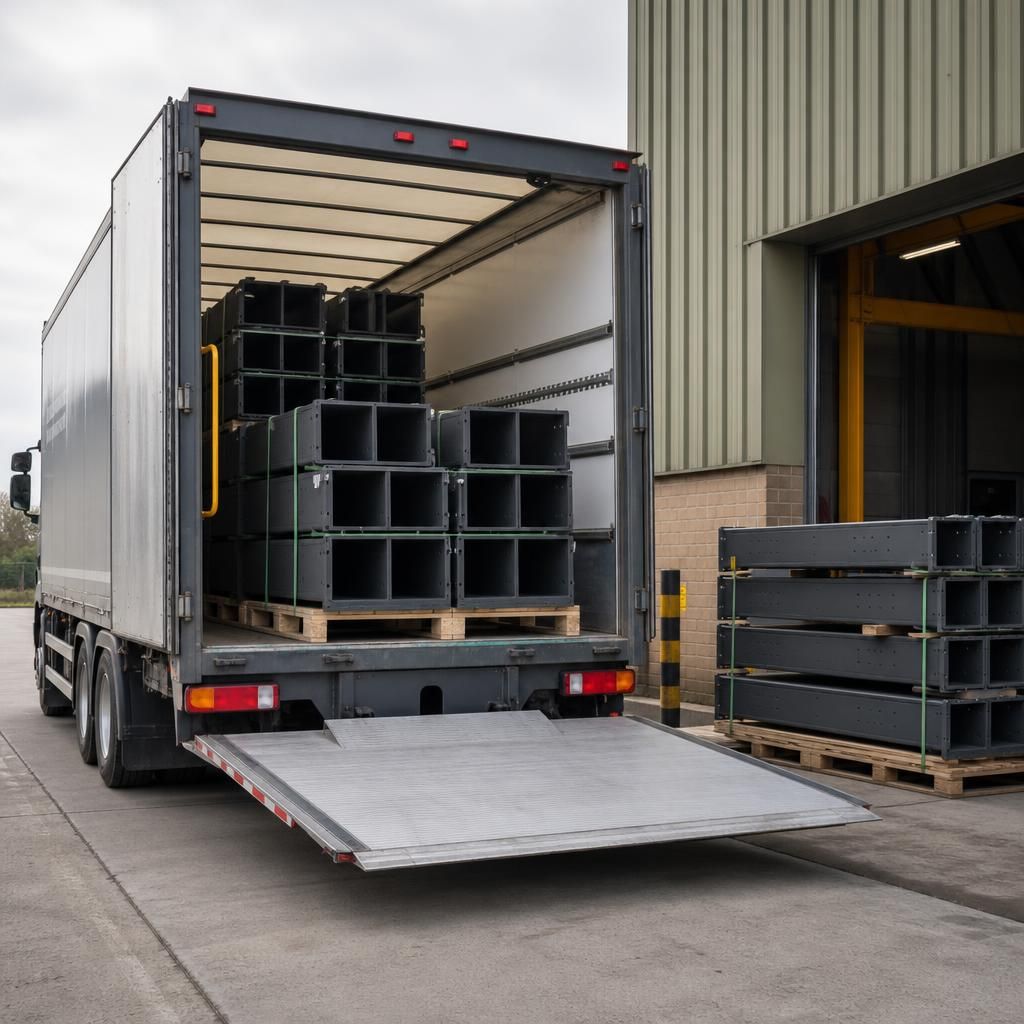
For industrial projects, collection and delivery options can be a practical advantage of using a regional powder-coating service. Coordinating the movement of components reduces the need for a business to arrange separate transport between its facility and the coating process. This can simplify project planning, particularly when parts are supplied in planned batches or require return transport after curing and inspection.
Discuss your large-scale powder coating requirements
Discuss your large-scale powder coating requirements with our team, including component details, production volumes, finish specifications and service environment. We can help assess the most suitable coating approach for your industrial application.