

What are the main benefits of choosing electrostatic powder coating for stainless steel over traditional liquid coatings?
Electrostatic powder coating gives stainless steel a hard, durable finish with strong corrosion and chemical resistance, while allowing efficient transfer of powder and a consistent coating across suitable components. Compared with traditional liquid coatings, it produces little or no solvent-related emissions and can reduce overspray waste, making it a practical choice for demanding industrial applications.
The main benefits of electrostatic powder coating for stainless steel are a controlled dry application, a wide choice of decorative finishes, reliable repeatability in batch production and a clean, hard-wearing surface once cured. Compared with traditional liquid coatings, powder is particularly well suited to stainless steel components that can be prepared, coated and oven-cured in a controlled industrial process.
Greater choice of appearance
Powder systems are available in many colours, gloss levels and surface textures. This allows stainless steel parts to be matched to a product design, corporate colour scheme or surrounding structure without relying on the bare-metal appearance of stainless steel. Textured finishes can also help disguise minor visual variations in the underlying surface, although they cannot replace proper preparation where scratches, weld marks or contamination are present.
Efficient dry-film processing
Liquid coatings normally need a wet film to settle and dry before the component can be handled or moved to the next stage. Powder is applied as a dry material and then fused during curing, so the coating process does not depend on the same type of solvent or water evaporation. This can make the finish easier to integrate into a controlled production sequence, provided the component can safely pass through a suitable curing oven.
Good repeatability for manufactured parts
For manufacturers and fabricators producing repeated stainless steel components, powder coating supports a defined process based on substrate preparation, powder application and curing. Using the same preparation method, powder specification and cure conditions helps reduce variation between production batches. This is valuable where coated brackets, panels, frames, housings or fabricated assemblies need a closely matched appearance.
Suitable for functional and decorative requirements
Powder can be selected to provide more than a change of colour. The specification may take account of the component’s exposure, expected handling and required surface appearance. The correct choice of powder and pretreatment helps the finished coating perform as intended on stainless steel, rather than treating every application as a standard decorative finish.
Potentially simpler handling after curing
Once the powder has been correctly cured, the coating forms a solid film rather than remaining as a wet layer that can be marked during movement. This can be useful for fabricated parts that must be handled, packed or incorporated into larger assemblies. The part must still be allowed to reach the required cure condition, and unsuitable handling before that point can damage the finish.
Important conditions for achieving these benefits
Stainless steel requires careful preparation because surface contamination, polishing residues, grease and passivation characteristics can affect adhesion. Cleaning, suitable pretreatment and appropriate masking should be considered before coating. The powder must also be compatible with the required service conditions, component geometry and curing temperature.
- Check that the complete component can be heated to the required curing condition without affecting dimensions, inserts or assembled parts.
- Identify areas that must remain uncoated, including threads, electrical contact points, earth points and close-fitting interfaces.
- Confirm that the chosen finish is suitable for the component’s exposure, cleaning regime and handling requirements.
- Use test panels or representative components where the stainless grade, surface condition or design is unfamiliar.
Powder coating is not automatically the best option for every stainless steel item. Liquid coating may be more practical for heat-sensitive components, very large structures that cannot enter an oven, or isolated repairs where only a small area is being treated. Powder generally offers the stronger process advantages when stainless steel parts are suitable for factory preparation and controlled curing, particularly in repeat or batch manufacture.
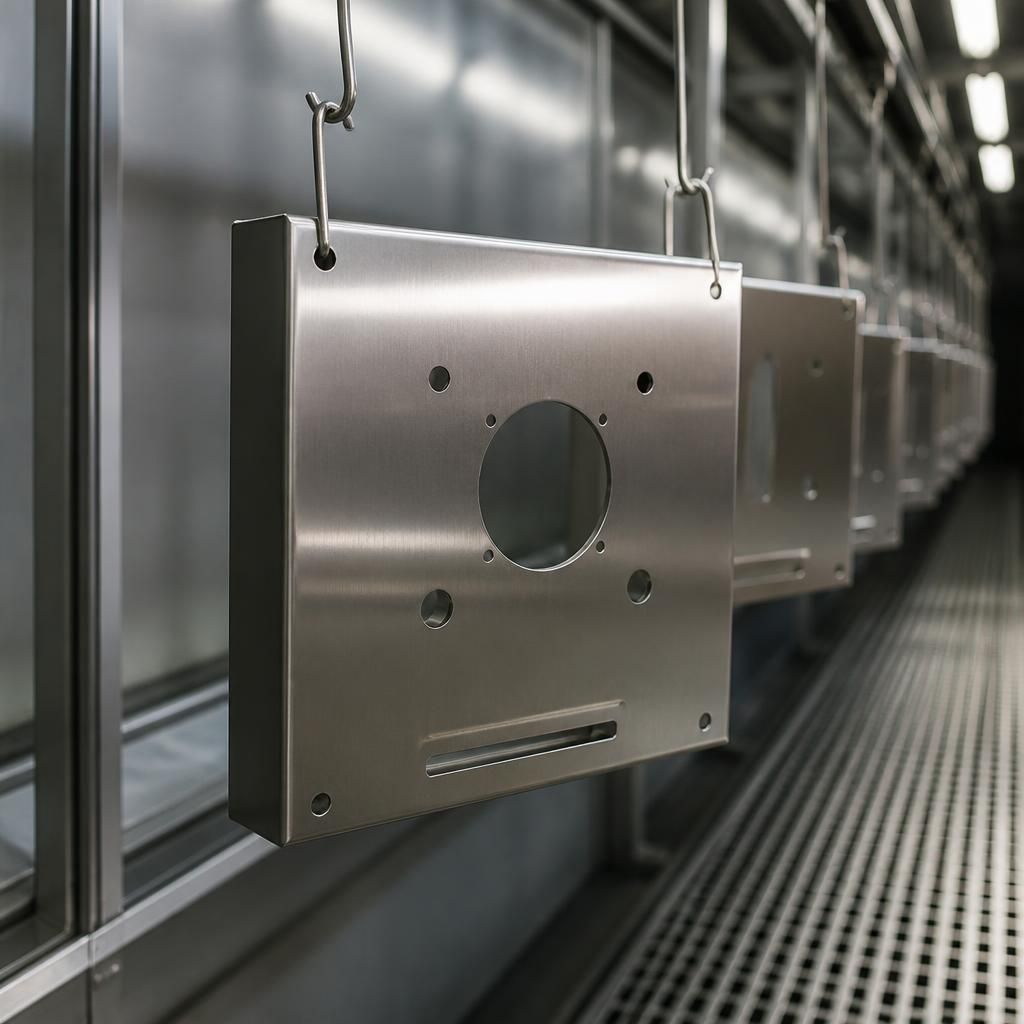
A key advantage of electrostatic powder coating is that the final film is formed under controlled curing conditions rather than by relying on liquid coating to dry in the surrounding atmosphere. This reduces the influence of airborne dust, changing humidity and solvent evaporation on the finished appearance, provided the stainless steel component is correctly prepared and the specified cure cycle is achieved.