

What is the importance of selecting the right blasting media for surface preparation?
Selecting the right blasting media is important because it determines how effectively contaminants are removed and what surface profile is created on the metal. The correct abrasive prepares the substrate for strong powder coating adhesion without causing unnecessary damage, distortion or an unsuitable finish.
Selecting the right blasting media is important because abrasive properties must match the metal, coating specification and condition of the component. Media that is too aggressive can remove sound material or alter the part, while media that is too mild may leave residues, corrosion or coatings that interfere with subsequent powder coating. The choice therefore affects process control, component integrity and the consistency of the finished work.
Different abrasives vary in hardness, shape, density, particle size and impact behaviour. These characteristics determine how the media acts on the surface:
- Hardness: a harder abrasive can remove firmly bonded coatings, rust and scale, but may be unsuitable for softer metals or thin sections.
- Particle shape: angular particles tend to cut into surface contamination, whereas rounded particles deliver a less cutting form of impact.
- Particle size: coarse media can remove substantial contamination efficiently, while finer media provide greater control on smaller or more detailed components.
- Density: denser particles transfer more impact energy, which can be useful for stubborn material but requires careful control on delicate parts.
- Cleanliness: the abrasive must not introduce substances that could remain on the substrate or affect the powder coating process.
The substrate is one of the most important considerations. Steel, aluminium, galvanised materials and other metal types do not respond identically to blasting. A treatment suitable for heavy steel fabrication may be unnecessarily severe for aluminium, which is more vulnerable to surface alteration and distortion. Galvanised surfaces also require a controlled approach because excessive abrasion can damage the zinc layer that provides corrosion protection. Components with thin walls, sharp edges, machined areas, threaded sections or close tolerances may need particularly careful media selection and operating parameters.
Existing surface condition also determines what is required. Light oxidation, mill scale, old coating, welding residue and embedded dirt present different removal challenges. Using the same abrasive for every part can lead to inefficient processing or inconsistent results. A suitable selection removes the relevant contamination while preserving features that must remain dimensionally accurate, such as holes, slots, threads and mating faces.
Media selection also influences the risk of abrasive becoming embedded in the substrate. Any foreign material left in the surface can create a contamination issue, particularly where the component will be powder coated or used in a demanding environment. For this reason, the abrasive, blasting equipment and handling procedure need to be considered together. Parts may require cleaning, inspection or further preparation after blasting so that loose particles and residues are not carried into the coating stage.
Dust generation is another practical factor. Some media produce more airborne dust than others, affecting visibility, housekeeping, equipment maintenance and operator protection. Media that can be recovered and reused may support more consistent processing, provided it is monitored and kept free from contamination. As abrasive breaks down during use, its performance changes; relying on worn or contaminated media can produce variable results across a batch.
The correct choice should therefore be based on the complete specification rather than the appearance of the raw material alone. Relevant considerations include:
- the metal type, thickness and geometry;
- the nature and severity of existing contamination;
- the required degree of preparation before powder coating;
- dimensional tolerances and areas that must be protected;
- the required visual finish and texture;
- whether abrasive recovery, waste handling or low-dust processing is important; and
- any customer or end-use requirements affecting corrosion protection and coating performance.
Effective preparation is not simply a matter of using the most powerful abrasive. Operators must match the media to the component and control variables such as impact pressure, nozzle distance, angle, traverse speed and exposure time. These settings determine how the selected abrasive behaves in practice. A well-chosen medium can still cause problems if the application is uncontrolled, while a carefully adjusted process can provide repeatable preparation without unnecessary treatment of the metal.
Inspection remains important after blasting. The surface should be checked for remaining contamination, uneven treatment, excessive roughness, embedded particles, sharp raised edges and signs of distortion. Where components are supplied in batches, consistent media condition and process settings help reduce variation between individual parts. This is particularly relevant to manufacturers and fabricators whose components must meet a defined coating or assembly specification.
For businesses preparing metalwork for powder coating, discussing the substrate, existing finish, component dimensions and intended use with the coating specialist helps establish a suitable blasting approach. The objective is a clean, controlled and compatible surface that is ready for the next treatment without compromising the underlying component.
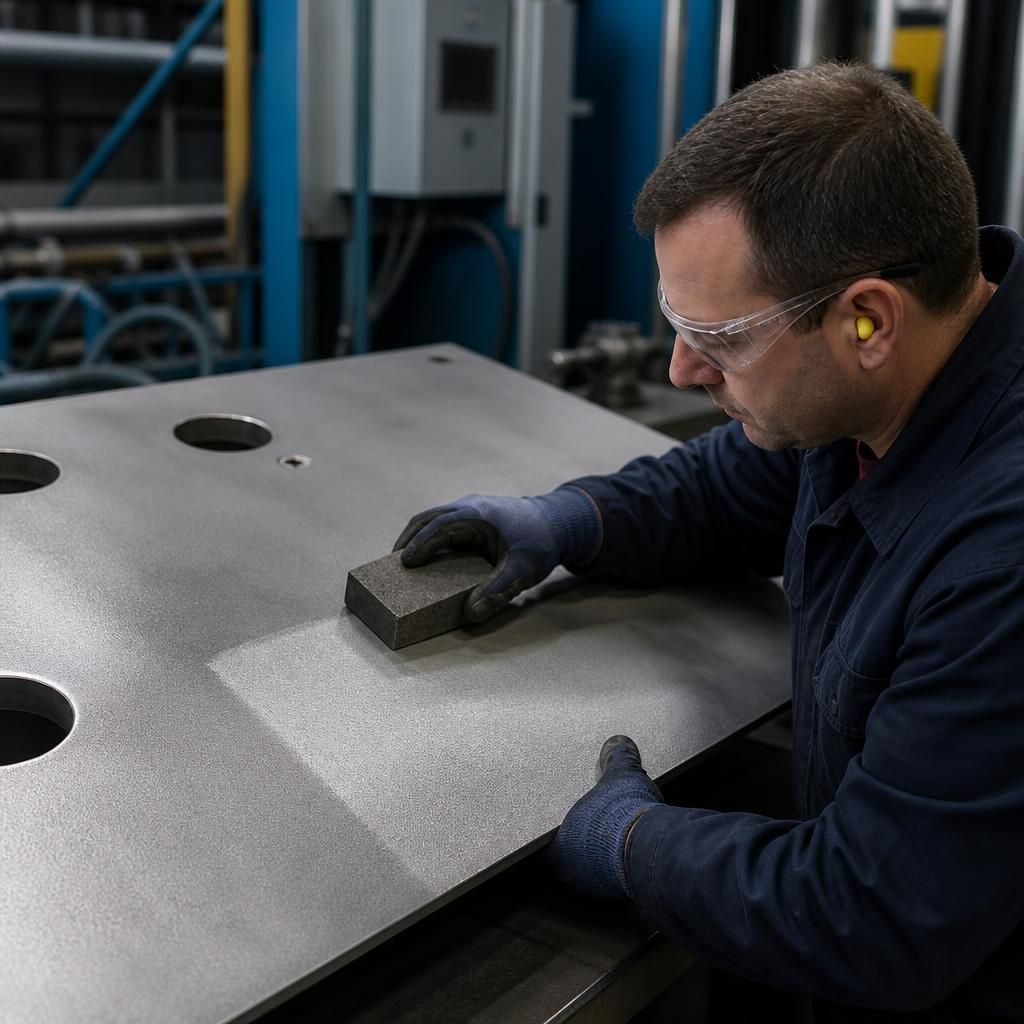
Abrasive selection is often confirmed on a representative test area before the full batch is processed. This allows the preparation team to assess whether the chosen media removes the existing finish cleanly and produces the required surface without affecting edges, apertures or other critical features.
The test area can also reveal practical issues that may not be apparent from the material specification alone, such as uneven treatment on complex shapes or an appearance that does not suit the intended coating system. If the result is unsuitable, the abrasive or blasting parameters can be adjusted before production begins, reducing the risk of processing an entire batch to an incorrect standard.
Discuss the Right Blasting Media for Your Components
Discuss your component requirements with Hamilton Industrial Powder Coating to help identify a suitable blasting media and preparation approach for the intended powder coating system. Provide details of the metal, existing finish and component design so the process can be assessed before production.