

How is black powder coated aluminium different from other powder coating finishes?
Black powder coated aluminium uses the same electrostatic powder application and curing process as other powder-coated finishes, but its black pigment gives it a distinct appearance and can absorb more solar heat than lighter colours. Compared with liquid paint or uncoated aluminium, it provides a consistent, cured finish with different texture, gloss and maintenance considerations depending on the powder formulation selected.
Black powder coated aluminium is distinguished mainly by its colourant, light absorption and visual behaviour rather than by a fundamentally different coating method. Its performance depends on the complete powder specification—resin, pigment, gloss level, texture and curing requirements—so black should not be treated as automatically more durable or more suitable than every other finish.
Colour and appearance
Black produces a strong, uniform appearance that can make aluminium components look more defined and visually substantial. It is available in different gloss levels and surface textures, including smooth, satin, matt and textured finishes. These choices affect how the surface reflects light, how pronounced its colour appears and how readily surface marks are seen.
Compared with white or pale colours, black generally shows dust, dried water marks, fingerprints and light scratches more readily. A matt or fine-textured surface can reduce reflections, but it may be more difficult to clean than a smooth finish. Metallic powders also behave differently: their visual effect can vary with spray direction, part orientation and batch consistency, whereas a standard solid black is normally selected for a more uniform colour impression.
Heat and thermal behaviour
Black surfaces absorb more of the sun’s radiation than lighter finishes, which can result in higher surface temperatures when aluminium is exposed to strong sunlight. This matters for external profiles, housings, panels, guards and components positioned close to heat-sensitive materials. The coating colour is only one part of the assessment; component geometry, ventilation, exposure, the aluminium alloy and the surrounding assembly also influence the final temperature.
For applications where heat build-up could affect dimensions, seals, electronics or adjacent materials, the colour should be considered alongside the operating environment. A lighter shade may reduce solar absorption, while a specialist formulation or design modification may be more appropriate where the component has a demanding thermal role.
Durability is formulation-dependent
Black powder coating is not inherently tougher simply because it is black. Resistance to impact, abrasion, chemicals, weathering and ultraviolet exposure is determined by the selected resin system, pigment package, film build, preparation of the aluminium and curing conditions. A black architectural-grade formulation, for example, may be specified for different exposure requirements from an industrial formulation intended for interior equipment.
Colour stability is also formulation-dependent. Extended ultraviolet exposure can cause some finishes to lose gloss or alter in colour, particularly where the powder is not selected for the relevant external environment. When comparing black with another colour, the correct comparison is between equivalent powder grades and specifications, not colour alone.
Effect of the substrate and preparation
Aluminium requires suitable preparation before powder application. The surface must be clean and free from contaminants, and the preparation system must be compatible with the alloy and the intended service conditions. Poor preparation can lead to adhesion problems, regardless of whether the chosen finish is black, white, metallic or another colour.
Aluminium’s relatively soft surface can also be marked during handling before coating. On visible black components, small dents, scratches, inclusions and unevenness may be more noticeable because of the contrast between the dark surface and any exposed metal. Good handling, appropriate masking and careful inspection are therefore particularly important for appearance-critical parts.
Comparison with common alternatives
- White and light colours: These usually reflect more sunlight and can make dust or minor surface marks less visually prominent, although they may show certain stains and discolouration clearly.
- Grey and neutral colours: These can offer a less visually stark appearance than black while still providing a modern, industrial finish. Their suitability still depends on the powder grade and exposure conditions.
- Metallic finishes: These can provide a metal-like appearance but may need tighter process control to maintain a consistent visual effect across batches and component orientations.
- Textured finishes: These can disguise minor surface irregularities and reduce reflected glare, but dirt can collect in the texture and cleaning may require more attention.
- Clear powder coatings: These preserve more of the aluminium’s underlying appearance, so preparation quality and the condition of the substrate remain highly visible.
Specification and quality checks
The most suitable finish should be selected by considering the part’s location, expected handling, exposure to sunlight and chemicals, required appearance, permissible colour variation and cleaning method. The specification should identify the powder grade, colour reference, gloss or texture, preparation requirements, target film thickness and curing parameters. These details help distinguish a finish selected for a particular duty from one chosen only for appearance.
For batch-produced aluminium parts, colour comparison should be made under consistent lighting and against an agreed reference. A black finish can appear different under direct light, diffuse light and artificial lighting, while changes in gloss or texture can alter the perceived depth of colour. Components should also be inspected for coverage, contamination, runs, pinholes, impact damage and masking accuracy before they are assembled.
In practical terms, black powder coated aluminium is usually chosen for its defined visual character, compatibility with a wide range of industrial designs and potential suitability for durable metal components. It differs from other powder coating finishes through its optical and thermal characteristics, not through an automatic advantage in every performance category. The correct choice is the black powder formulation and specification that match the aluminium component’s environment, appearance requirements and service conditions.
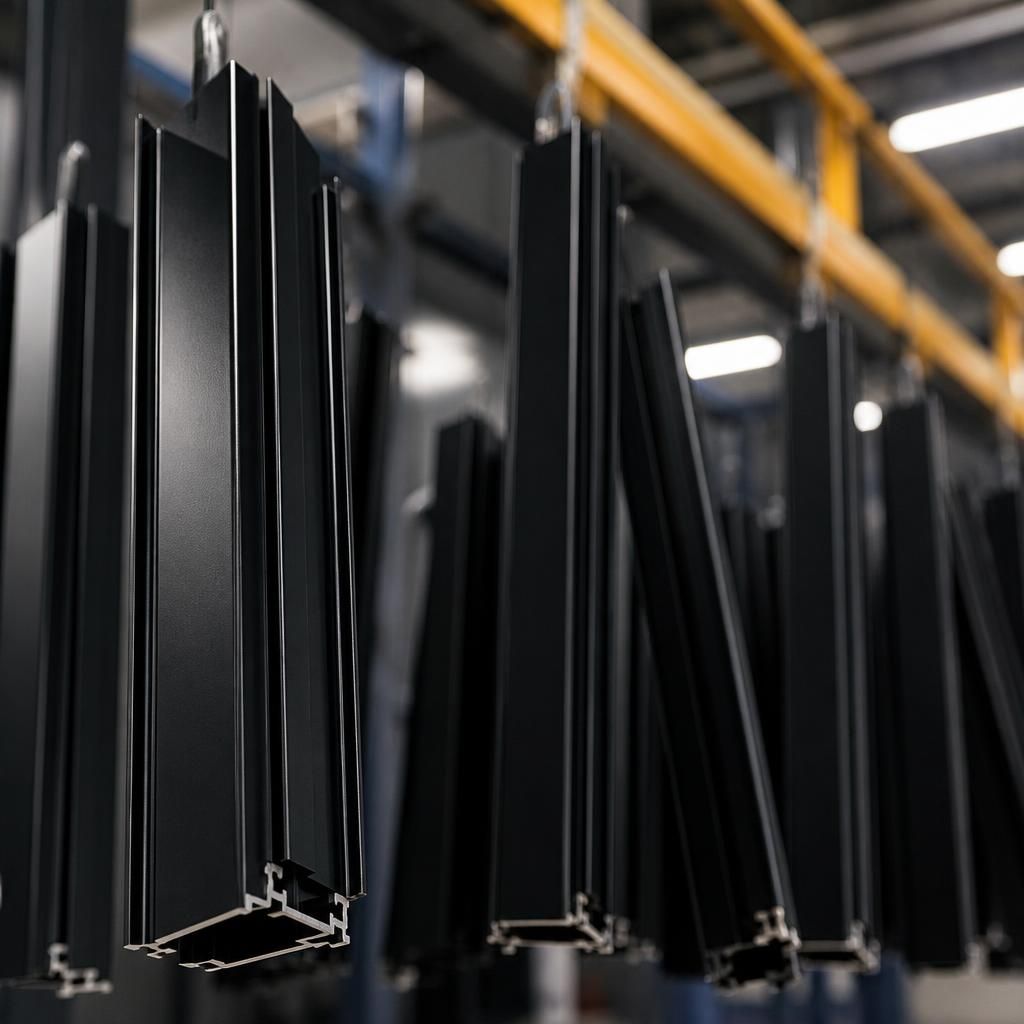
Black powder coating should not be confused with black anodising, even though both can produce a dark finish on aluminium. Powder coating applies a separate, cured polymer layer over the prepared metal, while anodising alters the aluminium’s surface through an electrochemical process. The two finishes therefore differ in surface character, specification requirements and how they should be assessed.
This distinction matters when replacing an existing finish or matching adjacent components. A powder-coated part should be specified by its powder grade, colour reference, gloss or texture and required coating performance rather than simply described as “black aluminium”. Confirming the finishing process at the design stage helps prevent unsuitable comparisons and ensures that appearance and service requirements are evaluated on a like-for-like basis.
Discuss your black powder coated aluminium requirements
Discuss your black powder coated aluminium requirements with our powder coating specialists, providing details of the components, intended environment and preferred appearance. This will help establish a suitable coating specification for your application.