

What factors should I consider when selecting a high gloss powder coat for my project?
When selecting a high gloss powder coat, assess the required durability, colour and gloss level, metal substrate, exposure conditions, pre-treatment requirements and expected maintenance. Also consider batch size, component dimensions, finish consistency, compatibility with any performance or safety requirements, and the total project cost.
Selecting a high gloss powder coat requires a written finish specification covering appearance, resin chemistry, resistance requirements, application tolerances and future repair. The term “high gloss” describes the reflectivity of the surface, but it does not define how well the coating will withstand chemicals, abrasion, sunlight, cleaning or handling. A suitable specification therefore needs to address both the visual result and the conditions the finished component will face.
Define the required appearance precisely. Gloss level should be treated as a measurable finish characteristic rather than a subjective description. Agree how the surface will be assessed, including acceptable variation in gloss, colour, texture, orange peel, pinholes, inclusions and surface waviness. A highly reflective finish can make minor imperfections more visible than a satin or textured coating, particularly on broad, flat panels. If visual uniformity is important, specify the viewing conditions, inspection distance and acceptable limits before production begins.
Colour selection also needs more detail than a general colour name. Where the coating must match an existing assembly, painted component or corporate colour, compare a physical sample under suitable lighting rather than relying solely on a screen image or colour reference. Metallic, pearlescent and effect powders can be especially sensitive to application direction and film build, so components that will be seen together should be processed under consistent conditions. A sample panel or trial component can help confirm the intended combination of colour, gloss and surface appearance before the full batch is coated.
Choose the resin system for the use case. Powder coatings are formulated for different performance profiles. Polyester-based systems are commonly selected where resistance to weathering and sunlight is important, while epoxy systems are often considered for internal applications requiring chemical or corrosion resistance but limited exposure to ultraviolet light. Hybrid systems may suit particular indoor requirements. These are general selection principles rather than substitutes for the coating manufacturer’s technical data, because the correct formulation depends on the complete service environment.
Consider the substances that may contact the component, not just general wear. Oils, fuels, detergents, solvents, salts, process chemicals and cleaning agents can affect coatings in different ways. The temperature of exposure, duration of contact and frequency of cleaning may be as important as the chemical itself. Ask for resistance information relevant to the actual application and distinguish between occasional splashes, prolonged immersion and repeated wiping.
Check the design and coating specification together. Sharp external edges, deep recesses, narrow gaps, threaded sections and enclosed cavities can affect powder coverage and the final appearance. Parts may also need defined masking areas for electrical contact points, earth connections, bearing seats, threads or close-tolerance faces. Identify these features on the drawings before coating so that masking, hanging and contact arrangements can be planned without compromising the visible finish.
Dimensional requirements deserve particular attention where coated parts fit together or interact with moving components. Powder adds a measurable film to the surface, so critical bores, threads, mating faces and locating features may require protection or post-coating inspection. If a component has tight tolerances, provide the coater with the relevant limits rather than assuming that all surfaces can be coated uniformly.
Establish consistency requirements for production. For repeat work, record the approved powder specification, colour, gloss, texture, film-build range and inspection method. Consistency can be affected by powder storage, application settings, curing conditions, part orientation and the way components are hung. Components that are intended to appear as one assembly should be considered as a single visual group, even if they are manufactured or coated in separate batches.
Ask how non-conforming parts will be assessed and handled. A decision is needed on whether minor cosmetic variation can be accepted, whether a part can be stripped and recoated, and which surfaces are critical to function. Rework may not reproduce the original appearance exactly, particularly where the replacement powder or application conditions differ, so an agreed acceptance standard is more useful than an informal expectation of a “perfect” finish.
Consider installation, maintenance and repair. A high gloss surface may show fingerprints, scuffs, dust and local damage more readily than a lower-sheen finish. Select cleaning methods that are compatible with the coating and avoid specifying aggressive chemicals without confirming their suitability. Also consider whether the finished item can be removed for professional recoating or whether small areas will need local repair in place. Powder coating is generally applied in a controlled process, so touch-up materials and colour matching should be discussed where future repairs are likely.
Finally, compare quotations against the complete technical scope rather than the powder price alone. Check whether the proposal covers inspection, masking, hanging, packaging, documentation, sample approval, rework arrangements and any special handling required by the component design. For a B2B project, providing accurate drawings, quantities, finish samples and service-environment information enables a coating specialist to identify risks before production and recommend a high gloss system that is practical to apply and assess.
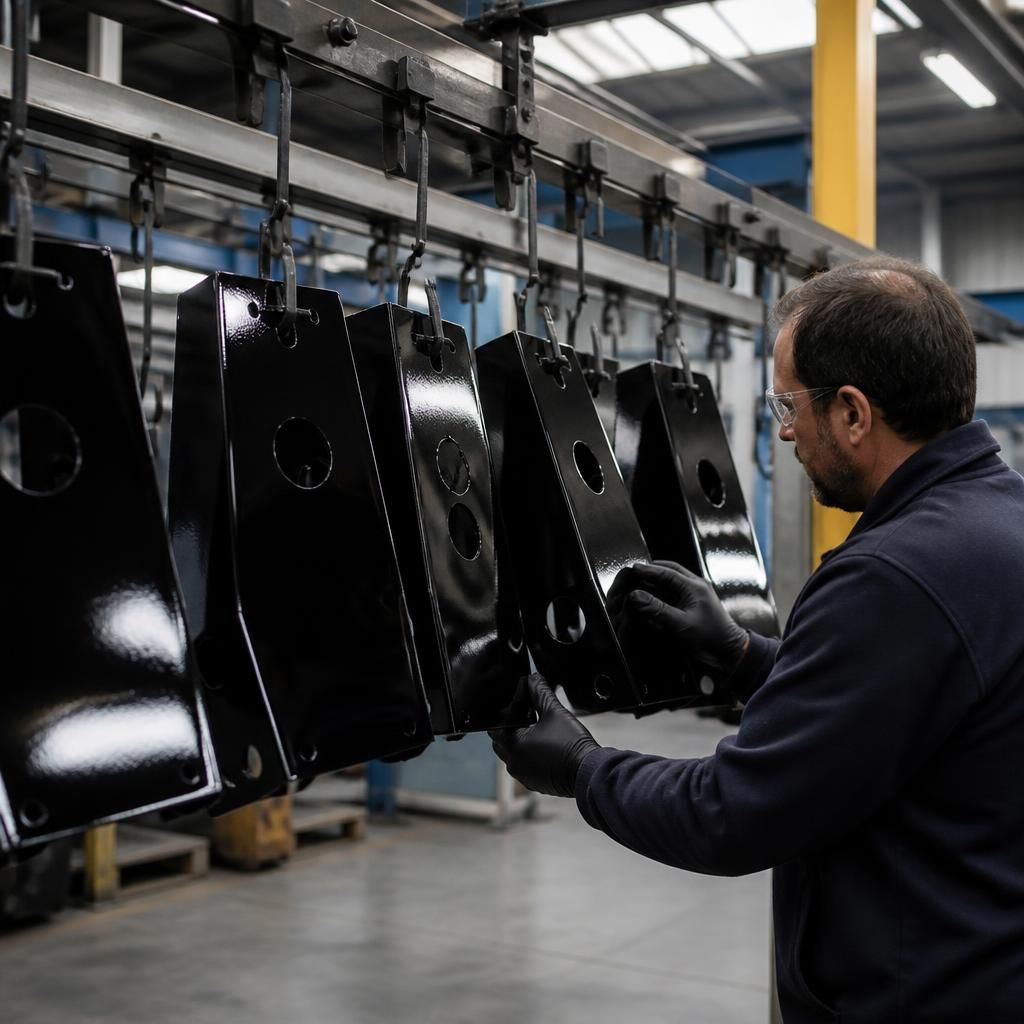
Substrate compatibility is a key selection factor because the same high gloss powder may perform differently on steel, aluminium or other metal surfaces. Before choosing the coating, confirm the substrate, its existing condition and any previous finish, contamination or corrosion that must be addressed.
Ask the coating specialist to recommend a pre-treatment route suited to the metal and the intended service environment. The process should support adhesion and corrosion protection without affecting the required gloss, colour or surface smoothness. Areas with welds, residues, oxidation or mixed metals may need particular attention, so provide accurate information about the component’s manufacture and condition.
Where the substrate or preparation method is uncertain, approve a representative test panel or trial component before committing the full batch. Assess the cured finish for adhesion, appearance and any visible reaction between the preparation, powder and metal. This is especially useful when a consistent high gloss finish is required across parts made from different materials.