

What are the specific benefits of using powder coat finishes on aluminium components in industrial settings?
Powder coating aluminium components provides a tough, uniform finish that improves resistance to corrosion, abrasion and weathering while enhancing their appearance. It also offers consistent colour and coverage across batches, making it suitable for demanding industrial applications where both protection and presentation matter.
Powder coating gives aluminium components a controlled, factory-applied surface that can improve their service performance, simplify production and provide a repeatable specification across manufactured parts. In industrial settings, its value extends beyond appearance: the coating system can be selected and applied to suit the component’s substrate, geometry, operating environment and handling requirements.
Better use of aluminium’s lightweight properties
Aluminium is often chosen for components that need a favourable strength-to-weight ratio, such as enclosures, extrusions, brackets, panels and fabricated assemblies. Powder coating adds a protective and decorative surface without requiring a separate heavy covering or changing the underlying design of the component. This allows manufacturers to retain the handling and transport advantages of aluminium while giving the finished part a defined surface specification.
Reliable adhesion when the substrate is prepared correctly
Aluminium naturally develops an oxide layer, and residues from forming, machining or handling can interfere with coating adhesion. A suitable pre-treatment removes contamination and prepares the surface before powder is applied. This is particularly important on castings, extrusions and fabricated parts, where variations in surface condition can otherwise lead to inconsistent results. Correct preparation helps the coating bond to the aluminium rather than merely forming a surface film.
Efficient coverage of formed and fabricated parts
Powder is applied electrostatically, so charged particles are attracted to the earthed metal component before curing. This can provide efficient coverage across many profiles and shapes, although recesses, sharp internal corners and enclosed sections still need to be assessed during design and specification. Compared with a conventional wet-paint process, the dry application method avoids liquid runs and sagging during application and does not require solvent evaporation before curing.
Defined film performance for production requirements
Industrial powder systems are available in formulations designed for different levels of mechanical, chemical and environmental exposure. Selecting the correct chemistry, pre-treatment and film specification allows the coating to be matched to the component’s actual use rather than treating every aluminium part in the same way. This is useful for items exposed to cleaning agents, handling, industrial atmospheres or repeated contact, provided the chosen system has been verified for those conditions.
Improved manufacturing control
Powder coating is a repeatable process when application settings, part preparation and oven conditions are controlled. The finish is cured as part of a defined production sequence, which helps manufacturers establish inspection criteria for colour, coverage, adhesion and surface defects. That repeatability can simplify quality control for batches of components and make it easier to identify whether a problem originates from preparation, application or curing.
The process also supports practical production planning. Components can be masked before coating so that threads, earth points, bearing seats, fixing faces and other areas remain free of powder where assembly tolerances require it. Specifying these areas in advance reduces the risk of coating interfering with fit, electrical contact or later assembly operations.
Reduced handling restrictions after curing
Once fully cured and cooled, a powder-coated component has a dry, finished surface rather than a wet film that must continue evaporating. This can make parts easier to move between manufacturing stages, inspect and assemble. The required cure schedule still needs to be matched to the powder formulation and aluminium component, since insufficient or excessive heat can affect the final properties and, in some designs, the dimensional condition of the part.
Lower process waste than some liquid-coating systems
Powder coating contains no liquid solvent carrier, so it avoids the solvent-handling issues associated with solvent-borne paint. Uncured overspray may also be collected in suitable systems, although recovery and reuse depend on the equipment, colour change requirements and powder specification. This can support a cleaner, more controlled coating area and reduce material losses when production is planned effectively.
These benefits depend on matching the powder, pre-treatment and curing method to the aluminium alloy, component geometry and service environment. For industrial work, the coating specification should therefore be agreed before production, with particular attention to masking, surface preparation, cure requirements and the conditions the finished component will encounter.
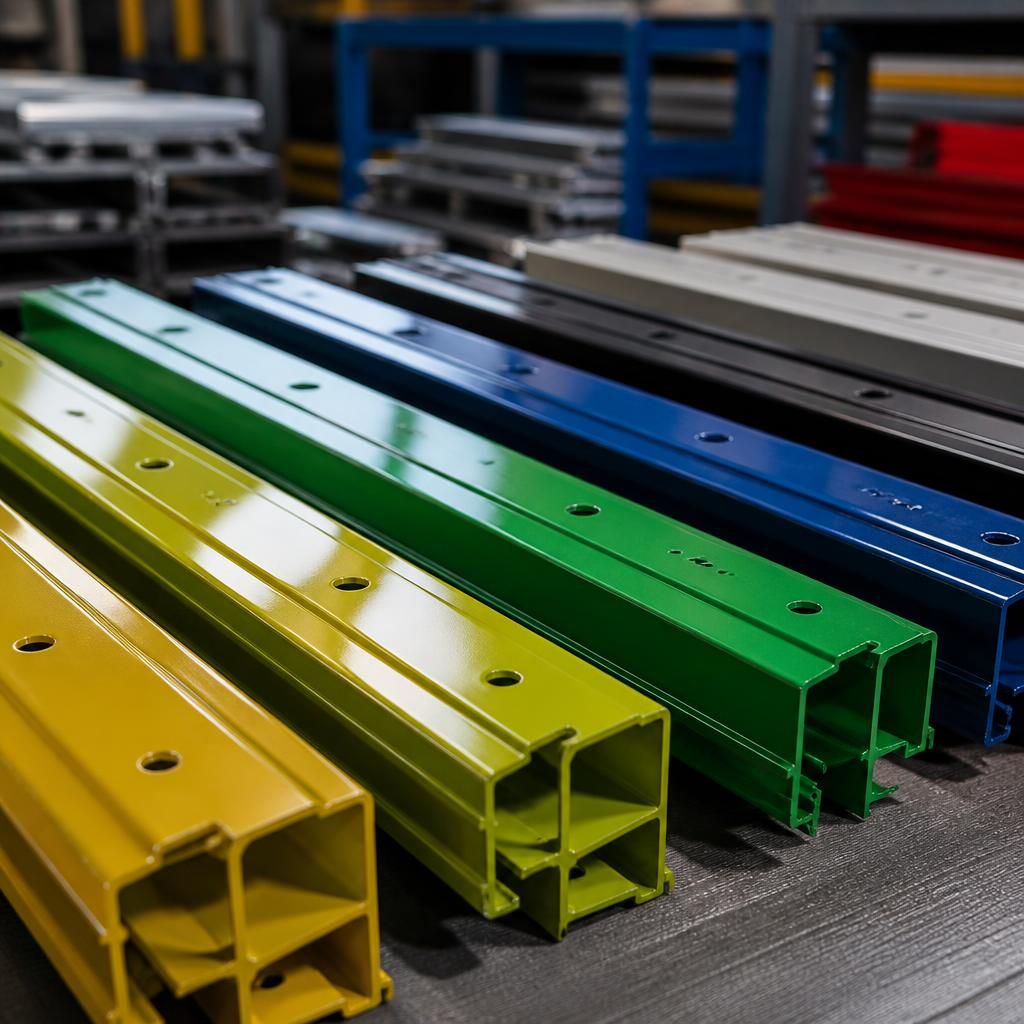
Powder coating can give aluminium components a functional colour-coding system as well as a finished appearance. Where a manufacturer assigns defined colours to different part types, assemblies or service functions, the coating can make components easier to identify during inspection, assembly and maintenance. This is particularly useful when several visually similar aluminium parts are handled within the same production environment.
For this benefit to be reliable, the colour specification must be agreed as part of the component’s documentation and applied consistently across batches. Colour coding should support, rather than replace, part numbers, labels or other identification methods, but it can provide an immediate visual distinction without adding a separate marking process.