

What are the benefits of using electrostatic aluminium powder spray over traditional paint methods?
Electrostatic aluminium powder spray typically provides a tougher, more uniform and longer-lasting finish than traditional liquid paint. The powder is electrically attracted to the aluminium before curing, which supports efficient coverage, reduces runs and produces a clean, durable coating without the solvent content associated with many liquid paints.
Electrostatic aluminium powder spray offers several practical advantages over traditional liquid paint, particularly where aluminium components need a controlled, factory-applied finish. The main differences are the way the coating is applied, cured and inspected, as well as the options available for repeat production work.
More controlled film formation
Powder coating is applied as dry particles and then heated until the material flows and cures into a continuous film. Unlike liquid paint, there is no wet layer whose appearance can be significantly affected by brush marks, spray overlap or solvent evaporation. This makes the process well suited to components that need a repeatable specification across a batch.
The coating thickness still depends on correct preparation, gun settings, part positioning and curing conditions. Electrostatic attraction helps the powder reach and remain on the grounded aluminium surface, but it does not remove the need for skilled application or suitable masking. Edges, recesses, sharp corners and enclosed sections must be assessed individually because the electrical field is not distributed equally across every shape.
A more efficient production process
For suitable aluminium parts, powder coating can simplify production because the coating is cured in an oven rather than left to dry through solvent evaporation. Once the specified cure has been achieved and the components have cooled, the finish can be assessed as a finished coating rather than waiting for a liquid layer to dry progressively.
This can be valuable for manufacturers and fabricators processing repeat batches. Parts can be racked, coated and cured according to a defined process, helping production teams plan handling and inspection more consistently. The most suitable method depends on component size, alloy, geometry, required finish and the available oven capacity; powder coating is not automatically appropriate for every aluminium item.
Fewer application-related defects
Liquid paint can be affected by sagging, brush or spray marks, trapped solvent, uneven drying and contamination while the coating is wet. Powder application avoids some of these wet-paint issues, although defects can still result from inadequate cleaning, incorrect pre-treatment, poor storage or an unsuitable cure schedule.
Because the powder is cured as a film, the final appearance is generally less dependent on the gradual evaporation of a liquid carrier. This is particularly useful when a batch must meet a consistent colour, texture or gloss requirement. Inspection should still cover coverage, adhesion, colour, surface contamination and cure, rather than relying on appearance alone.
Reduced reliance on solvent-based materials
Many traditional paint systems use liquid carriers that evaporate during and after application. Powder is supplied as a dry coating material, so the process does not use those liquid carriers in the same way. This can simplify material handling and reduce the solvent-related considerations associated with some liquid systems.
That does not mean powder coating has no environmental or operational controls. Overspray, contaminated powder, cleaning materials, oven energy use and waste must still be managed responsibly. The environmental comparison depends on the complete coating system and the way the facility operates.
Better suitability for repeatable metalwork finishes
Electrostatic powder spraying is particularly useful when a business needs the same finish applied to multiple aluminium components. A defined pre-treatment, application and curing specification can be documented and repeated, making it easier to compare results between batches than with informal or variable liquid-paint application.
It also supports a broad range of decorative and functional requirements, including different colours, gloss levels and textures. The chosen powder must be compatible with the intended service conditions and the aluminium substrate. If the component will face outdoor exposure, abrasion, chemicals or unusual temperatures, the coating specification should be selected for those conditions rather than chosen on appearance alone.
Important limitations when comparing the methods
Traditional paint may remain more suitable where the component cannot tolerate oven curing, where work must be carried out on site, or where a small local repair is required without processing the complete item. Liquid systems can also be useful for substrates or assemblies that combine materials with different heat requirements.
For powder coating, aluminium components need suitable cleaning and pre-treatment before spraying. Oils, oxide layers and other contaminants can interfere with adhesion, while trapped moisture or unsuitable masking can affect the finished result. The parts must also be able to withstand the curing conditions, and their size and shape must be compatible with the coating equipment.
In practice, electrostatic aluminium powder spray is strongest where the work involves prepared metal components, repeatable factory conditions and a defined finish specification. Traditional paint may be preferable for heat-sensitive, site-applied or repair-focused work. The correct choice should therefore be based on the component, operating environment, production volume and quality requirements rather than on the coating name alone.
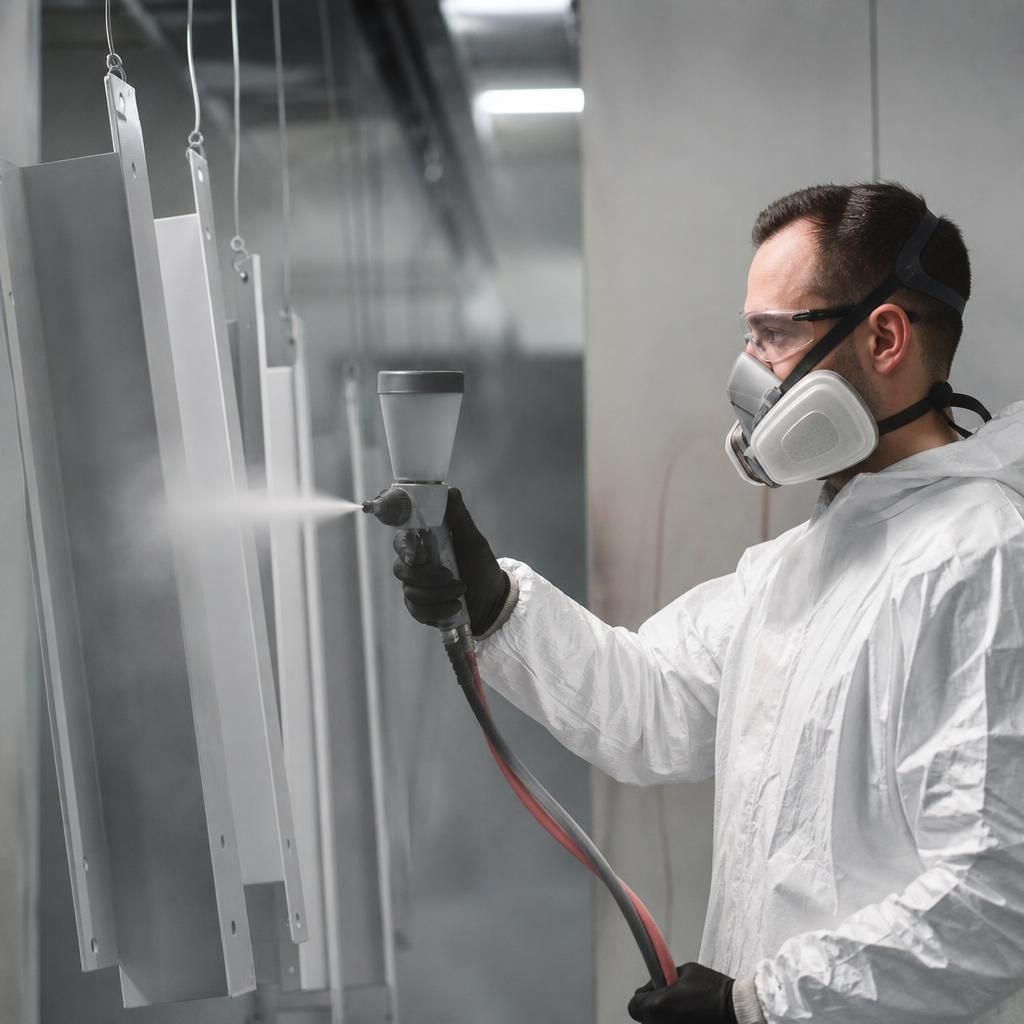
A key advantage of electrostatic aluminium powder spray is the performance of the cured film during handling and service. Once the correctly specified powder has been applied and cured, it forms a continuous coating that can provide greater resistance to everyday abrasion, impact and weathering than many conventional paint systems. This makes it suitable for aluminium components that will be handled repeatedly or exposed to demanding operating conditions.
The result depends on more than the application method. Powder chemistry, pre-treatment, coating thickness, curing and the component’s environment must all be matched to the specification. A coating intended for exterior use, for example, may require different performance characteristics from one used on an indoor component. Assessing these factors helps ensure that the finish is selected for functional protection as well as appearance.