

What are the advantages of using nylon coatings for aluminium applications?
Nylon coatings provide aluminium components with a tough, durable barrier that helps resist abrasion, impact, chemicals and moisture. They can also deliver a smooth, consistent finish, making them suitable where aluminium needs enhanced protection and an improved surface appearance.
Nylon coatings offer aluminium components more than surface protection: they can provide a resilient, low-friction and electrically insulating layer while retaining the lightweight advantages of the aluminium substrate. This combination is useful where components are handled, assembled against other materials or exposed to repeated contact during service.
Key advantages include:
- Reduced friction and wear: Nylon has relatively good sliding properties, so it can reduce rubbing between aluminium parts and mating components. This is valuable for guides, rollers, bushes, chutes, slides and handling equipment where repeated movement could otherwise mark the metal or increase maintenance requirements.
- Protection of mating surfaces: A nylon layer can help prevent direct aluminium-to-metal contact. This may reduce scuffing, galling and marking during assembly or operation, particularly where components need to fit together without damaging one another.
- Electrical isolation: Nylon is non-conductive, allowing a coating to separate an aluminium component electrically from adjacent metalwork. This can help reduce the risk of unwanted contact or galvanic interaction between dissimilar metals, although the complete assembly design, coating continuity and operating conditions must still be assessed.
- Noise and vibration reduction: The polymer layer can damp some contact noise and absorb minor vibration at points where coated aluminium meets another component. This makes it useful for covers, guards, trays, brackets and equipment parts where metal-on-metal contact would be undesirable.
- Improved handling and user contact: Nylon provides a less harsh contact surface than bare aluminium. It can therefore be suitable for components that are frequently handled or that come into contact with finished products, provided the selected formulation meets the relevant hygiene, contamination and operating requirements.
- Coverage of edges and complex profiles: When the application process and part design are suitable, nylon can form a substantial coating over shaped aluminium components, including profiles and fabricated parts. This can protect areas that would otherwise remain exposed, although sharp edges, recesses and internal faces require careful preparation and process control.
- Consistent component performance: By separating the aluminium from direct contact, a nylon coating can help maintain predictable movement, handling and assembly characteristics over the component’s service life. The benefit is greatest when the coating thickness, adhesion and finish are specified for the actual duty rather than selected as a general-purpose finish.
The choice of nylon grade is important. Different formulations vary in hardness, flexibility, friction behaviour, temperature capability, chemical compatibility and resistance to moisture absorption. Nylon can absorb some moisture, which may affect dimensions and mechanical properties in certain environments. Continuous operating temperature, occasional temperature peaks, exposure to oils or solvents, UV exposure and the required coating thickness should therefore be considered before specification.
Aluminium also needs suitable preparation before coating. Cleaning, removal of oxide or contamination and the use of an appropriate pre-treatment or bonding system are central to achieving reliable adhesion. Poor preparation can allow local lifting or delamination, particularly around edges, drilled holes and areas subject to repeated flexing. The coating system should be assessed as a complete specification rather than judging the nylon material alone.
For industrial applications, nylon is most advantageous when aluminium requires a functional polymer surface as well as a protective finish. It is often considered for parts that slide, guide, separate, insulate or contact other components. It may be less suitable where the component operates beyond the coating’s temperature range, requires a very thin coating with tight tolerances, or is exposed to chemicals known to attack the selected nylon formulation. Testing representative parts or samples can help confirm adhesion, dimensional fit and performance before a larger production batch is coated.
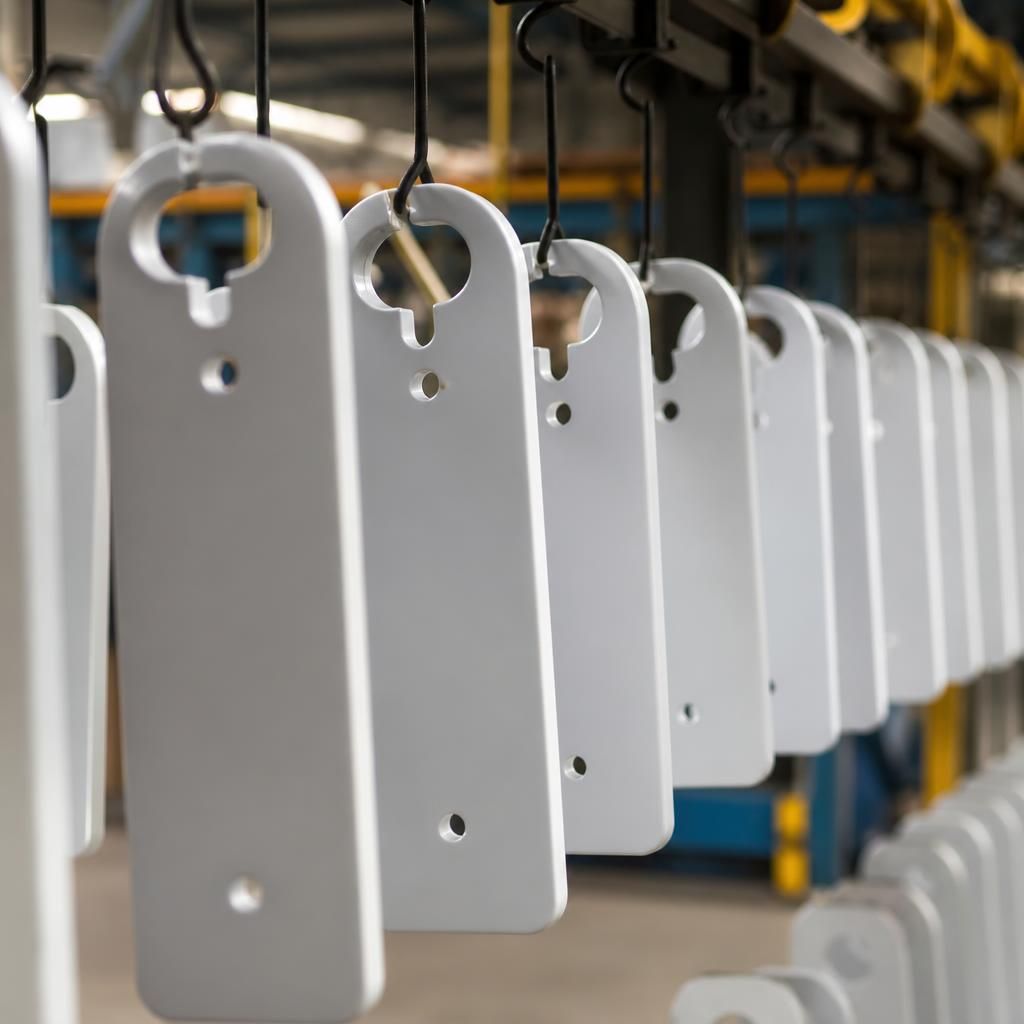
A key advantage of nylon coating is that it allows the aluminium substrate and the working surface to perform different roles. Aluminium can provide a lightweight, rigid base, while the nylon layer supplies the contact characteristics needed at the interface with adjoining components. This is useful in assemblies where the metal must remain structurally stable but should not be the material directly exposed at points of contact.
That separation can simplify component design by avoiding a need to manufacture the entire part from a different material. The suitable coating thickness and grade still depend on the fit, loading, temperature and environment, but the approach can provide a practical balance between aluminium’s structural properties and nylon’s functional surface behaviour.