

What are the key benefits of blasting before aluminium powder coating?
Blasting before aluminium powder coating removes contaminants, oxidation and weak surface material, creating a clean, lightly keyed surface for the coating to grip. This improves adhesion and helps produce a more consistent, durable finish.
Blasting before aluminium powder coating provides controlled mechanical preparation, giving the coater a more predictable surface on which to build the finish. Its main benefits are consistent surface texture, improved process control, better treatment of complex components and a lower risk of coating defects caused by uneven preparation.
It creates a controlled surface profile. Blasting alters the surface at a fine scale, producing a texture that can help the powder coating system form a reliable mechanical bond. The profile must be appropriate to the aluminium grade, component and coating specification: excessive blasting can roughen the surface unnecessarily, while insufficient preparation may leave areas unsuitable for coating.
It improves consistency across the component. Aluminium parts may have different surface conditions around edges, welds, joints, recesses or areas affected by fabrication. A correctly selected blasting process can make preparation more uniform across these areas than manual abrasion alone. This is particularly useful where several components need to have a closely matched appearance and comparable coating performance.
It reaches areas that are difficult to prepare by hand. Abrasive blasting can treat awkward profiles, textured sections, internal corners and fabricated assemblies more evenly than sanding or other localised methods. The effectiveness still depends on line of sight, nozzle access and the geometry of the part, so masking and inspection may be needed for protected faces, threaded sections, machined tolerances or delicate features.
It supports reliable quality control. A defined blasting specification can control factors such as abrasive type, pressure, nozzle distance, angle and movement. Recording and repeating these conditions helps reduce variation between batches. Visual inspection and, where required, checks of the prepared profile allow unsuitable areas to be identified before powder is applied, rather than after the finished coating has been rejected.
It can reduce the effect of fabrication marks. Aluminium components may carry light handling marks, surface irregularities or changes caused by forming and fabrication. Blasting can help produce a more even foundation for the coating, although it should not be treated as a substitute for correcting deep dents, sharp burrs, poor weld finishing or other significant substrate defects.
It helps the full pretreatment process work more effectively. Blasting is often one stage in a wider preparation sequence rather than a complete alternative to chemical pretreatment. Depending on the required performance, the prepared aluminium may still need rinsing, chemical conversion treatment, drying and careful handling before powder application. Combining compatible stages can provide more dependable protection than relying on mechanical preparation in isolation.
There are important limits. Aluminium is relatively soft, so an unsuitable abrasive or aggressive setting can distort thin sections, close tolerances, embed unwanted particles or leave an excessively coarse finish. The abrasive should therefore be selected for aluminium and the required coating system, with equipment kept free from cross-contamination from incompatible metals. After blasting, parts should be inspected and protected from recontamination before coating.
In practice, the benefit of blasting is greatest when the process is specified around the component rather than applied as a standard setting to every job. Part geometry, alloy, fabrication method, final appearance, coating requirements and any dimensional restrictions should all be considered. This approach makes the surface condition more repeatable and gives the powder coating process a sounder basis for producing a consistent finish.
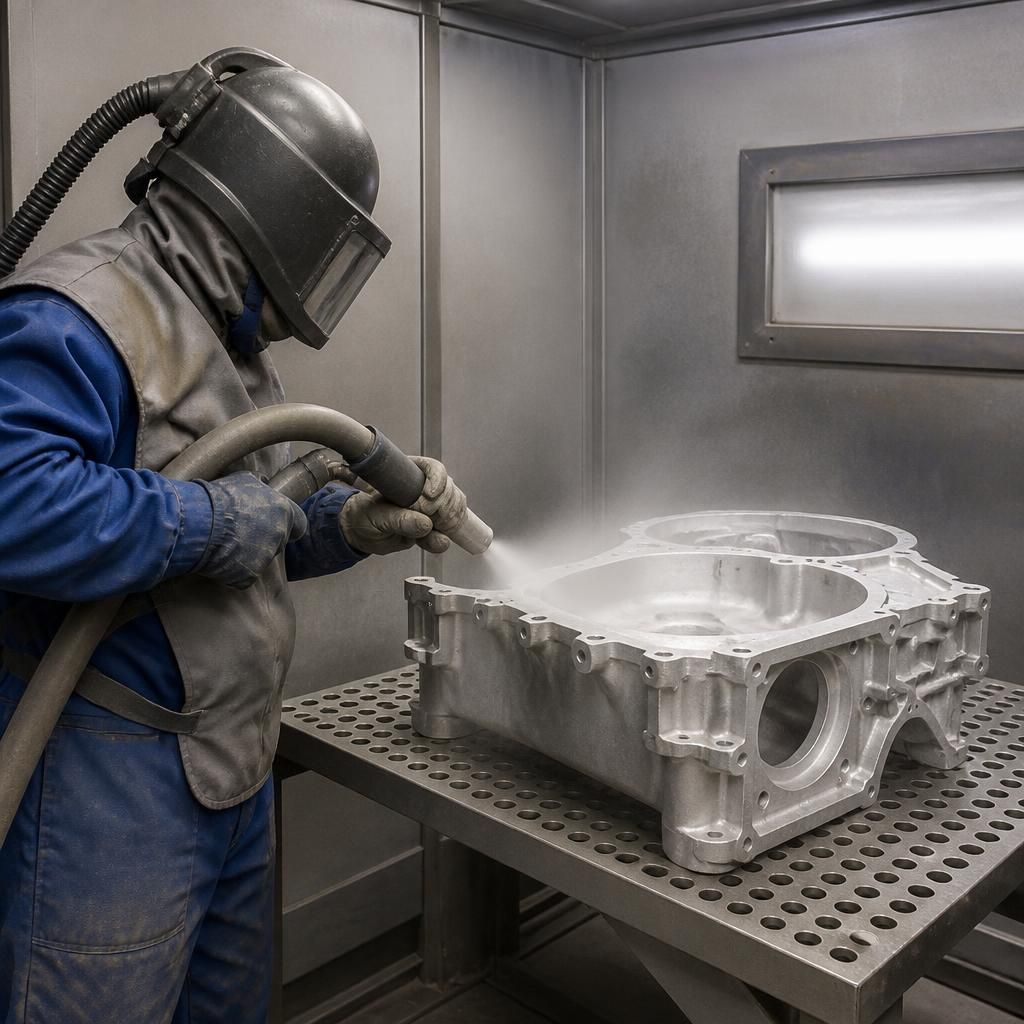
Blasting can reduce the contaminant load placed on subsequent pretreatment stages. On aluminium components carrying workshop dirt, handling residue, loose oxidation or fabrication debris, mechanical cleaning removes much of this material before rinsing or chemical conversion treatment begins.
This helps prevent contaminants being carried into cleaning tanks or spread across the component during wet processing. It also makes the later stages easier to control, because they are working on a more stable surface rather than having to overcome heavy or uneven deposits. Blasting is therefore useful as a preparatory step within a complete pretreatment sequence, provided the chosen abrasive and settings are suitable for the aluminium.
Discuss Your Aluminium Blasting Requirements
If you are assessing whether blasting is suitable for an aluminium component, discuss its alloy, geometry, surface condition and coating specification with the powder-coating team. They can help identify an appropriate preparation approach for your requirements.