

What are the most important factors to consider when choosing a protective primer for powder coating repair?
The most important factors are compatibility with the existing powder coating and metal substrate, the required level of corrosion protection, adhesion, application method and curing requirements. Also consider the repair environment, exposure to moisture or chemicals, the primer’s build and colour, and whether it can be blended into the surrounding powder-coated finish.
The most important factors are the condition and geometry of the damaged area, the primer’s suitability for the specific substrate and repair system, its recoat window, the achievable film continuity, and the evidence available to confirm performance. A protective primer should be selected as part of a defined repair process rather than as a standalone coating.
Start by defining the repair scope. A small scratch exposing clean metal has different requirements from widespread edge breakdown, corrosion beneath the coating, or damage around welds and fasteners. Identify whether the existing powder coating is firmly attached around the defect. If it is lifting, blistered or undercut, applying primer only over the visible mark can leave weakened coating beneath the repair. The affected area may need to be extended until a sound coating boundary is reached.
Assess the substrate before choosing the product. Steel, galvanised steel and aluminium can present different preparation and coating requirements. Look for rust, mill scale, oxidation, welding residues, grease, salts and moisture. These contaminants can remain beneath a repair and cause premature failure even where the primer itself is technically suitable. The preparation method should produce a clean, stable surface with properly feathered coating edges, without polishing the exposed metal so smooth that the repair has insufficient mechanical key.
Consider the primer’s place in the complete coating system. The primer must work with the intended repair topcoat, not merely form a film on the exposed metal. Check the product data for the approved overcoat interval, minimum and maximum recoat times, required surface condition before overcoating, and any restrictions on the type of finish applied above it. A primer that has been left beyond its recoat window may require abrading or other treatment before the next layer is applied.
Examine coverage of difficult areas. Damage at sharp edges, corners, holes, folded sections, weld toes and recessed details is more difficult to protect consistently than damage on a flat panel. The selected primer should allow the operator to achieve continuous coverage without excessive runs, pooling or thin areas. Pay particular attention to edges, because coating films commonly become less uniform there. The repair specification should state how these areas are to be treated rather than relying on a single general application instruction.
Check practical handling characteristics. For local repairs, the product’s working life, drying behaviour, viscosity and packaging can affect whether the specified film can be applied accurately. A primer that is suitable in a controlled production process may be impractical for a small repair if it cannot be mixed, applied or overcoated within the available process window. Review the technical data sheet for mixing requirements, induction time where applicable, minimum application temperature and restrictions caused by condensation or damp surfaces.
Specify measurable film requirements. Excessive primer thickness can affect drying, edge definition and the appearance of the final repair. Insufficient thickness may leave discontinuities over the exposed substrate. The manufacturer’s stated dry film thickness range should therefore be translated into an inspection requirement, using a suitable gauge where the substrate and coating system permit. Any primer build should also be considered alongside the thickness of the repair topcoat so that the completed area does not create an obvious ridge.
Look for evidence rather than relying only on product descriptions. Useful supporting information includes technical data, substrate-specific recommendations, documented testing and clear limitations. Where the repair is important or the product is unfamiliar, apply the proposed system to a representative test piece or a concealed area first. Examine adhesion, drying, surface defects and the interaction between primer and topcoat before treating production components. Testing should reflect the actual substrate, preparation method and coating sequence as closely as possible.
Include inspection and traceability in the selection. Record the primer identification, batch information, substrate preparation, application conditions and overcoating time. This makes it easier to investigate defects and repeat a repair consistently across a batch of components. Inspection should cover surface cleanliness, visible coverage, edge treatment, curing and the final appearance, rather than assessing colour alone.
In practice, the right protective primer is the one supported by a complete, repeatable repair specification: sound preparation, controlled application, a defined overcoat sequence, suitable coverage of complex geometry and checks that demonstrate the repaired coating has formed correctly. If any of these points cannot be established from the product information or a controlled trial, the primer should not be selected solely because it is described as suitable for metal or powder coating repairs.
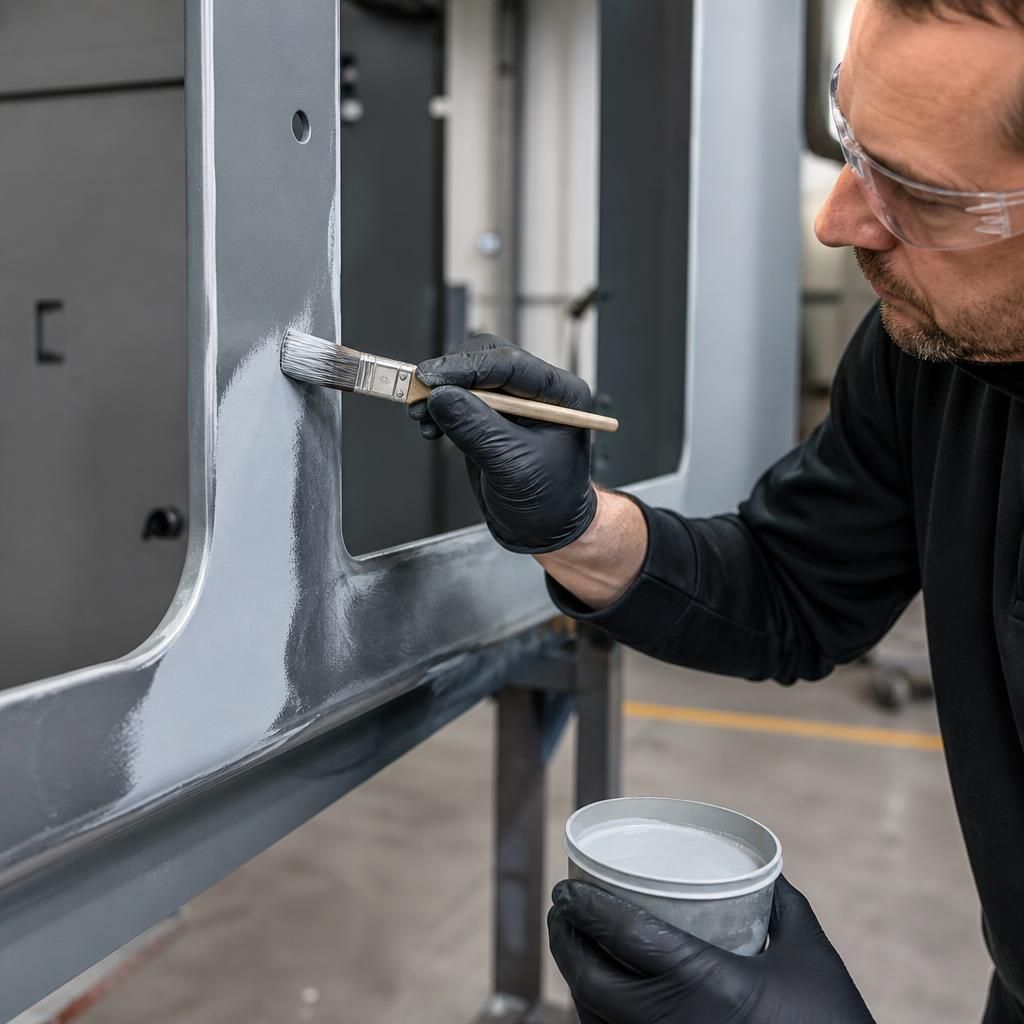
A protective primer for powder coating repair must be compatible with both the exposed metal and the surrounding cured powder coating. A product may adhere well to bare steel yet soften, wrinkle or poorly wet the existing finish when it overlaps the repair edge. This is particularly important where the coating has been feathered back, because the primer will normally cover a narrow band of sound powder coating as well as the exposed substrate.
Check the technical information for restrictions on applying the primer over existing coatings, including solvent sensitivity, surface preparation and allowable overlap. A small trial should include the complete edge arrangement rather than testing the primer only on bare metal. Inspect the boundary for lifting, swelling, loss of gloss or visible texture changes before applying the repair topcoat. This confirms that the selected primer will protect the defect without creating a second failure point around the perimeter.