

What are the most effective methods for removing powder coating from metal surfaces?
The most effective method for removing powder coating depends on the coating thickness, component size and condition of the metal beneath it. Chemical stripping, abrasive blasting and controlled heat removal are the main options, while mechanical methods such as scraping or grinding are generally best suited to small areas or local repairs.
Effective powder coating removal is a controlled preparation process: the coating must be separated from the metal without distorting the component, embedding contamination or removing more substrate than necessary. In practice, the best approach is selected by assessing the coating system, the part’s geometry, the metal beneath it and the finish required before repair or recoating.
Chemical stripping is often suitable for components with intricate profiles, recesses, folds or areas that are difficult to reach mechanically. The component is treated with a purpose-designed coating remover that softens or breaks down the powder film, allowing the residue to be washed or brushed away. This can expose detailed features more evenly than an abrasive process, particularly where blasting media could become trapped.
Chemical stripping requires careful control. The chemical must be compatible with the substrate and any inserts, seals, welds or other attached materials. After stripping, the part needs thorough rinsing and drying so that residues do not interfere with inspection, repair or the adhesion of a new coating. Any remaining corrosion or surface contamination may still require a separate preparation stage.
Abrasive blasting removes powder coating by directing abrasive media at the surface under controlled pressure. The choice of media and blasting intensity affects both removal speed and the resulting profile of the metal. A suitable process can remove coating, corrosion and other surface contamination while leaving a clean, keyed surface for subsequent treatment.
Blasting is particularly useful for robust steelwork, fabrications and components where a uniformly prepared surface is required. It needs more control around thin sheet, sharp edges, machined faces and delicate details, because excessive impact can cause distortion, edge rounding or an unsuitable surface profile. Masking or adjusting the process may be necessary where certain faces, threads or close-tolerance features must be protected.
Thermal removal uses controlled heat to decompose or loosen the powder coating before the softened residue is removed. It can be effective for substantial steel components or heavily coated parts where other processes would be slow. The temperature and heating cycle must be controlled to avoid changing the metal’s properties, warping the component or damaging attached materials.
Thermal treatment is not appropriate for every alloy, assembly or design. Aluminium and thin sections can be especially sensitive to heat, while components containing bearings, plastics, adhesives or sealed cavities may be damaged. Heating can also leave ash or degraded coating residues, so a further cleaning or blasting stage is commonly needed before the surface is assessed for recoating.
Mechanical removal includes scraping, wire brushing, sanding, grinding and localised power-tool work. These methods are useful for small areas, damaged sections, weld repairs and spot preparation where stripping the entire component would be unnecessary. They provide direct control over a local defect but are labour-intensive over large surfaces and can create grooves, flat spots or heat-affected areas if used aggressively.
Grinding should be used selectively because it removes metal as well as coating. It may also smear softer metals or leave abrasive contamination in the surface. Scraping and hand abrasion are less likely to affect the substrate, but they may not remove firmly bonded powder from pits, corners or textured surfaces. Mechanical preparation is therefore often best treated as a local or finishing operation rather than the sole process for a complete refurbishment.
Laser removal can be considered where highly selective coating removal is needed. A controlled laser beam ablates the coating while limiting contact with the metal, making the technique useful for defined repair zones, markings or components with sensitive geometry. Its suitability depends on the coating, substrate, equipment and required production volume, and extracted fumes and residues must be managed correctly.
Before choosing a method, inspect the component for corrosion, previous repairs, heat-sensitive attachments, trapped moisture and areas where the metal may already be thin. Identify the substrate, since steel, aluminium, galvanised surfaces and other alloys respond differently to chemicals, impact and heat. Check whether dimensions, threads, sealing faces, welds or machined tolerances must be preserved.
- For complex profiles: chemical stripping or carefully controlled low-impact preparation can reach areas that tools or abrasive streams cannot access effectively.
- For durable steel fabrications: abrasive blasting or controlled thermal treatment may be appropriate, depending on the coating build-up and condition of the component.
- For local repairs: scraping, sanding or grinding may remove only the defective area and avoid unnecessary treatment of sound coating.
- For heat-sensitive or delicate parts: avoid thermal processes unless the material and complete assembly have been assessed as suitable.
- For tight tolerances: use a process that protects dimensions, edges, threads and functional contact surfaces.
Removal should normally be followed by a close inspection rather than immediate recoating. Look for pitting, cracks, corrosion beneath the former coating, weld defects and evidence of substrate damage. The chosen repair may require further degreasing, rinsing, drying, abrasion or blasting to produce the required surface condition. The surface should not be left exposed to contamination or moisture between preparation and the next coating stage.
Waste handling is also part of the method selection. Spent chemicals, removed powder, blasting media and contaminated rinse water require suitable collection and disposal in line with applicable environmental and waste requirements. The process should be carried out with appropriate ventilation, protective equipment and controls for dust, fumes, noise and chemical exposure.
For large, valuable or complex metal components, a trial on a representative area can confirm whether the selected process removes the coating without harming the substrate. The result should be judged not only by how quickly the powder is removed, but also by the cleanliness, dimensional accuracy and surface condition achieved before repair or application of a new coating.
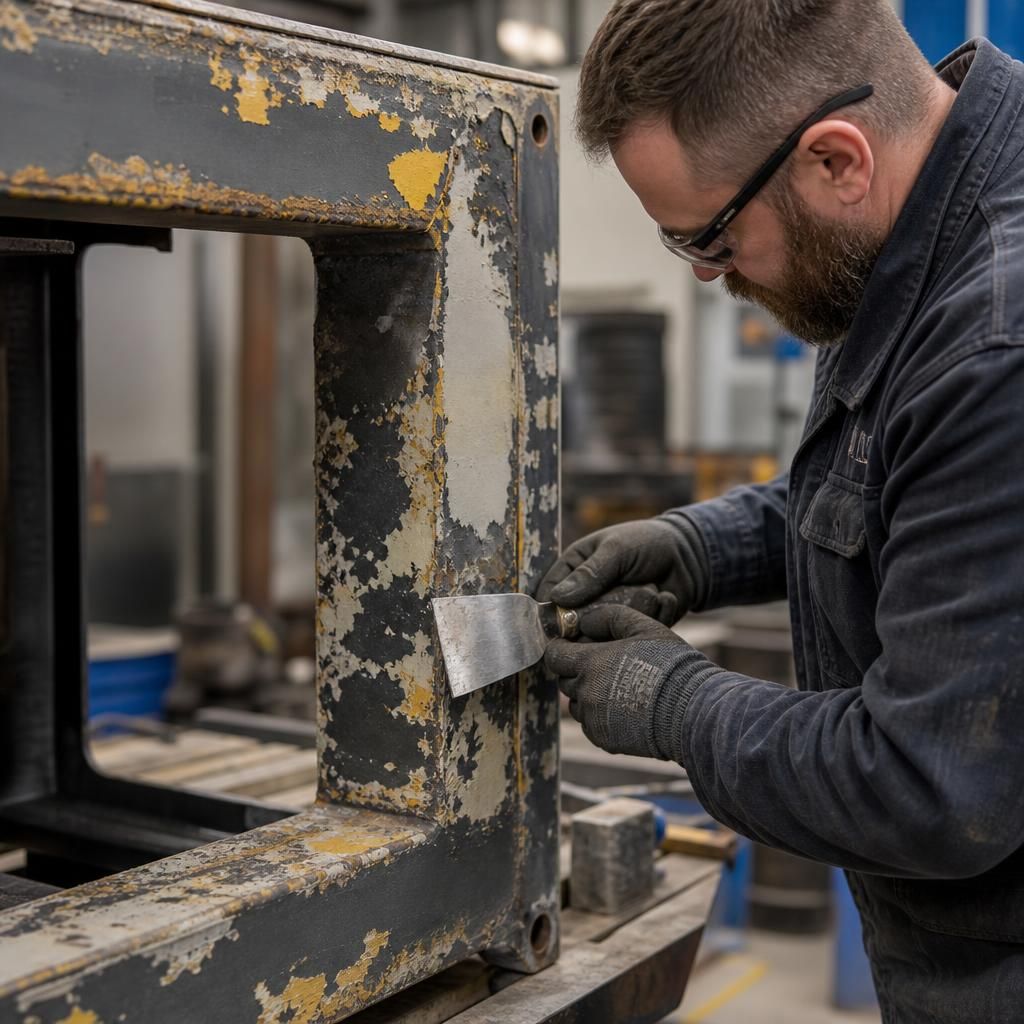
Older components may contain several coating layers rather than one uniform powder film. A later recoat, primer or local touch-up can respond differently from the outer layer, so a process that appears effective on one area may leave a firmly bonded film elsewhere. Edges, welds and previously repaired sections are particularly likely to show this variation.
Removal should therefore be assessed across representative areas of the component, not judged solely by the first exposed patch of metal. If an earlier coating remains, the next preparation step may need to be adjusted to achieve the surface condition required for repair or recoating without unnecessarily treating sound areas.