

What is the process for repairing rust and corrosion on powder-coated metal?
Repairing rust and corrosion on powder-coated metal involves assessing the damage, removing loose coating and corrosion, preparing the exposed metal, and applying a suitable repair system. Where corrosion has spread beneath the coating or the finish is extensively damaged, the component may need full stripping, treatment and powder recoating rather than a local touch-up.
Repairing rust and corrosion on powder-coated metal is a controlled refurbishment process that restores the metal substrate and rebuilds the protective finish. The correct method depends on whether the defect is limited to a small damaged area, has spread beneath the coating, or has affected the component so extensively that the existing finish must be removed and replaced.
1. Inspecting the component
The component is first examined to establish the source and extent of the corrosion. The inspection considers damaged edges, chips, scratches, bubbling, blistering, staining, rust bleed and areas where the coating has lifted from the metal. Particular attention is given to joints, folds, drilled holes, welds and contact points, as moisture can remain in these areas and allow corrosion to develop beneath an apparently sound finish.
The type of base metal and the original coating system are also relevant. Steel, galvanised steel and aluminium respond differently to preparation and treatment. A repair should address the cause of the failure, such as impact damage, trapped moisture, inadequate drainage, contamination or exposure of unprotected metal, rather than simply covering the visible rust.
2. Deciding between a local repair and full refurbishment
A local repair may be appropriate where the affected area is small, firmly bonded coating surrounds the defect and the underlying metal remains structurally sound. The damaged coating is removed back to a stable edge, allowing the repair area to be properly cleaned and prepared before a compatible finish is applied.
Full refurbishment is normally more suitable where corrosion extends under the surrounding powder coating, multiple areas are affected, adhesion is poor, or the component has already received several unsuccessful touch-ups. In this situation, retaining sound-looking sections of a failing coating can leave hidden corrosion in place. Stripping the component provides a clearer surface for inspection and allows the complete coating system to be rebuilt.
3. Removing failed coating and corrosion
Loose, blistered or poorly adhered coating must be removed. Depending on the component and its condition, this can involve mechanical preparation, controlled abrasive blasting or another suitable stripping method. The process is selected to remove corrosion and failed finish without unnecessarily damaging the metal, edges, threads, machined areas or other critical features.
Rust is removed until the remaining substrate is suitable for treatment. Any sharp transition between old and removed coating is dressed or feathered so that the repaired finish does not sit over a raised edge. Deep pitting may need additional assessment because removing surface rust does not restore metal that has already been lost through corrosion.
4. Cleaning and preparing the substrate
After stripping, the surface is cleaned to remove dust, grease, oil, salts and other contaminants. This stage is essential because contamination can interfere with adhesion and may trap corrosion beneath the new coating. Weld spatter, burrs and residues around fixings are dealt with where they could affect coverage or create points for moisture retention.
Preparation also includes checking drainage holes, seams, folds and enclosed sections. If water can remain trapped after recoating, the same corrosion problem may return even when the visible repair is sound. Components are therefore assessed for features that need cleaning, sealing, modification or careful coating application.
5. Applying corrosion protection
The exposed metal is treated with a suitable corrosion-protection system before the final powder coat is applied. The choice depends on the substrate, intended environment, required appearance and compatibility with the existing finish. Steel may require a system designed to protect prepared ferrous metal, while galvanised surfaces and aluminium need preparation that supports adhesion without causing unnecessary surface damage.
Where the repair involves a local area, the new material must be compatible with the surrounding powder coating. Where the component is fully stripped, a primer and topcoat system may be selected to provide a more consistent protective layer. The coating is applied at an appropriate and controlled thickness, with care taken around corners, recesses, holes and edges where coverage can be less uniform.
6. Curing and checking the finish
Powder coating requires controlled curing so that the powder melts, flows and forms a continuous film. The curing process must suit the coating system and the component, particularly where the item has significant mass, complex geometry or heat-sensitive sections. Insufficient or unsuitable curing can affect the finish and its adhesion.
Once finished, the component is checked for visual defects such as missed areas, runs, inclusions, inconsistent texture, pinholes or visible transitions between old and new coating. Where required by the job specification, further checks can assess coating coverage, adhesion and other finish requirements. Any defect identified at this stage should be corrected before the component is returned to service.
7. Reassembly and practical review
Before the repaired part is used, mating faces, threads, apertures and contact points are checked to ensure that coating has not interfered with fit or function. Masking and finishing requirements are particularly important for components that must connect electrically, move against another part or maintain precise clearances.
A properly planned repair therefore involves more than painting over a rust mark. It requires diagnosis of the failure, removal of unstable material, preparation of the remaining substrate, selection of a compatible protective system and inspection of the cured finish. If corrosion has compromised the metal itself, the component should also be assessed for structural suitability before coating work proceeds.
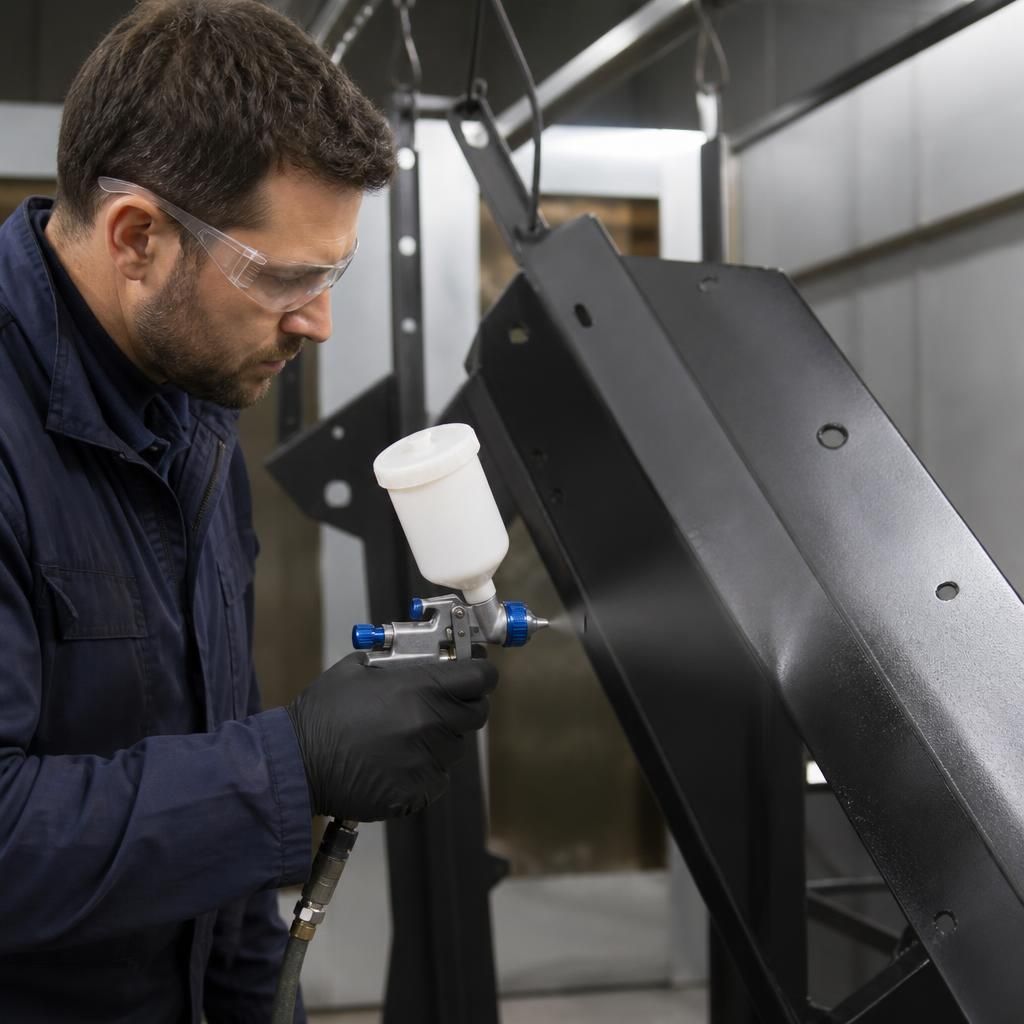
The repair coating must be selected for the component’s actual service environment, not solely for colour or appearance. Outdoor exposure, coastal air, industrial pollutants, chemical contact, abrasion and repeated handling can all influence the level of corrosion protection required.
The specification should also account for the base metal, the surrounding powder coating and any functional requirements such as electrical continuity, movement or close-fitting parts. A compatible repair system helps the new coating bond correctly and reduces the risk of premature failure at the boundary between the repaired area and the original finish.
Discuss Your Powder-Coated Metal Repair Requirements
Discuss your powder-coated metal repair requirements with the specialist team, providing details of the component, its service environment and the corrosion observed. This helps establish the most suitable repair or refurbishment route before coating work begins.