

What are the benefits of powder coating over galvanised steel in high-temperature environments?
Powder coating over galvanised steel provides an additional protective barrier, improving resistance to corrosion, abrasion and weathering while offering a consistent colour and finish. In high-temperature environments, the benefit depends on selecting a powder formulation and curing system suited to the expected service temperature, as excessive heat can affect coating performance.
Powder coating galvanised steel can provide a more controlled, decorative and functional finish than galvanising alone in high-temperature applications. Its main advantages are the ability to specify a suitable heat-resistant coating system, achieve a uniform appearance, add chemical and electrical insulation properties where appropriate, and retain the underlying zinc layer as part of a duplex protection system. These benefits depend on the actual operating temperature, exposure conditions and correct preparation of the galvanised surface.
A wider choice of finish
Galvanised steel normally has a metallic grey appearance that can vary according to the steel grade, cooling conditions and the development of the zinc surface. Powder coating allows the finished component to be supplied in a selected colour, gloss level and texture. This can help manufacturers identify components, match surrounding equipment or meet a defined appearance requirement without changing the steel substrate.
In high-temperature locations, the finish must be selected for the service conditions rather than for appearance alone. Standard decorative powders may lose colour, gloss or mechanical performance when exposed continuously to elevated temperatures. Specialist high-temperature powders are formulated to tolerate greater thermal exposure, although every coating has a practical limit and colour stability can still vary between shades.
Complementary protection from a duplex system
When powder coating is applied correctly over galvanised steel, the two layers perform different functions. The zinc coating is bonded to the steel and provides sacrificial protection if the surface is locally damaged, while the powder coating separates the component from the surrounding environment. This combination is often referred to as a duplex system.
The advantage in a heated installation is not that the powder layer makes the steel immune to temperature-related degradation. Rather, it provides a carefully specified outer finish while the galvanised layer remains part of the overall system. The design should consider thermal cycling, because repeated heating and cooling can place stress on the interface between the zinc, pretreatment and powder film.
Improved resistance to some operating contaminants
Depending on its chemistry, a powder coating may offer useful resistance to oils, cleaning agents, mild chemicals and industrial handling contaminants. This can make coated galvanised components easier to maintain where the surrounding process produces deposits or requires regular cleaning. The precise resistance depends on the coating formulation, concentration and temperature of the substance involved, so chemical exposure should be checked with the coating supplier before specification.
Electrical insulation where the design requires it
Powder coatings are non-conductive films in many applications. On a galvanised metal component, this can help provide electrical separation between the substrate and adjacent parts, provided the coating remains intact and the system is suitable for the operating temperature and voltage. It should not be treated as a substitute for a separately engineered electrical insulation system, particularly where heat, abrasion or sharp edges could damage the film.
A consistent film on complex components
Powder application can produce an even, repeatable film across fabricated items, brackets, enclosures and other metal components when the part is designed and prepared appropriately. It avoids the runs and solvent release associated with liquid application, while electrostatic application can help coat accessible faces and profiles efficiently. Recesses, Faraday cage areas, threaded features and drainage points still require attention, especially where the component will experience repeated heating and cooling.
Important limitations before choosing the system
- Confirm the continuous and peak operating temperatures, rather than relying only on the temperature of the surrounding room or process.
- Consider whether the component is heated uniformly or exposed to local hot spots, rapid temperature changes or thermal cycling.
- Check compatibility between the galvanised surface treatment, pretreatment, primer if required and the selected powder.
- Allow for zinc outgassing and surface condition, as trapped gases or contamination can cause pinholing, blistering or adhesion problems during curing.
- Review the effect of heat on colour, gloss, flexibility and chemical resistance, not just whether the coating remains present.
- Protect threads, mating faces and other close-tolerance areas from unwanted film build.
Powder coating is therefore most beneficial when the galvanised substrate is being used as part of a deliberately engineered finish rather than simply covered for appearance. A suitable powder, correctly prepared surface and controlled curing schedule are essential. For a production coating specification, the expected temperature range and contaminants should be provided with the component drawings so that the coating system can be assessed against the real service conditions.
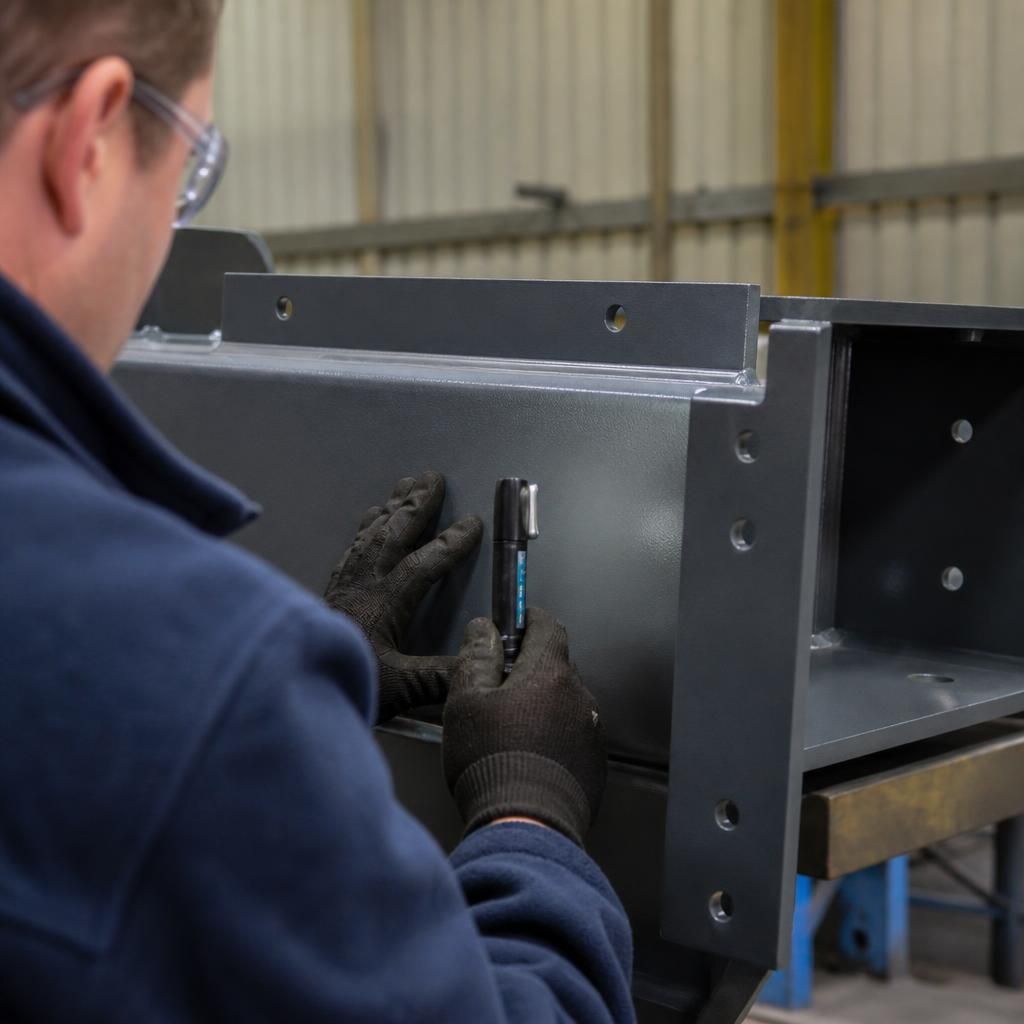
A key benefit of powder coating over galvanised steel is that it allows the visible condition of the component to be assessed separately from the condition of the zinc layer. Changes in colour or gloss after prolonged heating may indicate thermal ageing of the powder film, but they do not automatically mean that the underlying galvanised steel has lost its corrosion protection. Inspection should also look for cracking, blistering, flaking or loss of adhesion, particularly around edges, joints and areas exposed to repeated temperature changes.
This distinction helps engineers decide whether a component needs cleaning, coating assessment or replacement. The powder layer can therefore provide a defined, inspectable finish while the galvanised substrate continues to form part of the protective system beneath it.