

What are the key factors to consider when choosing a high temperature powder coating system for metal surfaces?
When choosing a high temperature powder coating system for metal surfaces, assess the required operating temperature, metal substrate, exposure to chemicals or corrosion, desired film thickness, and the coating’s curing requirements. The formulation should provide suitable heat resistance without compromising adhesion, surface protection, finish quality or long-term performance in the intended industrial application.
The right high temperature powder coating system is selected by matching the coating’s complete performance profile to the component’s real operating conditions, manufacturing process and finish requirements. Temperature capability is only one part of that assessment; thermal cycling, coating chemistry, part geometry, application controls, dimensional tolerances and validation testing also determine whether the finished system will perform reliably.
Define the service profile. Establish how the component will be used before comparing coating systems. Consider whether heat exposure is continuous or intermittent, how often the part cools and reheats, and whether it will experience rapid temperature changes. A coating that tolerates a stable elevated temperature may behave differently when repeatedly exposed to thermal shock. Record contact with oils, fuels, cleaning agents, process vapours and moisture as part of the service profile, because these conditions can affect the coating alongside heat.
Assess thermal expansion and cycling. The coating and metal substrate expand and contract as temperature changes. Differences between these materials can place stress on the coating, particularly around edges, corners, welds, joints and areas with sharp changes in section. For components that cycle between ambient and elevated temperatures, prioritise a system with suitable flexibility and resistance to cracking, blistering, flaking or loss of adhesion after repeated cycles. The expected rate of heating and cooling should be included in the specification rather than relying only on a maximum temperature description.
Choose chemistry for the required balance of properties. High temperature resistance can involve trade-offs with flexibility, impact resistance, surface appearance and protection against the surrounding environment. The formulation should be considered in relation to the component’s mechanical handling, abrasion, exposure and appearance requirements. Where the part needs both heat resistance and a protective barrier, check that the proposed system is intended to provide both functions under the same service conditions, rather than assuming that a high temperature rating alone confirms suitability.
Check the application method and production route. A suitable system must work with the available powder application equipment and the way parts are processed. Part size, production volume, component orientation and access to recessed areas can influence transfer efficiency and coating consistency. Complex shapes may require particular attention to recesses, internal corners, Faraday cage areas and edges, where achieving an even deposit can be more difficult. The specification should also account for whether components are coated individually or as part of a repeat batch process.
Consider part geometry and dimensional control. Powder coating adds a measurable layer to the finished component. This matters where parts fit together, locate against machined faces, pass through apertures or rely on close tolerances. Identify surfaces that must remain free from coating and define masking requirements for threads, bores, contact points and mating faces. Masking materials and hooks must themselves tolerate the process conditions without contaminating the finish or affecting electrical contact during application.
Specify the required finish accurately. Colour, gloss level, texture and visual uniformity should be agreed before production. Some high temperature systems have a narrower appearance range than general-purpose architectural or industrial powders, so confirm that the chosen formulation can provide the required finish without compromising its functional properties. Also consider how colour change, chalking, oxidation or gloss loss would be assessed after exposure, particularly where appearance remains important during service.
Review powder handling and storage. Powder condition affects application quality. Moisture, contamination, unsuitable storage conditions or excessive reclaim can contribute to poor fluidisation, inconsistent transfer and surface defects. Establish controls for identification, segregation and handling of powders, especially when several formulations or finishes are used in the same facility. Reclaim should only be incorporated where the process and coating supplier’s guidance support it, as uncontrolled reclaim can alter appearance and consistency.
Plan preparation and masking around the coating system. Surface preparation must remove contamination and produce a surface condition that supports dependable adhesion at the intended service temperature. The preparation method should be compatible with the metal, the coating formulation and any existing surface treatment. Weld spatter, sharp burrs, residues and trapped contaminants can create local defects that become more significant during heating. Parts should be inspected before coating, with particular attention to welds, crevices and areas where contamination may be retained.
Confirm the curing window and process capability. The chosen system must be compatible with the oven, loading method and component mass. Large or heavy parts may heat at a different rate from thin sections, so oven air temperature alone does not establish whether the coating has received the required cure. Use the coating supplier’s technical data and a controlled process to confirm that the complete part reaches the specified conditions. If components have different thicknesses or thermal masses, validate the most demanding areas rather than assuming that one oven setting affects every surface equally.
Establish inspection and testing criteria. Before approving a system, define how the finished coating will be checked. Typical controls may include visual inspection, coating thickness measurement, adhesion assessment and checks for pinholes, runs, craters, incomplete coverage or contamination. Where the application is safety-critical or exposed to severe service conditions, representative test panels or production parts can be subjected to relevant heat, cycling, chemical or mechanical exposure. Testing should reflect the actual combination of conditions instead of examining heat resistance in isolation.
Check technical documentation and traceability. Request the product data sheet, application guidance, recommended preparation, curing information and stated limitations for the specific formulation. Keep records of powder identification, batch details, preparation method, application conditions and inspection results. This makes it easier to investigate variations between batches and to demonstrate that the selected system was applied in accordance with the agreed specification.
For a manufacturing or fabrication project, the final selection should therefore be based on a written performance specification covering service conditions, thermal cycling, chemical and mechanical exposure, appearance, dimensional limits, preparation, curing, inspection and testing. A powder coating specialist can then assess the component drawings and production route against that specification, helping distinguish a system that is merely heat-resistant from one that is appropriate for the complete industrial application.
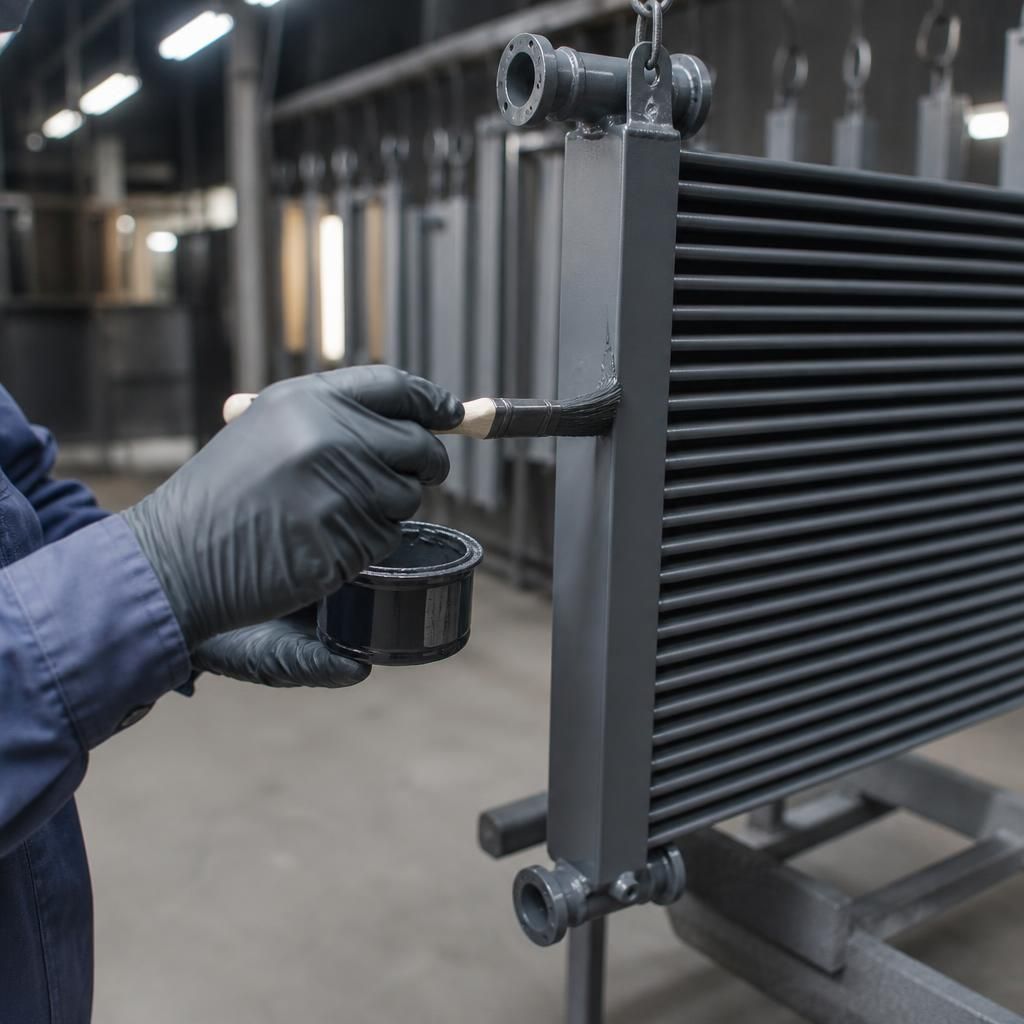
A high temperature powder coating system should be assessed for maintenance and repair as well as initial performance. If a coated component may be scratched, cut, modified or locally damaged during assembly or service, establish how the affected area will be prepared and repaired without undermining the surrounding coating.
Ask whether the proposed system has a documented touch-up or recoating method, and confirm that any repair material is suitable for the component’s operating temperature and chemical exposure. This is particularly important for large, fixed or difficult-to-access parts, where complete stripping and recoating may be impractical. Including repair requirements in the original specification helps prevent the use of incompatible materials and supports consistent protection throughout the component’s service life.
Discuss your high temperature powder coating system requirements
If you need to compare high temperature powder coating systems for a specific metal component, discuss the application with Powder-coatings.co.uk. Providing details of the substrate, operating conditions and required finish will help establish the most appropriate options for evaluation.