

What distinguishes high heat and heat-resistant epoxy coatings from standard powder coatings?
High heat and heat-resistant epoxy coatings are formulated to retain adhesion, protection and finish performance at elevated temperatures, whereas standard powder coatings are generally intended for normal industrial service conditions. The correct choice depends on the component’s operating temperature, exposure to chemicals or thermal cycling, and the coating system’s specified limits.
High heat and heat-resistant epoxy coatings differ from standard powder coatings mainly in the formulation of the resin, curing system and heat-stability additives. They are designed for components exposed to temperatures or thermal conditions that may cause a conventional powder finish to soften, discolour, lose adhesion or deteriorate. Standard powder coatings remain suitable for many general industrial applications, but their specified operating limits must be checked against the component’s actual service conditions.
Temperature performance
A standard powder coating is normally selected for routine environmental exposure rather than sustained extreme heat. When its temperature limit is exceeded, the coating can lose hardness and mechanical strength, become brittle, blister or develop surface defects. Repeated heating and cooling can also create stresses between the coating and the metal substrate, particularly where the component expands and contracts significantly.
Heat-resistant epoxy systems are formulated to retain their protective function at higher temperatures. Depending on the product, they may use a modified epoxy resin, heat-stable pigments, specialist fillers or a different curing chemistry. The relevant performance measure is not simply the highest temperature mentioned in a product description. It is the coating’s specified continuous service temperature, short-term or peak-temperature capability, resistance to thermal cycling and performance in the presence of other exposures.
Resin chemistry and curing
Epoxy coatings are thermosetting materials. During curing, the resin and hardener form a cross-linked film that cannot be remelted like a thermoplastic. The degree of cross-linking and the selected formulation affect hardness, adhesion, chemical resistance and behaviour at elevated temperatures. Heat-resistant grades are adjusted to reduce the loss of these properties as operating temperature rises.
Standard powder coating is a broad category rather than one single chemistry. It includes epoxy, polyester, epoxy-polyester hybrid and other formulations, each designed for different conditions. Consequently, the comparison should be made between the specific products and coating systems, not between the word “epoxy” and “powder” as if they were mutually exclusive. Some epoxy coatings are applied as powder, while some high-temperature systems use a modified resin or a specialist coating technology.
Durability under heat
At elevated temperatures, a coating must resist more than visible colour change. Important considerations include:
- retention of adhesion to the prepared metal;
- resistance to softening, cracking, blistering and flaking;
- stability during repeated heating and cooling;
- continued protection against moisture, oxidation and corrosion; and
- resistance to chemicals that become more aggressive at higher temperatures.
A standard powder finish may provide excellent abrasion, impact and corrosion resistance within its intended operating range. It is not automatically unsuitable for heated equipment. The issue is whether its tested limits cover the real combination of temperature, exposure time, movement, chemicals and physical contact. A heat-resistant epoxy is more appropriate where the standard system’s thermal margin is inadequate or where the coating must continue protecting the substrate during demanding thermal cycles.
Appearance and weathering
Heat can affect gloss, colour and surface texture even when the film remains attached to the metal. Heat-resistant formulations may prioritise thermal stability over decorative appearance, so a finish intended for hot machinery may not retain the same visual characteristics as a general-purpose architectural or industrial powder coating.
Epoxy coatings also need to be assessed for ultraviolet exposure. Many epoxy systems offer strong adhesion and chemical resistance but are not intended as the final exposed finish in prolonged direct sunlight, where chalking or colour change may occur. If a heated component is also installed outdoors, the coating specification may need to address both elevated temperature and weathering rather than selecting on heat resistance alone.
Application and preparation
The application principles are similar in that the metal must be clean, suitably prepared and free from contaminants before coating. However, a heat-resistant system can be less forgiving of incorrect preparation, contamination, excessive film build or incomplete curing. These defects may become more apparent when the component is first heated or subjected to repeated thermal movement.
Component geometry also matters. Sharp edges, recesses, welds, joints and concealed areas can produce uneven coverage or local stress concentrations. The coating specification should therefore define the preparation standard, target film thickness, curing conditions and inspection requirements. The curing schedule must be matched to the coating manufacturer’s technical data and to the metal’s actual temperature, rather than relying only on the temperature of the oven air.
Choosing between the systems
Use a standard powder coating where the component operates within the coating’s stated limits and the main requirements are general protection, appearance, handling durability or resistance to normal industrial conditions. Consider a high heat or heat-resistant epoxy system where the component experiences sustained heat, intermittent temperature peaks, rapid changes in temperature or a combination of heat and chemical exposure.
The selection should be based on documented test data and the complete service profile. Key information includes the normal operating temperature, maximum exposure temperature, duration of each exposure, heating and cooling rate, substrate material, expected movement, chemical contact, outdoor exposure and required finish life. It is also important to distinguish between the temperature of the surrounding air and the actual temperature reached by the coated metal.
For industrial components, the most reliable comparison is a product-specific review of the technical data sheet and, where necessary, a sample or trial coating exposed to representative conditions. A coating specialist can then assess whether the proposed system provides an adequate margin for the component’s intended use, rather than selecting a general-purpose powder finish solely because it is familiar.
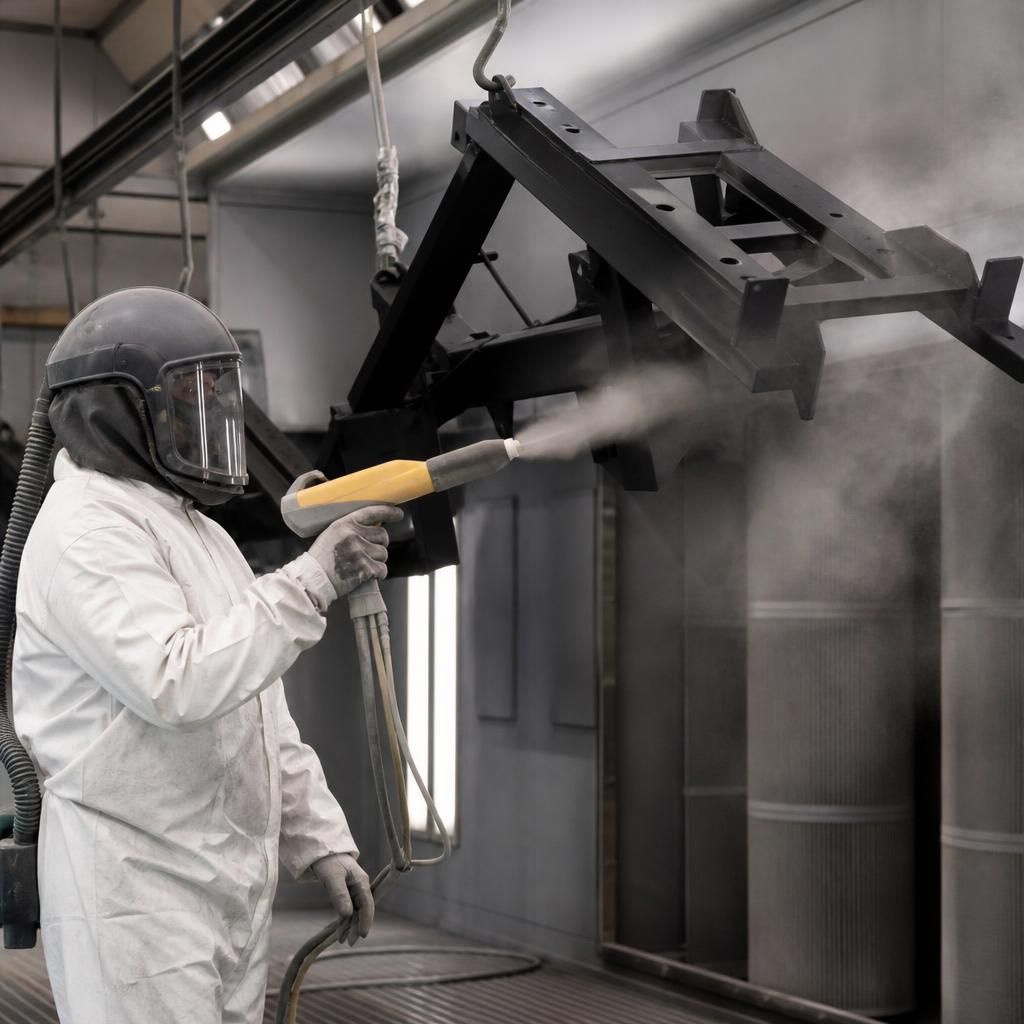
Heat-resistant epoxy coating should not be confused with fireproof or fire-rated protection. Its purpose is to maintain the coating’s adhesion and protective properties at elevated service temperatures; it does not prevent the metal beneath from heating, nor does it provide the same function as an intumescent or other fire-protection system.
This distinction matters when specifying a finish for heated plant, exhaust-related components or equipment exposed to a possible fire. The coating should be selected according to the component’s normal and peak operating temperatures. Where direct flame exposure, fire resistance or protection of the substrate is required, those requirements need to be assessed separately rather than inferred from the coating’s heat-resistant classification.
Discuss your high heat epoxy coating requirements
Discuss your component’s operating conditions, substrate and required finish with our powder-coating specialists to help determine whether a high heat epoxy or standard powder coating is appropriate. Share any available technical requirements or drawings for a more informed coating assessment.