

What are the key differences between a powder coat system and a liquid paint system?
A powder coat system applies dry powder electrostatically before curing it in an oven, while a liquid paint system sprays or applies paint carried in water or solvent, which then dries or cures. Powder coating typically creates a thicker, highly durable finish with minimal solvent use, whereas liquid paint offers greater flexibility for thin coats, colour matching and components that cannot withstand oven curing.
The main difference is how the coating is applied, formed and repaired. A powder coat system applies electrically charged dry particles to a suitably prepared component and then uses controlled heat to melt and cure them. A liquid paint system applies a wet film, typically by spray, and relies on solvent or water evaporation followed by drying or chemical curing. This distinction affects equipment, part preparation, finish control, production planning, repair methods and the types of components each system can handle.
Application and curing: Powder coating normally requires an enclosed application area, electrostatic equipment and a curing oven. The component must be able to enter the booth and withstand the specified curing cycle without distortion, degradation or damage to heat-sensitive materials. Liquid paint can be applied using spray equipment, brushes or rollers, depending on the component and specification. It may air-dry, force-dry or cure through a chemical reaction, so it can be suitable for parts that are too large for an oven or unable to tolerate elevated temperatures.
Liquid systems also provide more options where a coating must be applied on site, built up in stages or blended into an existing painted surface. Powder coating is generally more dependent on a controlled production sequence because the part must be cleaned, coated and cured within a defined process. That dependence is an advantage for repeatable batch work, but it must be considered when components vary significantly in size, material or configuration.
Substrate preparation: Both systems depend on preparation rather than simply the coating material. Oil, grease, mill scale, rust, dust and previous coatings can interfere with adhesion and corrosion protection. Powder coating commonly uses a staged preparation process that can include degreasing, rinsing, chemical conversion and drying, with blasting or other mechanical preparation where appropriate. Liquid paint may use similar preparation, but the exact process can be adapted to the existing coating, the substrate and the specified primer system.
Preparation is particularly important around welds, edges, recesses, fixings and areas contaminated during fabrication. A coating can appear acceptable while still failing prematurely if contamination remains beneath it or if the surface profile is unsuitable. The correct comparison is therefore between complete, specified systems—including preparation and any primer—not between powder and liquid material in isolation.
Durability and protection: A cured powder film generally provides strong resistance to impact, abrasion, weathering and routine handling. Liquid paint can also deliver a durable result when the primer, intermediate coat and topcoat are selected for the service environment and applied at the required film thickness. In demanding conditions, a liquid system may be selected as a multi-coat specification because different layers can provide adhesion, corrosion resistance and weather protection.
Neither method automatically prevents corrosion. Performance depends on the metal, edge design, pretreatment, coating chemistry, film thickness, curing or drying conditions and exposure to moisture, chemicals, ultraviolet light and mechanical damage. For outdoor or industrial components, the expected environment should be defined before selecting the system.
Finish and appearance: Powder coating can produce consistent smooth, textured, matt, satin or gloss finishes, subject to the selected powder and process settings. It is well suited to repeat batches where the same finish must be reproduced across multiple components. Liquid paint offers a broad choice of decorative and protective formulations and can be useful where very fine film control, colour adjustment, shading or a multi-layer visual effect is required.
Liquid paint can also be advantageous when a component contains areas that need different coating specifications or when a finish must be matched to an existing painted surface. Powder changes require thorough cleaning and process control to avoid contamination between colours or formulations. Liquid systems also need cleaning and controlled handling, particularly where different colours, solvents or two-pack materials are used.
Component design and coverage: The geometry of a part affects both processes. Electrostatic powder application can be less straightforward in deep recesses, narrow cavities and Faraday cage areas, where the electrical field can limit particle deposition. Skilled application and suitable gun settings can reduce this effect, but design, racking and access remain important. Liquid spray can reach some difficult areas more readily, although it may create runs, sags, overspray or uneven build if the operator cannot maintain the correct distance and movement.
Powder coating also requires attention to masking and tolerances. Threads, mating faces, bores and electrical contact points may need to remain free of coating. Liquid paint can sometimes be applied more selectively or feathered into a local area, which is useful where only part of a component needs treatment.
Repair and rework: A damaged powder-coated surface is not normally repaired by simply melting the original coating back into place. Local damage may require cleaning, abrasion and a compatible liquid touch-up product, while extensive damage may justify stripping and recoating the component. The repaired area may differ slightly in texture, gloss or colour from the surrounding finish.
Liquid paint is generally easier to touch up, overcoat or blend, provided the existing surface is sound and compatible with the new material. This does not make every liquid repair suitable: contamination, poor adhesion or an unknown coating history can still cause failure. For both methods, repair should address the cause of damage and restore the required protective performance, not just conceal the visible mark.
Production, waste and operating considerations: Powder coating uses dry material and requires a dedicated curing stage, while liquid painting requires management of wet paint, drying or curing conditions and, where relevant, solvent vapours and extraction. Powder overspray may be collected and reused in some systems, although recovery depends on the equipment, colour control requirements and coating specification. Liquid overspray cannot generally be returned to the original paint container in the same way and must be managed as part of the finishing process.
Cost comparisons must include more than the price of the coating. Relevant factors include preparation, masking, labour, booth and extraction requirements, oven capacity, energy use, material utilisation, colour changes, drying space, inspection and any required rework. Powder may be efficient for repeatable batches of compatible parts, whereas liquid paint may be more practical for irregular work, large assemblies, low-temperature substrates or projects requiring staged application.
Choosing between the systems: Powder coating is often considered where components are metal, can be handled through an oven and need a hard-wearing, repeatable finish. Liquid paint may be preferable where the substrate or assembly is heat-sensitive, the component is too large for available curing equipment, a multi-coat specification is required, or future touch-up and colour blending are significant considerations.
The most reliable selection considers the substrate, component dimensions, service environment, required appearance, production quantity, coating thickness, tolerances, repair expectations and applicable specification. For manufacturers and fabricators, supplying accurate drawings, material details, masking requirements and end-use conditions allows the coating process to be assessed before production rather than after a finish has failed to meet its purpose.
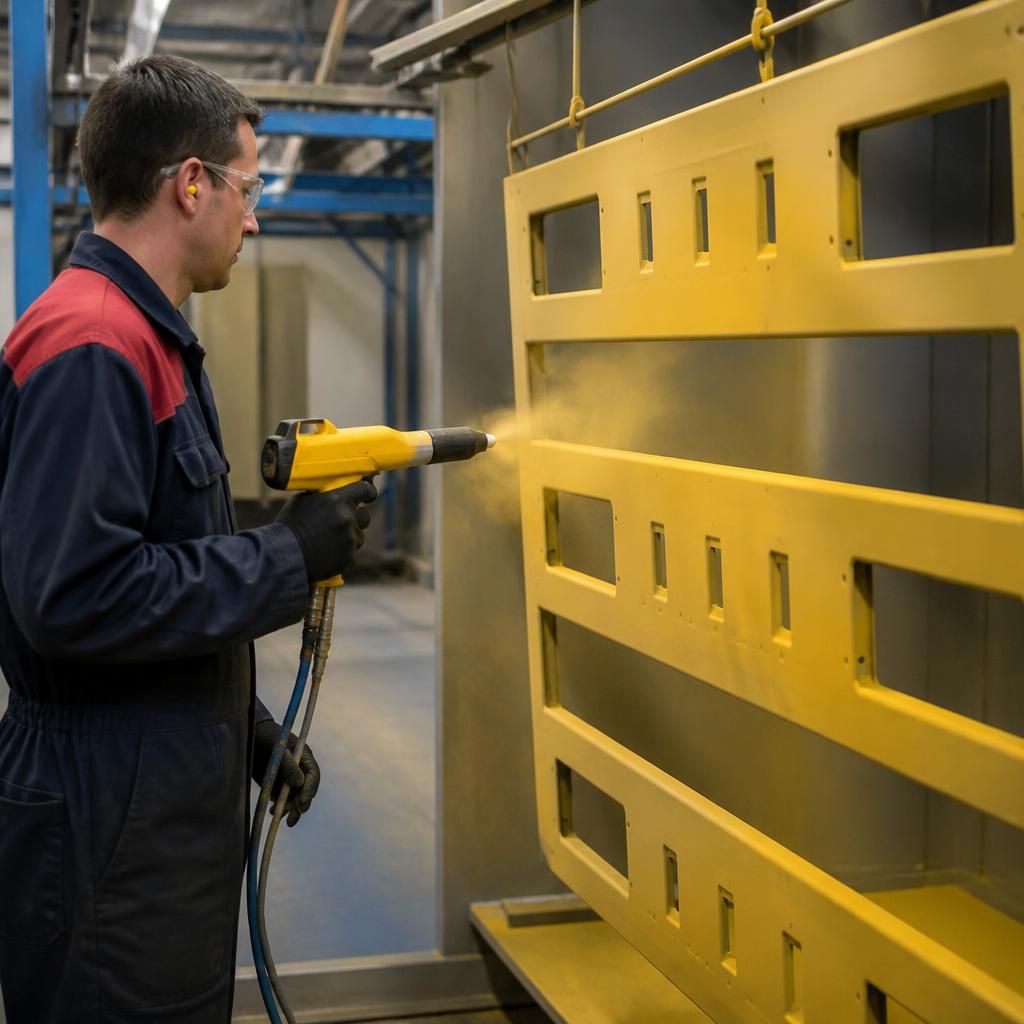
Electrical requirements are a further distinction. Electrostatic powder application relies on the component being electrically conductive and correctly grounded so charged particles are attracted to its surface. Reliable contact between the component, rack and system is therefore important; poor grounding can cause uneven deposition or powder loss. Liquid paint does not depend on this electrostatic attraction, so its application is less affected by the electrical continuity of the part and its hanging arrangement.